

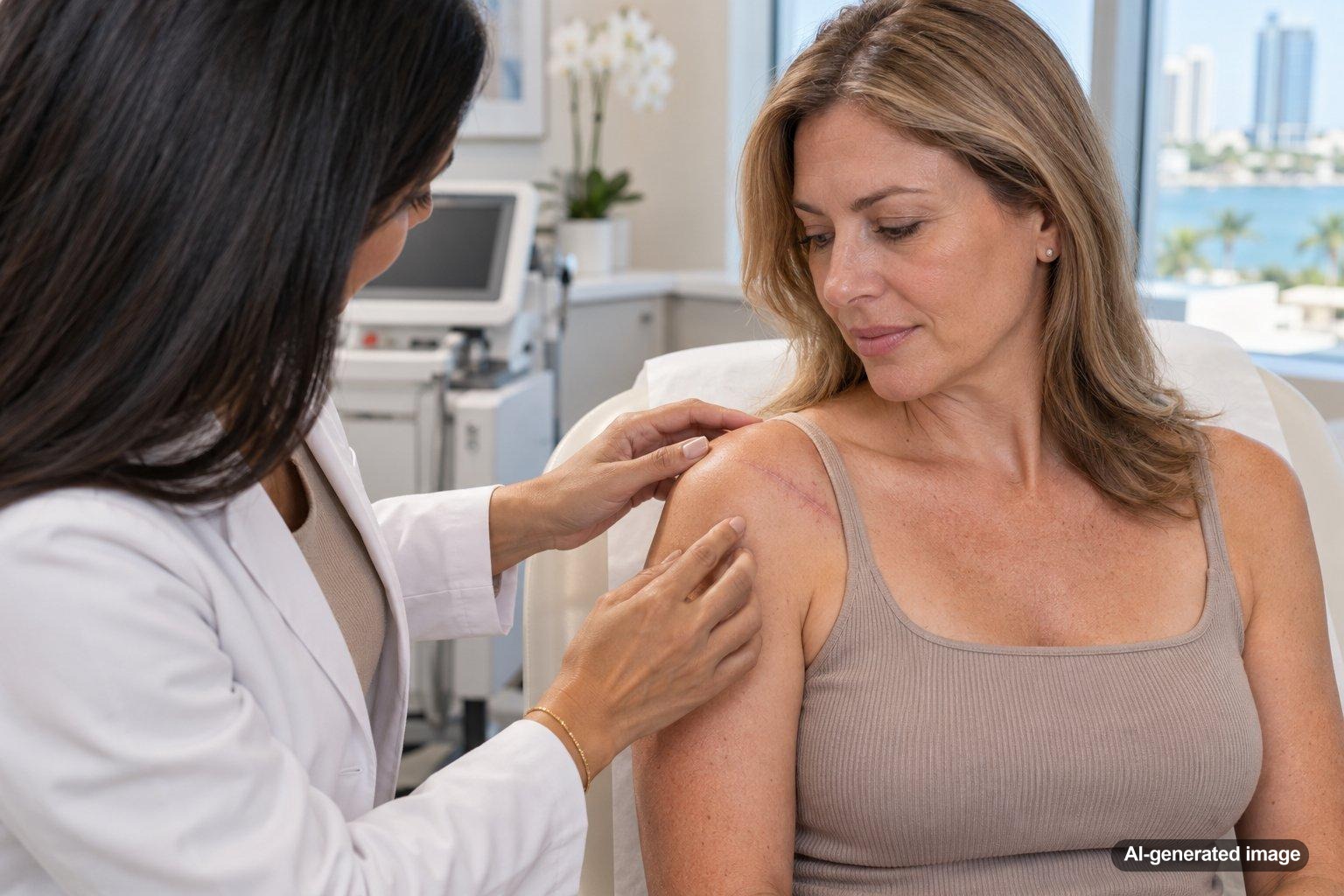
Redness around a surgical scar can linger even after the incision has closed and the area otherwise feels healed. In some cases, the color reflects small blood vessels that remain prominent while the scar continues to remodel. In other situations, redness can be related to irritation, inflammation, or a problem that deserves medical evaluation.
Excel V+ is a laser platform that may be considered when persistent scar redness is primarily vascular. The important first step is determining why the scar looks red, whether it has healed enough for laser treatment to be considered, and whether there are any signs that point to another cause.
Quick answer
- Persistent pink or red color in a healed scar can be associated with visible blood vessels that developed during the healing process.
- Vascular laser treatment may help reduce the appearance of redness in appropriately selected scars.
- Not every red scar should be treated with a laser, especially if the area is still actively healing, irritated, infected, or changing unexpectedly.
- Skin tone, scar type, medical history, recent sun exposure, and the location of the scar can all affect treatment planning.
- A dermatologist can examine the scar and help determine whether Excel V+ or another approach may be appropriate.
What persistent redness around a surgical scar means
A scar is active tissue, and its appearance can change considerably as it matures. During wound healing, the body develops new blood vessels to support tissue repair. Some scars remain pink or red because those vessels continue to be visible after the wound itself has closed.
That vascular component is one reason laser and light treatments are sometimes used for red scars. Certain laser wavelengths can interact with blood vessels in the skin, which may gradually make vascular redness less noticeable. The appropriate approach depends on the individual scar rather than color alone.
Scar maturation can also take time, so persistent redness does not automatically mean something is wrong. However, a dermatologist should evaluate redness that is worsening, accompanied by symptoms, or otherwise behaving differently than expected after surgery.
Common causes or triggers
Several factors can contribute to a surgical scar looking persistently red. Common possibilities include:
- Ongoing scar remodeling. Newly formed blood vessels can remain visible during the normal healing process.
- Prominent superficial vessels. Some healed scars retain noticeable vascularity even after other aspects of healing have settled.
- Scar thickness. Raised or thickened scars can sometimes look red as well as feel firm or textured.
- Friction or irritation. Clothing, adhesives, skincare products, or repeated rubbing may temporarily intensify redness.
- Sun exposure. UV exposure can make color differences between a scar and the surrounding skin more noticeable.
- Inflammation or another medical issue. Increasing redness, warmth, tenderness, drainage, or other changes should be evaluated rather than assumed to be a cosmetic scar concern.
What you can do at home
For a completely closed surgical scar, conservative care often focuses on protecting the area while it continues to mature. Follow the postoperative instructions provided by your surgeon, because recommendations can differ depending on the procedure and location.
- Use broad-spectrum sun protection on exposed scars when your clinician has cleared the area for sunscreen.
- Avoid picking, rubbing, or repeatedly irritating the scar.
- Use gentle skincare around the area and avoid adding strong acids, scrubs, retinoids, or other potentially irritating products without guidance.
- If your surgeon or dermatologist has recommended silicone gel or silicone sheets, use them according to those instructions.
- Take periodic photos under similar lighting if you want to track gradual changes in color and texture.
Home care can support the healing environment, but it cannot determine whether persistent redness is vascular, inflammatory, infectious, or related to another process. If the scar is becoming more symptomatic rather than gradually settling, an examination is the safer next step.
Professional options for persistent scar redness
A dermatologist may first evaluate the scar’s age, color, thickness, texture, symptoms, location, and surrounding skin. The original surgery and the way the incision healed also matter. Depending on those findings, professional options can include observation, scar-care measures, injections for certain raised scars, laser or light treatment, or consultation with the original surgeon when structural scar revision is being considered.
For redness driven by visible blood vessels, vascular laser treatment may be one option. Laser treatment uses focused light at selected wavelengths to interact with specific targets in the skin. Cleveland Clinic notes that laser treatments can be used to make scars less noticeable and that vascular lasers may target small blood vessels associated with persistent pink or red scar color.
Excel V+ may be considered when the treatment goal is vascular redness, but settings and candidacy need to be individualized. Factors such as skin tone, tanning, medications, previous reactions to lasers, scar characteristics, and the degree of remaining inflammation can influence the plan. Temporary redness, swelling, pigment changes, blistering, and other complications are possible with laser procedures, which is why treatment should be selected and performed appropriately.
The U.S. Food and Drug Administration describes medical lasers as devices that use precisely focused light to treat or remove tissue and notes that medical laser products are subject to medical device and radiation safety requirements.
At Waverly DermSpa, we offer Excel V+ and can help you understand whether it may be appropriate.
When to see a dermatologist
Before treating a scar simply for redness, it is worth having the area evaluated if the appearance is persistent, unusual, or changing. Seek medical assessment sooner if you notice:
- Redness that is spreading rather than remaining confined to the scar.
- Increasing warmth, pain, swelling, or tenderness.
- Drainage, crusting, an open area, or delayed wound healing.
- A scar that is rapidly becoming thicker, firmer, or more symptomatic.
- New itching, burning, bleeding, or other symptoms that concern you.
- A sudden change after the scar had previously been stable.
If you recently had surgery and have concerns about infection, wound separation, or another postoperative complication, contacting the surgical team that performed the procedure may also be appropriate.
FAQ
Can Excel V+ remove a surgical scar?
Laser treatment generally does not erase a surgical scar. When vascular redness is a prominent feature, treatment may help make the red or pink coloration less noticeable. Texture, thickness, width, and pigmentation are separate scar characteristics that may require different approaches.
How do I know whether my scar redness is vascular?
Color alone is not enough to determine the cause. A dermatologist can examine the scar, consider how long ago the surgery occurred, assess symptoms and texture, and decide whether visible blood vessels appear to be contributing to the redness.
Can a scar be treated while it is still healing?
The appropriate timing varies with the procedure, scar, treatment goal, and healing process. A recently operated area should be evaluated before laser treatment. Your dermatologist may also coordinate with your surgeon when needed.
Will one Excel V+ session be enough?
The number of treatments varies. Scar vascularity, skin response, treatment settings, scar age, and the desired degree of improvement can all influence whether more than one session is considered. Your clinician can discuss a personalized plan after examining the area.
Can darker skin tones be treated?
Laser treatment planning should account carefully for skin tone because pigment changes can occur after laser procedures. A dermatologist can evaluate your skin and scar, discuss the potential benefits and risks, and decide whether a vascular laser approach is suitable.
Should I see my surgeon or a dermatologist about a red scar?
If the incision is newly healing or you are concerned about a postoperative complication, contacting your surgeon is important. For a healed scar with persistent color, texture, or other skin-related concerns, a dermatologist can evaluate the scar and discuss dermatologic treatment options. In some cases, both clinicians may be involved.
Ready to get help?
Schedule an appointment or send a message and our team will get back to you.
Prefer to call? 954-666-3736
Disclaimer
This article is for educational purposes and is not medical advice. For diagnosis and personalized treatment, please book an appointment with a board-certified dermatologist.
Sources & further reading
- U.S. Food and Drug Administration (FDA) – Medical Lasers
- Cleveland Clinic – Scars: Treatment and Cause
