

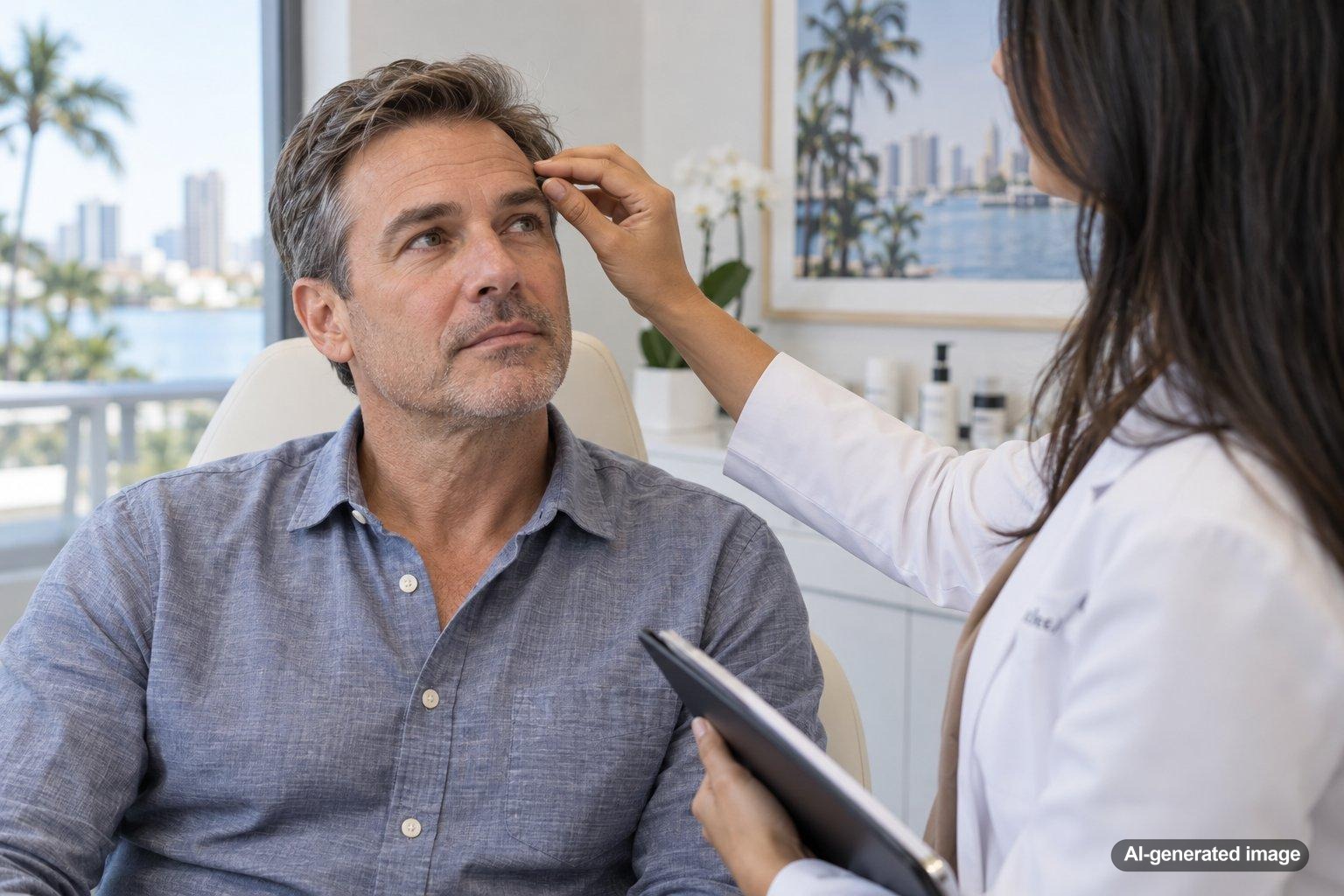
If the middle of one eyebrow suddenly looks thinner than it used to, there are several possible explanations. Sometimes the change comes from repeated rubbing, grooming, or irritation around the brow. In other cases, eyebrow hair loss can be associated with an inflammatory skin condition, alopecia areata, thyroid disease, medication effects, or another issue affecting the hair follicles.
The pattern matters. A small smooth patch, scaling or redness, broken hairs, itching, changes elsewhere on the skin, or thinning in other areas can give a dermatologist useful clues. Because a new one-sided change cannot be diagnosed from appearance alone, a persistent or clearly worsening patch is worth having examined.
Quick answer
- Repeated plucking, waxing, rubbing, or cosmetic irritation can contribute to localized eyebrow thinning.
- Skin inflammation around the brow, including dermatitis, eczema, or psoriasis, may affect nearby hairs.
- Alopecia areata can cause sudden, patchy hair loss and may involve the eyebrows.
- Medical conditions, medications, and nutritional or hormonal factors can sometimes contribute to hair loss, so unexplained changes deserve evaluation.
Why would only the middle of one eyebrow become thin?
Eyebrow hair can become sparse when hairs are being removed, breaking, shedding prematurely, or failing to grow normally. The location of the thinning does not identify the cause by itself. Cleveland Clinic uses the term madarosis for abnormal loss of eyebrow or eyelash hair and notes that many different skin, immune, medical, and treatment-related factors can contribute.
When the change is limited to one small area, a dermatologist may look closely at the skin surface, the remaining hairs, and the follicle openings. They may also ask whether you have changed brow products, started a new skincare routine, experienced itching or scaling, or noticed hair loss anywhere else.
Common causes and triggers
- Repeated grooming or friction: Frequent tweezing, waxing, threading, rubbing, or manipulating the same section of the brow can affect the hairs in that area.
- Contact or skin irritation: Brow dyes, makeup, cleansers, retinoids, exfoliating products, adhesives, or other products used near the eyebrow can irritate sensitive skin in some people.
- Inflammatory skin conditions: Conditions such as eczema, seborrheic dermatitis, and psoriasis can affect skin near the eyebrows. Redness, flaking, itching, or irritation may occur along with the hair change.
- Alopecia areata: This autoimmune condition can cause sudden patches of hair loss. The American Academy of Dermatology notes that alopecia areata may affect the eyebrows as well as the scalp and other hair-bearing areas.
- Thyroid or other medical conditions: Thyroid disorders and some other systemic conditions can be associated with eyebrow or hair thinning. These patterns are not always limited to one small central patch, so the overall clinical picture matters.
- Medications or medical treatments: Certain medications and treatments can contribute to hair loss. A clinician can review timing and other symptoms rather than assuming a medication is responsible.
What you can do at home while watching the area
A conservative approach is usually reasonable while you arrange an evaluation, especially if the skin is irritated. Avoid additional plucking, waxing, threading, or aggressive brushing over the thinning section. It may also help to pause recently introduced brow cosmetics or strongly active skincare products that repeatedly touch the area.
Use gentle cleansing and avoid scratching or rubbing. Taking a clear photograph in consistent lighting can make it easier to tell whether the patch is actually expanding over the next several weeks rather than relying on memory.
Avoid starting prescription products, potent topical medications, or hair-growth treatments around the eye without professional guidance. The skin around the eyes is delicate, and the appropriate approach depends on the reason the hair is thinning.
What a dermatologist may look for
A dermatologist can examine whether the skin looks smooth, inflamed, scaly, scarred, or otherwise changed and whether the remaining eyebrow hairs are intact or broken. They may also ask about scalp hair loss, eyelash changes, nail changes, recent illnesses, medications, skincare products, grooming habits, and other symptoms.
If alopecia areata is being considered, the pattern and appearance of the hair loss are important. The American Academy of Dermatology describes alopecia areata as an autoimmune disease in which the immune system attacks hair follicles. It can produce smooth patches of hair loss and may involve eyebrows or eyelashes. A dermatologist can distinguish that possibility from the many other reasons eyebrow hair may become sparse.
Depending on the history and examination, additional testing may or may not be appropriate. Treatment is directed at the underlying cause rather than simply treating every case of eyebrow thinning the same way.
When to see a dermatologist
Consider scheduling an evaluation if the thinning appeared suddenly, continues to expand, has not started to stabilize, or has no obvious grooming-related explanation. It is also worth getting checked if you notice additional patches on the scalp or body, loss of eyelashes, nail changes, significant redness or scaling, pain, swelling, crusting, or other new symptoms around the eye.
A dermatologist should also evaluate the area if the skin itself looks distinctly different or if you are concerned about progressive hair loss. Early evaluation can help clarify whether the issue is primarily related to irritation and grooming or whether a medical cause should be considered.
FAQ
Can stress make one eyebrow thin?
Stress can be associated with several types of hair shedding, but a small isolated patch in the middle of one eyebrow has multiple possible explanations. The pattern should not automatically be attributed to stress without considering local skin and hair changes.
Does eyebrow thinning always mean alopecia areata?
No. Alopecia areata is one possible cause of patchy eyebrow loss, but irritation, inflammatory skin conditions, grooming practices, medications, medical conditions, and other factors can also contribute. An examination helps distinguish among them.
Can eyebrow makeup cause thinning?
Makeup itself does not necessarily cause eyebrow loss, but irritation, allergic reactions, aggressive removal, repeated rubbing, or certain products used around sensitive skin may contribute in some people. Consider whether the thinning began after introducing a new brow or skincare product.
Will a thin eyebrow grow back?
Whether eyebrow hair grows back depends on why it was lost and whether the follicles remain capable of producing hair. Some causes are temporary, while others require treatment or can lead to more persistent changes. A dermatologist can provide a more individualized assessment.
Should I use a hair-growth serum on the patch?
It is better to identify the cause first, particularly because the product would be used close to the eye. A dermatologist can help you decide whether any topical or prescription option is appropriate for the specific pattern of hair loss.
Ready to get help?
Schedule an appointment or send a message and our team will get back to you.
Prefer to call? 954-666-3736
This article is for educational purposes and is not medical advice. For diagnosis and personalized treatment, please book an appointment with a board-certified dermatologist.
Sources & further reading
- Cleveland Clinic – Madarosis (Eyebrow & Eyelash Hair Loss): Causes & Treatment
- American Academy of Dermatology (AAD) – Hair loss types: Alopecia areata signs and symptoms
- National Alopecia Areata Foundation – Symptoms and Diagnosis
