

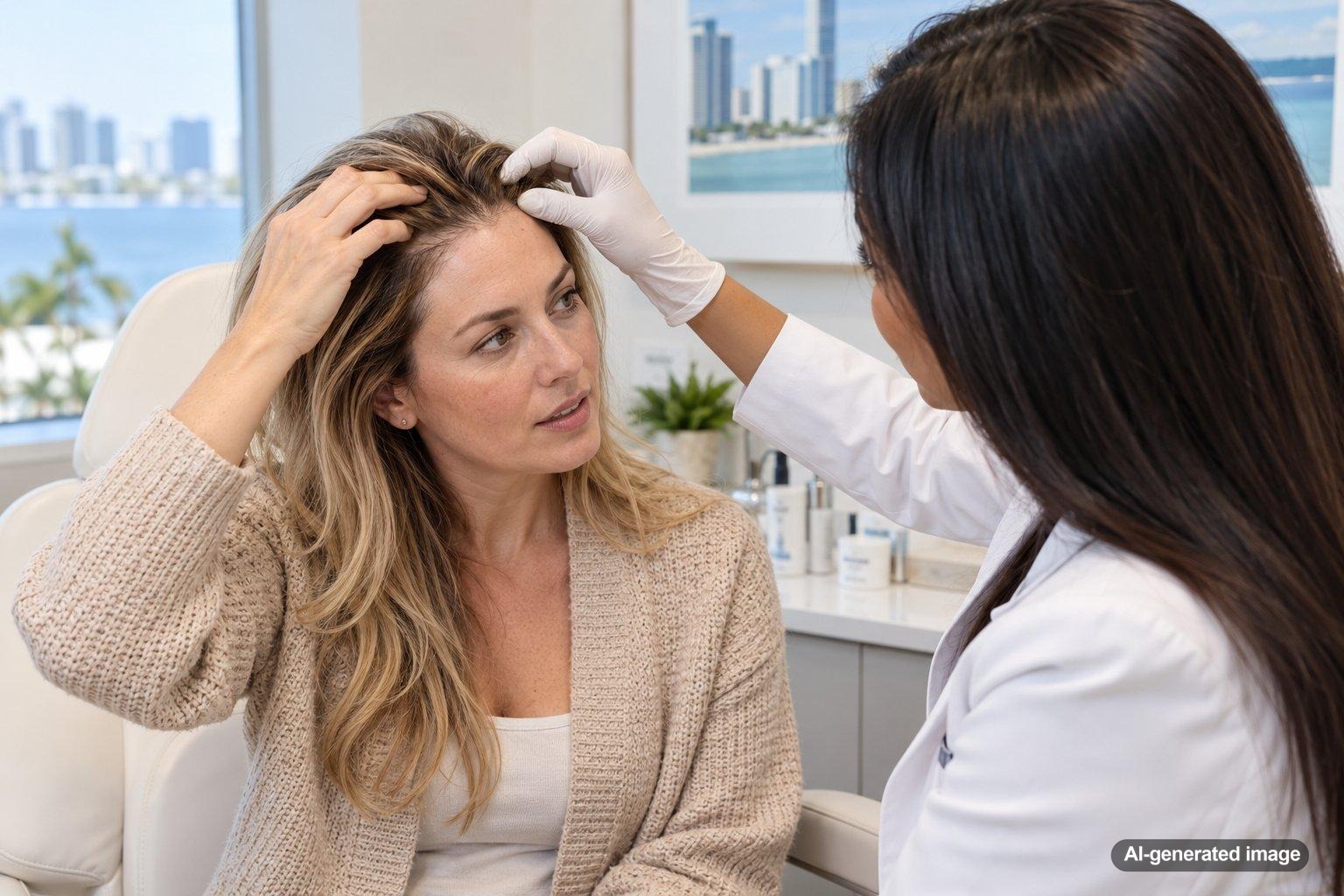
Flaking that seems concentrated around the hairline can happen for several reasons. The border of the scalp is exposed to shampoo, styling products, hair color, skin care, sweat, hats, and environmental irritation, while also being a common location for inflammatory scalp conditions. The pattern alone cannot identify the cause, but where the flakes appear and what the surrounding skin looks or feels like can provide useful clues.
Sometimes the issue is mild dandruff or product buildup. In other cases, conditions such as seborrheic dermatitis, eczema, psoriasis, or contact irritation may be involved. A dermatologist can examine the scalp and hairline if the flaking persists, becomes uncomfortable, or is difficult to distinguish at home.
Quick answer
- Dandruff and seborrheic dermatitis commonly affect the scalp and can be especially noticeable near the hairline.
- Hair and skin products can irritate the scalp border because they often collect or overlap there.
- Eczema or psoriasis can sometimes create scaling near or beyond the hairline.
- Scratching and over-cleansing may make visible flaking and irritation worse.
- Persistent, painful, spreading, or unexplained scaling is worth having evaluated by a dermatologist.
Why the hairline can flake differently from the rest of the scalp
The hairline is a transition zone between scalp skin and facial or neck skin. It frequently comes into contact with substances that do not reach the center of the scalp in the same way. Facial cleansers, sunscreen, makeup, moisturizers, hair sprays, gels, edge-control products, dry shampoo, hair dye, and fragranced products can all overlap at this border.
The hairline is also a location where certain inflammatory scalp conditions may become particularly visible. Seborrheic dermatitis, for example, often affects oily areas of the scalp and face and can produce dry or greasy scale. Psoriasis can also involve the scalp and may extend beyond the hairline. Because several conditions can look similar, appearance alone may not be enough to tell them apart.
Common causes and triggers
- Dandruff: Mild scalp flaking may be most visible around the front or sides of the hairline, especially against darker hair or clothing.
- Seborrheic dermatitis: This inflammatory condition commonly affects the scalp and may cause white or yellowish scale, irritation, or changes in skin color near the hairline.
- Contact irritation: Shampoo, conditioner, hair color, styling products, fragrances, adhesives, skin care, or other substances can irritate skin where they repeatedly touch the scalp border.
- Eczema: Sensitive or inflamed skin may become dry, itchy, and flaky, particularly where products, sweat, or friction affect the skin barrier.
- Psoriasis: Scalp psoriasis can create thicker, more persistent scale and may extend beyond the edge of the scalp.
- Product buildup: Dry shampoo, styling creams, sprays, gels, oils, or residue from incomplete rinsing can collect around the hairline and resemble or worsen flaking.
- Friction and occlusion: Hats, headbands, helmets, wigs, hairpieces, or tight hairstyles may increase sweat, friction, or product accumulation along the scalp margin.
Clues that may help you describe the flaking
Before changing multiple products at once, it can help to notice the pattern. Is the scale fine and powdery, or thicker and more attached? Does the skin feel oily, dry, itchy, tender, or completely normal? Does the flaking extend onto the forehead, behind the ears, around the eyebrows, or along the back of the neck?
Also consider whether the problem appeared after introducing a new shampoo, hair dye, styling product, sunscreen, makeup product, wig adhesive, hat, or hair treatment. These details can help a dermatologist narrow the possibilities without assuming that one visual feature confirms a diagnosis.
What you can do at home
For mild flaking without significant pain, swelling, drainage, or hair loss, conservative scalp care may be reasonable while you observe the pattern.
- Wash the scalp often enough to remove oil, sweat, and product residue without aggressively scrubbing the skin.
- Rinse shampoo, conditioner, and styling products thoroughly from the hairline.
- Temporarily simplify your routine if flaking started after adding several new hair or skin products.
- Avoid scratching or picking at scale, which can further irritate the skin.
- If ordinary dandruff seems possible, an over-the-counter dandruff shampoo may help some people. Follow the product directions and stop if it causes significant irritation.
- Keep styling products off visibly irritated areas until the skin settles.
- Pay attention to whether hats, headbands, wigs, adhesives, or tight hairstyles consistently make the area worse.
If the scalp becomes more irritated after a new product, discontinuing that product may help clarify whether it is contributing. Persistent reactions may require professional evaluation because allergic contact dermatitis and other inflammatory conditions can resemble ordinary dryness.
Professional evaluation and treatment options
A dermatologist can examine the distribution and character of the scale, the condition of the surrounding skin, and whether other areas such as the eyebrows, ears, forehead, or neck are involved. This can help distinguish simple dandruff from inflammatory conditions, irritation, infection, or another scalp disorder.
Treatment depends on the suspected cause. Options may include medicated shampoos, anti-inflammatory topical medications, antifungal treatments, changes to hair-care products, or strategies for reducing exposure to an irritating or allergenic ingredient. Prescription therapies should be selected after an appropriate clinical evaluation rather than based on flaking alone.
When to see a dermatologist
Consider scheduling an evaluation if hairline flaking continues despite gentle scalp care or if you are unsure what is causing it. Professional evaluation is especially helpful when:
- The scale is thick, persistent, or spreading beyond the hairline.
- The scalp is significantly itchy, painful, swollen, or tender.
- You notice cracking, bleeding, crusting, drainage, or signs of infection.
- There are patches of hair loss or broken hairs.
- The problem began after hair dye, adhesives, chemical treatments, or another new product and keeps recurring.
- You also have scaling around the eyebrows, ears, nose, forehead, or other areas.
- Over-the-counter dandruff care has not improved the problem.
A dermatologist can evaluate whether the pattern fits dandruff, seborrheic dermatitis, eczema, psoriasis, contact dermatitis, a fungal infection, or another condition that may require a different approach.
FAQ
Can dandruff occur mainly around the hairline?
Yes. Dandruff can be visible throughout the scalp but may seem more prominent around the hairline because flakes are easier to see there and products, oil, or friction may accumulate along the scalp border.
Does greasy flaking mean seborrheic dermatitis?
Greasy or yellowish scale can be associated with seborrheic dermatitis, but appearance alone is not enough to confirm the cause. A dermatologist can evaluate the pattern and surrounding skin.
Can hair products make my hairline flaky?
They can. Styling products, fragrances, hair dye, shampoos, conditioners, adhesives, and skin-care products may irritate sensitive skin or trigger contact dermatitis in some people. The hairline is a common overlap zone for these products.
Can scalp psoriasis stay near the hairline?
Scalp psoriasis can involve the hairline and may sometimes extend onto nearby skin. It often produces more persistent or thicker scale, but similar-looking conditions can occur, so examination may be needed for an accurate diagnosis.
Should I scrub flakes off my hairline?
Aggressive scrubbing or picking can irritate the skin and may worsen discomfort. Gentle washing and treatment directed at the underlying cause are generally more appropriate than mechanically removing scale.
Why does my hairline improve and then start flaking again?
Some scalp conditions naturally flare and settle, while recurring exposure to a product, sweat, weather changes, friction, or changes in scalp oil may also contribute. Keeping track of triggers can be useful if the pattern keeps returning.
Ready to get help?
Schedule an appointment or send a message and our team will get back to you.
Prefer to call? 954-666-3736
This article is for educational purposes and is not medical advice. For diagnosis and personalized treatment, please book an appointment with a board-certified dermatologist.
Sources & further reading
- American Academy of Dermatology (AAD) – Seborrheic dermatitis: Overview
- DermNet – Seborrhoeic dermatitis
- American Academy of Dermatology (AAD) – How to treat dandruff
