

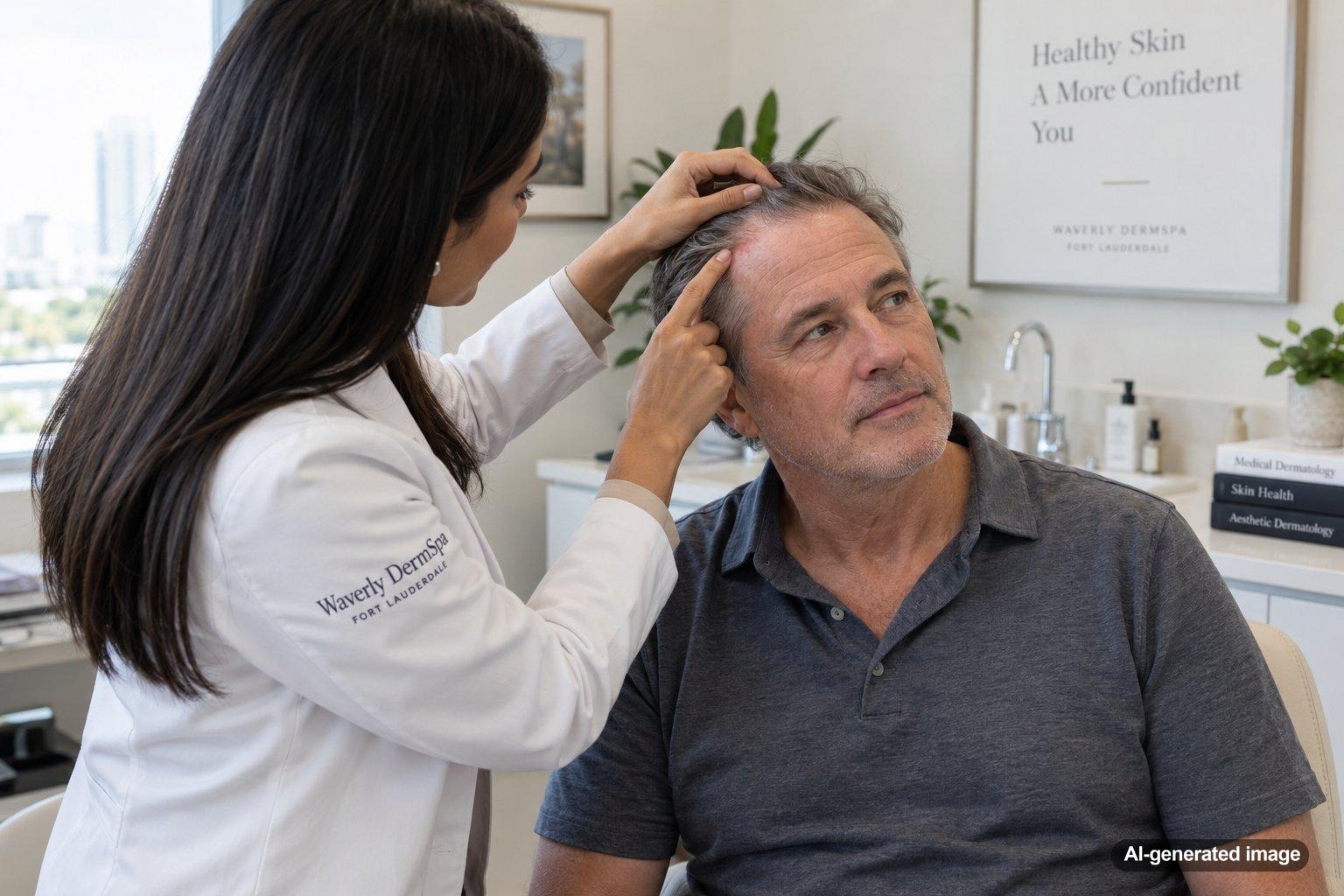
Itchy red bumps that appear along your hairline after using shampoo, conditioner, styling cream, gel, hairspray, hair dye, or another product may be a reaction to something touching your skin. Possible explanations include irritation, allergic contact dermatitis, or acne-like breakouts caused by product residue. The location and timing can provide useful clues, but similar-looking bumps can have different causes.
If the problem keeps returning with the same product, spreads beyond the hairline, or becomes uncomfortable, a dermatologist can evaluate the skin and help identify what may be triggering it.
Quick answer
- Hair products can irritate the skin along the forehead, temples, ears, neck, and scalp where residue collects.
- Fragrances, preservatives, dyes, cleansing ingredients, and other components may trigger irritant or allergic contact dermatitis in some people.
- Oily or occlusive styling products may contribute to clogged pores and acne-like bumps along the hairline.
- Temporarily stopping a suspected product and simplifying your routine can help clarify whether exposure is playing a role.
- Persistent, worsening, painful, blistering, or unexplained eruptions are worth having evaluated by a dermatologist.
What could be causing itchy bumps along your hairline?
The hairline is an easy place for shampoos, conditioners, styling products, sprays, oils, and dyes to reach the skin. Products can remain along the forehead or temples after styling, transfer from hair onto the skin during the day, or collect on pillowcases, hats, headbands, and other surfaces.
One possibility is contact dermatitis. Irritant contact dermatitis occurs when a substance directly disrupts or irritates the skin barrier. Allergic contact dermatitis is an immune reaction to an ingredient that a person has become sensitive to. Both can cause redness, itching, burning, dryness, swelling, or small bumps.
Another possibility is an acne-like breakout. Some hair products, particularly oily or heavy formulations, can contribute to clogged pores where the hair meets the forehead. These bumps may be small and closely grouped and can sometimes be confused with a rash.
Common hair product triggers
A reaction doesn’t necessarily mean that a product is poorly made or unsafe. Skin sensitivity varies from person to person, and an ingredient that causes no problem for most people may bother someone else’s skin. Potential triggers can include:
- Fragrance: Scent ingredients can be associated with allergic contact dermatitis in sensitive individuals.
- Preservatives: Hair and cosmetic products often require preservatives, and certain preservatives can trigger contact allergy in some people.
- Hair dyes: Ingredients used in permanent dyes, including paraphenylenediamine in some formulas, can cause allergic reactions in susceptible people.
- Cleansing ingredients: Some shampoos and washes may irritate already-sensitive or disrupted skin.
- Styling oils, pomades, waxes, and creams: Heavy products can migrate onto the forehead and may contribute to clogged pores.
- Multiple products layered together: When several products touch the same area, determining which ingredient is responsible can become more difficult.
Why can a product suddenly start bothering you?
A product doesn’t always cause trouble the first time you use it. Irritation may develop when the skin barrier is already dry, compromised, or exposed repeatedly. Allergic contact dermatitis can also appear after previous exposures to an ingredient that seemed fine before.
Changes in your routine matter too. A new shampoo may be an obvious clue, but changes in hair dye, leave-in conditioner, edge control, dry shampoo, fragrance, gel, mousse, heat protectant, or even the amount of an existing product can alter how much reaches your skin.
What you can do at home
If the reaction is mild and you suspect a particular product, a conservative approach is to reduce exposure while paying attention to how the skin responds.
- Pause the newest or most suspicious hair product rather than adding several new skin treatments at once.
- Rinse shampoo and conditioner thoroughly and try to keep residue from sitting on the forehead, temples, ears, and neck.
- Keep heavy oils, pomades, waxes, and leave-in products away from acne-prone areas of the face when possible.
- Use a gentle skin cleanser and avoid aggressive scrubbing of the bumps.
- Wash pillowcases, hats, scarves, headbands, bonnets, and other items that regularly contact your hairline if they may contain product residue.
- Consider fragrance-free or non-comedogenic alternatives when appropriate, while remembering that labels alone cannot rule out every possible reaction.
Avoid repeatedly experimenting with strong acids, scrubs, essential oils, or multiple spot treatments on an already irritated hairline. Adding more products can make it harder to determine what is causing the problem.
How a dermatologist can help
If the bumps don’t settle after simplifying your routine, a dermatologist can examine their appearance and distribution and review the products you use. This can help distinguish among contact dermatitis, acne-related eruptions, scalp conditions, and other causes that may look similar.
When allergic contact dermatitis is suspected, patch testing may sometimes be used to identify specific contact allergens. Depending on the findings, a dermatologist can also discuss appropriate treatment categories and help you build a more targeted avoidance plan rather than eliminating products at random.
When to see a dermatologist
Consider an evaluation if the rash is persistent, repeatedly returns, spreads beyond the original area, or is difficult to connect to a specific product. It’s also worth getting checked if you notice significant swelling, blistering, oozing, crusting, marked pain, hair loss, or symptoms involving the eyes or a large portion of the face or scalp.
If you develop rapid or severe swelling involving the face, lips, tongue, or throat, or have trouble breathing, seek urgent medical care.
FAQ
Can shampoo cause itchy bumps around my hairline?
Yes. Shampoo or another rinse-off product may irritate sensitive skin or contain an ingredient that triggers allergic contact dermatitis in a susceptible person. Residue can also reach the forehead, ears, neck, and other nearby skin.
Can hair gel or pomade cause forehead bumps?
It can. Heavy or oily styling products may reach the skin and contribute to clogged pores, especially near the hairline. Keeping these products away from the forehead and choosing products labeled non-comedogenic may help some people.
Does itching mean the bumps are an allergic reaction?
Not necessarily. Itching can occur with allergic contact dermatitis, irritation, and several other skin conditions. The appearance, timing, distribution, and product history all matter.
Should I stop every hair product I’m using?
Usually, changing everything at once makes it harder to identify a trigger. If the reaction is mild, focusing first on a newly introduced or strongly suspected product may provide more useful information. A dermatologist can help if the cause remains unclear.
Can I become allergic to a hair product I’ve used for years?
Yes. Contact allergy can develop after repeated exposure, so previous trouble-free use doesn’t completely rule out a product as a potential trigger.
Can a dermatologist test which ingredient is causing the rash?
In some situations, patch testing can help identify allergens responsible for allergic contact dermatitis. Your dermatologist can determine whether that type of testing makes sense based on your history and examination.
Ready to get help?
Schedule an appointment or send a message and our team will get back to you.
Prefer to call? 954-666-3736
This article is for educational purposes and is not medical advice. For diagnosis and personalized treatment, please book an appointment with a board-certified dermatologist.
Sources & further reading
- American Academy of Dermatology (AAD) – Itchy rash could be contact dermatitis
- DermNet – Cosmetics Allergy: Causes, Symptoms, and Treatment
