

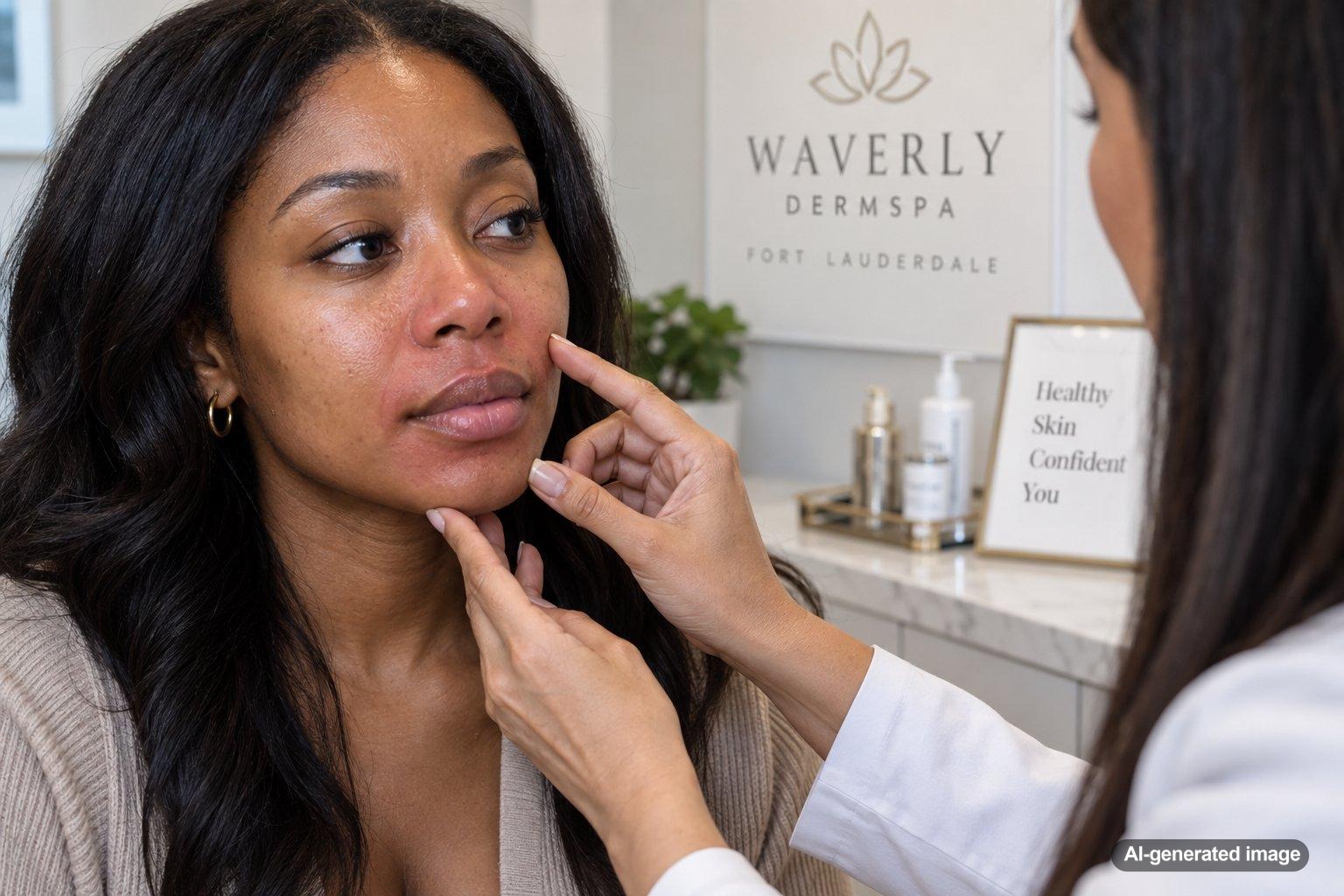
Redness that seems to concentrate around the nose and mouth can happen for several different reasons. The location offers useful clues, but it isn’t enough by itself to identify the cause. Periorificial dermatitis, seborrheic dermatitis, rosacea, irritation from skin care products, and contact reactions can all affect this part of the face.
The details matter. A dermatologist will often look at whether the area is flaky, bumpy, burning, itchy, oily, dry, or triggered by certain products. The pattern of the redness and what is happening elsewhere on your face can also help narrow down the possibilities.
Quick answer
- Small bumps around the mouth or nostrils can be associated with periorificial dermatitis.
- Flaking around the sides of the nose may occur with seborrheic dermatitis.
- Flushing or persistent central facial redness can be associated with rosacea.
- Burning after skin care products may point toward irritation or a contact reaction.
- A recurring or worsening rash is worth having evaluated rather than repeatedly trying new products.
Why this part of the face can become red
The skin around the nose and mouth encounters a lot during an ordinary day. Cleansers, moisturizers, sunscreen, makeup, toothpaste, shaving products, facial tissues, saliva, and environmental exposure can all come into contact with the area. The creases beside the nose also tend to behave differently from flatter areas of the face because they contain more oil-producing glands.
Because several skin conditions favor these locations, redness can look deceptively similar from one person to another. Texture, symptoms, triggers, and distribution are often more informative than color alone.
Common causes and patterns
Periorificial dermatitis
Periorificial dermatitis commonly develops around facial openings, particularly the mouth and nostrils. It may appear as clusters of small bumps with surrounding redness, dryness, flaking, burning, or sensitivity. The American Academy of Dermatology notes that it can occur around the mouth, nose, or eyes. Topical corticosteroids are one recognized association, although other skin care products and irritants may also play a role.
Seborrheic dermatitis
If the redness is especially noticeable in the creases along the sides of the nose and is accompanied by white or yellowish scale, flaking, or occasional itching, seborrheic dermatitis may be one possibility. This condition commonly affects oil-rich areas such as the scalp, eyebrows, forehead, ears, and sides of the nose.
Rosacea
Rosacea often affects the central face, including the nose and cheeks, and may sometimes involve the chin or forehead. Clues can include flushing, persistent color changes, sensitivity, burning, acne-like bumps, or visible small blood vessels. Heat, sunlight, stress, spicy foods, alcohol, and some skin care products can be triggers for some people.
Irritant or allergic contact dermatitis
Skin care products do not have to be unusually harsh to cause irritation. Fragrances, exfoliating acids, retinoids, acne products, essential oils, shaving products, makeup, toothpaste ingredients, or simply using too many active products at once may leave sensitive skin red and uncomfortable. Allergic contact dermatitis is a different process in which the immune system reacts to a particular ingredient or substance.
A damaged or stressed skin barrier
Sometimes the pattern is less about a single named condition and more about an irritated skin barrier. Over-cleansing, frequent exfoliation, dry weather, heat, repeated wiping of the nose, or combining several strong products can make the area feel tight, stingy, flaky, or unusually reactive.
What you can do at home
Until you know what is driving the redness, a simpler routine is often easier on reactive skin. The goal is to minimize unnecessary irritation rather than trying to treat several possible conditions at once.
- Use a gentle, fragrance-free facial cleanser and lukewarm water.
- Avoid scrubs, cleansing brushes, and aggressive exfoliation on the irritated area.
- Consider temporarily simplifying acids, retinoids, strong acne treatments, and fragranced products if they seem to worsen the redness.
- Choose a simple moisturizer that your skin already tolerates well.
- Use sun protection that feels comfortable on your skin.
- Avoid repeatedly adding new products while you are trying to identify a trigger.
- Do not repeatedly self-treat an unexplained facial rash with topical steroid creams. If you already use a prescribed steroid medication, ask the prescribing clinician before changing how you use it.
It can also help to note when the redness appears. Pay attention to new cosmetics, toothpaste, shaving products, weather changes, heat exposure, exercise, alcohol, spicy food, and changes in your prescription or over-the-counter products.
Professional options
A dermatologist can examine the pattern closely and determine whether the redness is more consistent with dermatitis, rosacea, irritation, another inflammatory condition, or a combination of factors. In many cases, the appearance and history provide useful information, although additional testing may occasionally be appropriate when an allergy or another diagnosis is suspected.
Treatment depends on the underlying cause. Common approaches may include changes to the skin care routine, topical medications, oral medications, or condition-specific management. Because treatments that help one facial rash can aggravate another, getting the diagnosis right is particularly useful when redness keeps returning.
When to see a dermatologist
Consider scheduling an evaluation if the redness persists, repeatedly returns, spreads, becomes increasingly uncomfortable, or develops bumps, crusting, significant scale, swelling, or other changes. It is also worth getting checked if your skin reacts to nearly everything you apply or if you have been relying on topical steroid cream to keep the rash under control.
Seek prompt medical attention for significant facial swelling, difficulty breathing, rapidly spreading redness with severe pain, or symptoms involving the eyes or vision.
FAQ
Why is the skin beside my nose red and flaky?
Several conditions can cause this pattern. Seborrheic dermatitis commonly affects the creases beside the nose, while irritation, contact dermatitis, and other inflammatory skin conditions can look similar. A dermatologist can evaluate the texture and distribution to help distinguish them.
Can perioral dermatitis appear around my nose too?
Yes. Periorificial dermatitis can involve the skin around the mouth, nostrils, or eyes. It often includes small bumps along with redness, dryness, or sensitivity.
Could my skin care routine be causing the redness?
It could be contributing. Strong active ingredients, frequent exfoliation, fragrances, acne products, or introducing several new products at once may irritate sensitive facial skin. A simpler routine can make it easier to identify whether a product is involved.
How can I tell rosacea from dermatitis?
The patterns can overlap. Rosacea often involves central facial flushing, persistent color changes, sensitivity, visible blood vessels, or acne-like bumps. Dermatitis may be more strongly associated with scale, itching, dryness, or a particular exposure. An in-person examination is often the clearest way to tell them apart.
Should I put hydrocortisone on redness around my mouth?
It is better not to repeatedly self-treat an unexplained facial rash with a topical steroid. Steroids can be associated with periorificial dermatitis and may alter the appearance of a rash. If a clinician prescribed a steroid for you, ask that clinician how to use it safely and whether the current redness should be evaluated.
Ready to get help?
Schedule an appointment or send a message and our team will get back to you.
Prefer to call? 954-666-3736
This article is for educational purposes and is not medical advice. For diagnosis and personalized treatment, please book an appointment with a board-certified dermatologist.
Sources & further reading
- American Academy of Dermatology (AAD) – Red rash around your mouth could be perioral dermatitis
- Cleveland Clinic – Seborrheic Dermatitis: Symptoms, Causes & Treatment
- DermNet – Periorificial dermatitis
