

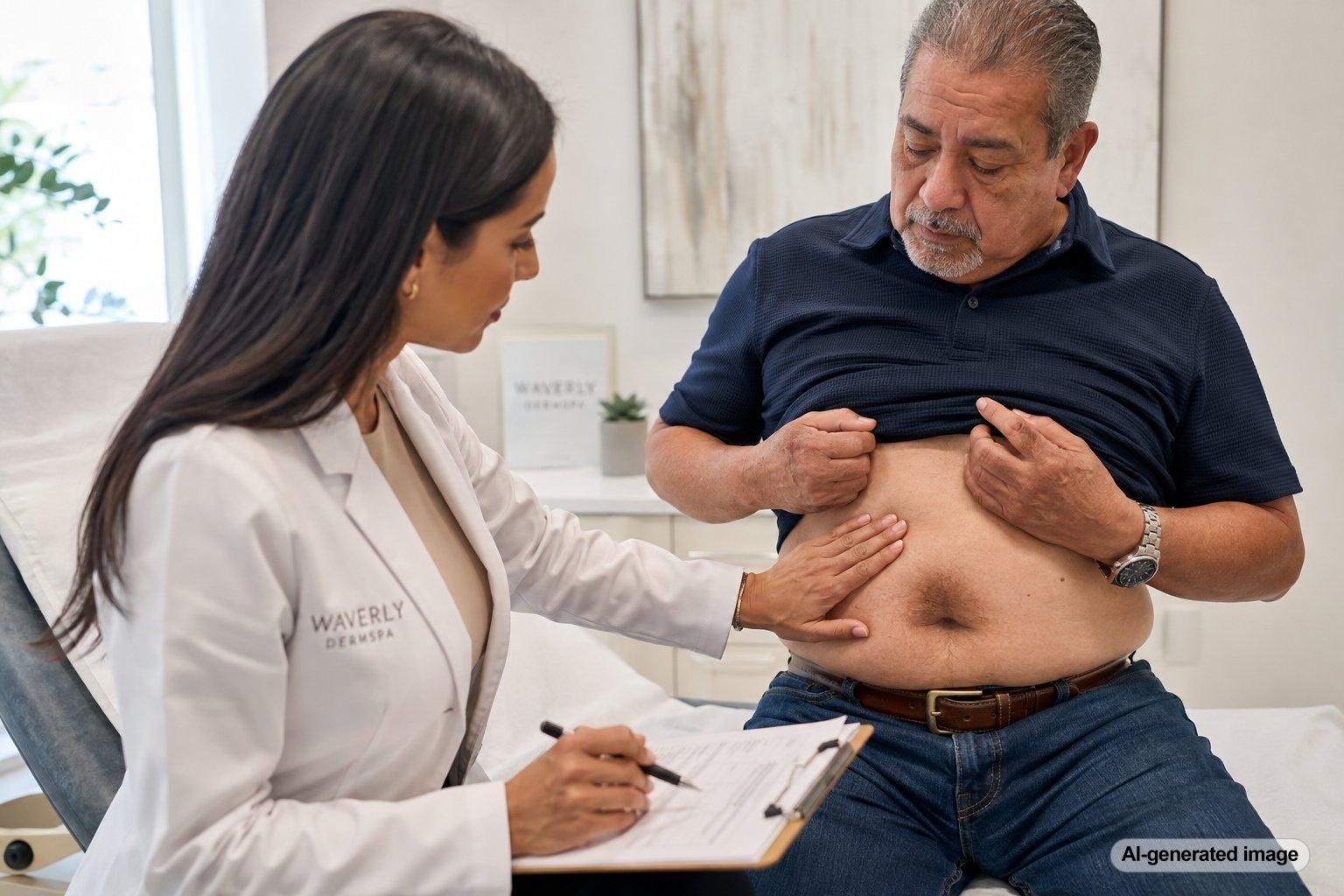
Dark, slightly thickened, or velvety-looking skin around the navel can have several possible causes. One possibility is acanthosis nigricans, a pattern of skin darkening and thickening that can appear in body folds and other areas where skin experiences friction. The appearance alone cannot confirm the cause, so a dermatologist can help determine what is happening.
If the change is new, becoming more noticeable, spreading, or appearing in other areas such as the neck, underarms, or groin, it is worth having the skin evaluated rather than assuming it is ordinary pigmentation.
Quick answer
- Acanthosis nigricans can cause skin to look darker, thicker, and more velvety than the surrounding skin.
- It may appear around the navel, although the neck, underarms, and groin are more commonly recognized locations.
- The pattern can be associated with underlying metabolic or hormonal factors, certain medications, or other health conditions.
- Friction, irritation, and other forms of hyperpigmentation can sometimes look similar.
- A dermatologist can evaluate the texture, distribution, and color change and help determine whether additional medical evaluation may be appropriate.
What acanthosis nigricans looks like
Acanthosis nigricans is a descriptive skin finding rather than a diagnosis based only on color. The affected skin may gradually become darker and feel thicker, softer, or more velvety than nearby skin. Some people notice subtle lines or folds becoming more pronounced.
Although it is often discussed in connection with the neck or underarms, similar changes can occur in other areas, including around the abdomen and navel. Because several skin conditions can cause discoloration in this location, texture and distribution matter as much as color.
Why can the skin around the navel become dark and velvety?
Acanthosis nigricans can be associated with several different factors. A dermatologist may consider the overall skin pattern along with your medical history rather than focusing on the navel alone.
- Metabolic factors: Acanthosis nigricans can be associated with insulin resistance and related metabolic changes.
- Hormonal conditions: Certain endocrine or hormonal conditions can sometimes occur alongside this skin finding.
- Medications: Some medications may be associated with acanthosis nigricans in certain people.
- Genetic tendency: Some people develop this skin pattern because of inherited or familial factors.
- Other medical conditions: Less commonly, a clinician may consider other underlying causes based on the person’s age, symptoms, and how quickly the skin changes appeared.
Could it be something other than acanthosis nigricans?
Yes. Dark skin around the belly button does not automatically mean acanthosis nigricans. Repeated friction from clothing, chronic rubbing, irritation from skin products, previous inflammation, or post-inflammatory hyperpigmentation can all change the color of the skin.
The navel can also develop irritation because it is a recessed area where moisture, sweat, and product residue may collect. A dermatologist can look for differences in scale, redness, tenderness, odor, texture, and the pattern of pigmentation to narrow down the possibilities.
What you can do at home
Until you know what is causing the change, gentle skin care is usually the safest approach. Avoid aggressive scrubbing or trying to remove the darkened skin by friction, since that can create irritation and make discoloration more noticeable.
- Wash the area gently and dry it thoroughly.
- Avoid harsh scrubs, abrasive washcloths, and repeated rubbing.
- Pause any new product that seems to sting, burn, or irritate the area.
- Choose fragrance-free, gentle skin care if the surrounding skin is sensitive.
- Notice whether similar dark or velvety areas are present on the neck, underarms, groin, or other folds.
Topical products may sometimes help with texture or uneven pigmentation, but they do not address a possible underlying cause. If the change appears consistent with acanthosis nigricans, evaluation is more useful than simply trying stronger brightening products.
How a dermatologist may evaluate it
A dermatologist can examine whether the skin truly has the characteristic thickened or velvety texture associated with acanthosis nigricans and whether similar areas are present elsewhere. They may also ask when the change began, whether it developed gradually or quickly, what medications you take, and whether you have noticed other symptoms.
If the skin findings suggest a possible underlying metabolic, hormonal, or medical factor, your dermatologist may recommend discussing appropriate evaluation with your primary care clinician or another medical specialist. Treatment decisions depend on the cause, the degree of pigmentation or thickening, and your individual skin.
When to see a dermatologist
Consider scheduling an evaluation if the darkening is new, persistent, spreading, changing in texture, or difficult to explain. It is also worth getting checked if similar velvety areas are appearing elsewhere on the body.
More prompt medical evaluation may be appropriate when skin changes appear rapidly, become widespread, or occur alongside other unexplained symptoms. A dermatologist can help distinguish acanthosis nigricans from irritation, hyperpigmentation, and other conditions that can affect the skin around the navel.
FAQ
Can acanthosis nigricans appear around the belly button?
It can. Acanthosis nigricans is more commonly recognized on the neck, underarms, and groin, but similar dark, thickened, velvety changes may occur in other areas. A dermatologist can determine whether the appearance around your navel fits that pattern.
Does dark skin around my navel mean I have insulin resistance?
No. Darkening around the navel alone cannot establish insulin resistance. Acanthosis nigricans can be associated with metabolic factors, but many other causes of pigmentation are possible. Medical evaluation is needed to determine whether any additional testing should be considered.
Can I scrub the dark skin away?
Scrubbing is not recommended. If the color change is caused by pigmentation or acanthosis nigricans, it is not simply surface dirt. Aggressive rubbing may irritate the skin and potentially worsen discoloration.
Will brightening creams make it go away?
Some topical approaches may help improve uneven tone or texture in selected cases, but results vary and they do not address an underlying medical factor. A dermatologist can help you decide whether a topical option is appropriate for your skin.
Should I be worried if the area has become darker quickly?
A rapid or unexplained change deserves evaluation, particularly if it is becoming widespread or accompanied by other symptoms. A dermatologist can assess the skin and advise whether further medical evaluation may be appropriate.
Ready to get help?
Schedule an appointment or send a message and our team will get back to you.
Prefer to call? 954-666-3736
This article is for educational purposes and is not medical advice. For diagnosis and personalized treatment, please book an appointment with a board-certified dermatologist.
