

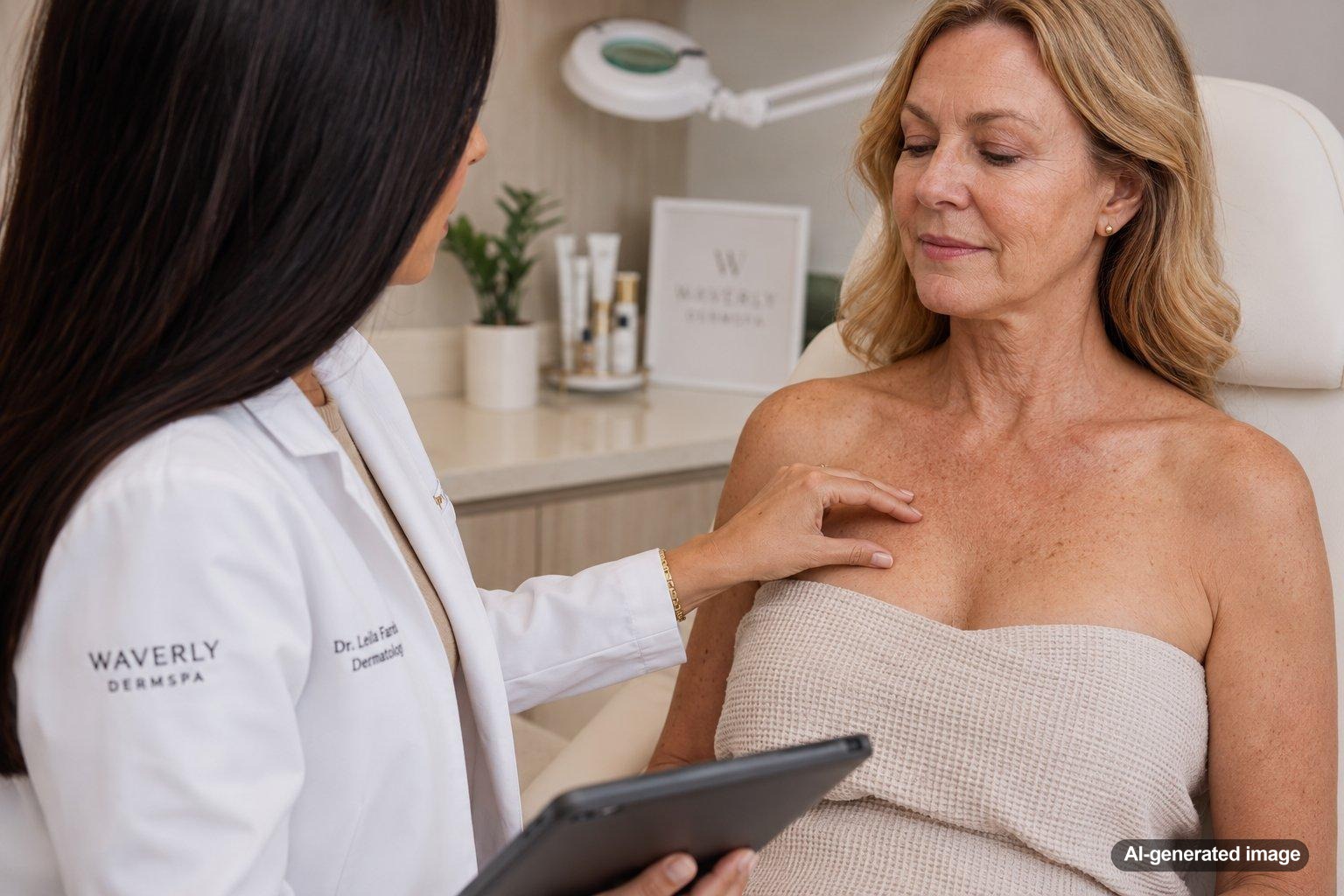
The face often gets most of the skincare attention, but the chest can show its own signs of accumulated sun exposure and natural skin aging. Fine lines, crepey texture, uneven tone, and scattered brown spots may become more noticeable over time, especially in a sunny climate such as South Florida.
Clear + Brilliant Touch is a fractional, non-ablative laser system used for skin resurfacing procedures. For appropriately selected patients, a dermatologist may consider it as one option for improving the overall appearance of sun-damaged skin on areas such as the chest. The right treatment depends on your skin, the type of pigmentation present, your medical history, and your goals.
Quick answer
- Clear + Brilliant Touch uses fractional laser energy for general skin resurfacing procedures.
- It may be considered when concerns include uneven tone, visible sun-related discoloration, fine lines, or rough texture on the chest.
- Not every brown spot should automatically be treated as cosmetic pigmentation, so a dermatologist should evaluate anything new, changing, irregular, or otherwise concerning.
- Sun protection remains important before and after cosmetic treatment because ongoing UV exposure can contribute to additional visible sun damage.
- Results, treatment plans, and recovery experiences vary, so an in-person evaluation is the best way to determine whether this approach is appropriate.
What is Clear + Brilliant Touch?
Clear + Brilliant Touch is a laser system designed for dermatological procedures involving soft-tissue coagulation and general skin resurfacing. It is a fractional treatment, meaning laser energy is delivered in a pattern of microscopic treatment zones rather than removing the entire surface of the skin.
The goal of a resurfacing treatment is generally to encourage a more refined appearance in skin tone and texture while allowing surrounding untreated tissue to remain intact. Clear + Brilliant Touch is non-ablative, so it works differently from more intensive ablative resurfacing procedures that remove portions of the skin’s outer surface.
Why the chest develops wrinkles and sunspots
The upper chest is easy to overlook when applying sunscreen, yet it often receives substantial incidental UV exposure from driving, walking outdoors, exercising, dining outside, and wearing lower-neck clothing. Over time, repeated exposure can contribute to visible changes in pigmentation and texture.
- UV exposure: Repeated ultraviolet exposure can contribute to uneven pigmentation, fine lines, and other visible signs of photodamage.
- Natural skin aging: Skin gradually changes in thickness, elasticity, hydration, and texture with age.
- Repeated movement and sleep position: Creasing of the chest can make existing lines look more noticeable in some people.
- Uneven pigmentation: Freckles, lentigines, and other types of brown discoloration can develop on sun-exposed areas, although not every pigmented spot has the same cause.
How Clear + Brilliant Touch may help chest texture
Fractional resurfacing may help improve the appearance of mild textural irregularity and fine lines by treating small portions of the skin in a controlled pattern. On the chest, the objective is typically gradual refinement rather than a dramatic change from a single treatment.
Because chest skin differs from facial skin, treatment settings and candidacy should be individualized. A dermatologist can evaluate the degree of sun damage, skin tone, history of pigmentation changes, prior procedures, and other factors before recommending a treatment plan.
How it may help visible sunspots and uneven tone
Laser resurfacing is one of several professional approaches dermatologists may use for visible signs of sun damage. Clear + Brilliant Touch may be considered when the goal is to improve the overall look of uneven pigmentation along with texture rather than treating every individual spot as a separate lesion.
However, a cosmetic laser should not be used as a substitute for evaluating an uncertain skin lesion. Brown, pink, red, scaly, crusted, changing, bleeding, or otherwise unusual spots deserve appropriate assessment before cosmetic treatment. A dermatologist can distinguish common cosmetic pigmentation from lesions that may require a different approach or further evaluation.
What a treatment visit may involve
A professional consultation usually comes first. Your clinician can review your goals, examine the chest, discuss medications and skincare products, and determine whether laser resurfacing fits your situation. Treatment parameters can then be selected based on factors such as skin tone, treatment area, pigmentation pattern, and sensitivity.
During treatment, the laser handpiece is passed across the selected area according to the planned settings. Sensations and post-treatment reactions vary. Your clinician should explain what to expect, what skincare products to use or avoid, and when normal activities can be resumed based on your individual treatment.
What you can do at home
Daily habits can support the appearance of the chest whether or not you pursue an in-office procedure. Keep the routine simple and consistent rather than layering multiple aggressive products onto an area that may be more sensitive than the face.
- Apply broad-spectrum sunscreen to the upper chest when it will be exposed.
- Consider protective clothing or shade during prolonged outdoor exposure.
- Use a gentle cleanser and moisturizer if the area tends to become dry or irritated.
- Avoid picking, scrubbing, or aggressively exfoliating visible spots.
- Follow your clinician’s specific pre-treatment and post-treatment skincare instructions if you undergo a procedure.
Other professional options for chest sun damage
Clear + Brilliant Touch is not the only possible approach. Depending on what a dermatologist sees during examination, options for visible sun damage can include other laser or light procedures, chemical peels, topical products, or combinations of treatments. Different technologies target different concerns, so a procedure that makes sense for pigmentation may not be the same choice for deeper wrinkles, redness, or significant textural change.
A dermatologist can also help determine whether your goals are realistic for a gentler resurfacing treatment or whether another approach would be more appropriate. Treatment intensity, number of sessions, recovery, cost, and risk of pigment changes can all influence that decision.
When to see a dermatologist before treating a sunspot
Any spot that is new, changing, irregular, symptomatic, or simply looks different from your other spots should be evaluated rather than assumed to be routine sun damage. The American Academy of Dermatology notes that skin cancers can sometimes be mistaken for age spots, which is one reason professional evaluation is important before cosmetic treatment of uncertain lesions.
It is also worth scheduling a dermatology visit if you have extensive sun damage, a personal history of skin cancer, a history of unusual reactions to cosmetic procedures, or questions about whether a particular area is appropriate for laser treatment.
FAQ
Can Clear + Brilliant Touch be used on the chest?
Clear + Brilliant Touch is designed for dermatological skin resurfacing procedures, and treatment beyond the face may be considered when clinically appropriate. Whether the chest is suitable for you depends on an evaluation of your skin, concerns, and medical history.
Can it remove all chest sunspots?
No cosmetic procedure should be expected to remove every form of pigmentation. Different brown spots can have different causes, and some lesions should be medically evaluated rather than treated cosmetically. A dermatologist can help identify what you are seeing and discuss reasonable options.
Will it erase chest wrinkles?
Fractional resurfacing may help improve the appearance of fine lines and texture, but outcomes vary. Deeper creases or more advanced skin changes may require a different strategy or combination approach.
How many treatments are needed?
There is no single treatment schedule that applies to everyone. The number and spacing of sessions can vary based on skin condition, treatment intensity, response, goals, and your clinician’s recommendations.
Is sun protection still necessary after treatment?
Yes. Ongoing UV exposure can contribute to additional sun damage and may interfere with efforts to maintain a more even-looking complexion. Your clinician can give you specific sun-protection guidance around the time of a procedure.
Who should perform a cosmetic laser evaluation?
A board-certified dermatologist can evaluate pigmentation, identify lesions that should not be treated cosmetically, and help you understand the benefits, limitations, and risks of available procedures.
At Waverly DermSpa, we offer Clear + Brilliant Touch and can help you understand whether it may be appropriate.
Ready to get help?
Schedule an appointment or send a message and our team will get back to you.
Prefer to call? 954-666-3736
This article is for educational purposes and is not medical advice. For diagnosis and personalized treatment, please book an appointment with a board-certified dermatologist.
Sources & further reading
- U.S. Food and Drug Administration (FDA) – 510(k) Premarket Notification: CLEAR+BRILLIANT TOUCH Laser System (K223647)
- American Academy of Dermatology (AAD) – How dermatologists treat sun-damaged skin
