

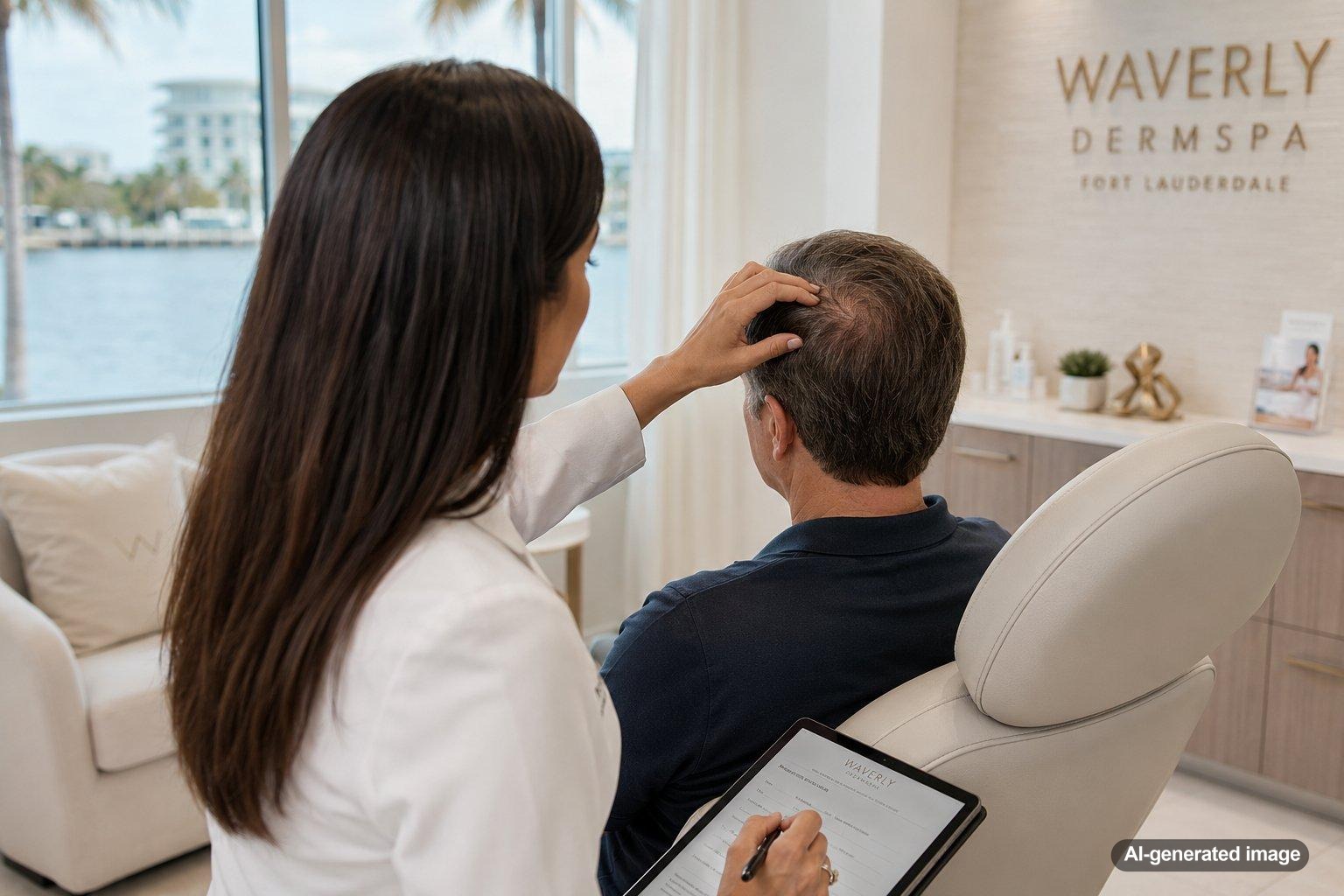
Finding a bald or noticeably thin spot exactly where your head meets the pillow can make the explanation seem obvious: the pillow must be rubbing the hair away. Friction and repeated mechanical stress can contribute to hair breakage in some situations, especially when hair is already fragile. But the location alone does not prove that sleeping on that area caused the hair loss.
A localized bald spot can have several possible explanations, including breakage, repeated pulling or rubbing, alopecia areata, scalp inflammation, or other forms of hair loss. The appearance of the scalp and hairs around the spot usually provides more useful clues than the fact that the area touches your pillow. A dermatologist can examine those details and help determine what is happening.
Quick answer
- Your pillow may be part of the picture, but it is not automatically the cause. Repeated friction can contribute to mechanical damage or breakage, particularly in fragile hair.
- A smooth, clearly defined bald patch deserves a closer look. Alopecia areata is one condition that can begin with a round or oval area of hair loss.
- Repeated tension matters too. Tight hairstyles, extensions, head coverings, or other sources of ongoing pulling can contribute to traction-related hair loss.
- Scalp symptoms provide important clues. Redness, scaling, tenderness, itching, pustules, crusting, or a shiny scar-like surface should not simply be blamed on a pillow.
- If the spot is new, expanding, completely smooth, symptomatic, or not improving after reducing mechanical stress, a dermatologist can evaluate it.
Can sleeping on the same spot cause a bald patch?
Ordinary sleep does not necessarily create enough friction or pressure to produce a true bald patch in a healthy scalp. However, repeated rubbing can contribute to damage along the hair shaft, particularly when combined with fragile strands, chemical processing, heat damage, tight styling, rough head coverings, or frequent movement against a coarse surface.
Mechanical hair damage can look different from hair that has been shed directly from the follicle. With breakage, you may notice shorter hairs of different lengths, rough or frayed strands, or reduced density without a completely bare patch. When hairs are being pulled repeatedly, the location of thinning often reflects where that tension occurs.
This is why the coincidence between a bald spot and your usual sleeping position is useful information, but it is only one clue. The shape of the patch, condition of the scalp, presence of broken hairs, styling habits, and pattern elsewhere on the scalp can all matter.
What else can cause a bald spot in that exact area?
Localized hair loss has a broad differential, and several conditions can resemble friction-related thinning at first glance.
- Hair breakage: Repeated rubbing, heat, chemical processing, aggressive brushing, or other physical damage can weaken the hair shaft and leave an area looking thinner.
- Traction-related hair loss: Hairstyles or accessories that repeatedly pull on the same hairs can cause localized thinning. Tight buns, braids, ponytails, extensions, rollers, and some head coverings are examples of ongoing mechanical stress.
- Alopecia areata: This immune-mediated form of hair loss commonly begins with one or more round or oval patches. The scalp may appear relatively normal even though the hair is missing, which can make the patch seem unexpectedly sudden.
- Inflammatory or infectious scalp conditions: Some scalp problems can produce hair loss along with redness, scaling, itching, tenderness, pustules, crusting, or broken hairs. These findings should be professionally evaluated rather than managed as simple pillow friction.
- Other types of alopecia: Localized or patterned hair loss may have causes that cannot be distinguished reliably by location alone. A dermatologist may use the pattern, medical history, scalp examination, and sometimes additional testing to narrow the possibilities.
How can I tell breakage from hair loss at the follicle?
One helpful distinction is whether the area contains many short, broken hairs or whether the scalp appears relatively bare. Breakage often leaves hairs at varying lengths because the shafts have snapped rather than shed from their roots. The surrounding hair may also feel dry, rough, or fragile.
Alopecia areata, by comparison, can produce a more defined round or oval patch. Other forms of hair loss may show different patterns or changes around individual follicles. These differences are not always easy to recognize without magnification, which is one reason a dermatology examination can be useful when a patch is persistent or unexplained.
Pay attention to the scalp itself as well. Redness, scale, bumps, drainage, crusting, pain, burning, or visible scarring suggests that something more than ordinary friction may be involved.
What can I do at home while I monitor the spot?
Conservative changes that reduce unnecessary mechanical stress are reasonable while you arrange an evaluation or watch for changes. The goal is to make the hair environment gentler without assuming that the pillow is the diagnosis.
- Keep hairstyles loose and avoid repeatedly pulling the same area tight.
- Limit aggressive brushing, excessive heat, and unnecessary chemical processing around fragile hair.
- If a bonnet, scarf, cap, or other covering rubs the exact area, make sure it is not tight or creating repeated tension.
- Consider a smoother pillowcase if your current fabric feels rough against the hair, while recognizing that changing fabric will not address every cause of a bald patch.
- Take a clear photo of the area in consistent lighting every few weeks so you can tell whether the patch is stable, filling in, or enlarging.
- Avoid picking, scratching, or aggressively massaging the area if the scalp is irritated.
It is also useful to think about whether anything else changed around the time you noticed the spot, including a new hairstyle, extensions, headwear, hair treatments, scalp symptoms, or hair loss elsewhere. Those details can help your dermatologist evaluate the pattern.
What might a dermatologist look for?
A dermatologist can examine whether hairs are broken, miniaturized, missing from the follicle, or associated with inflammation or scarring. The shape and borders of the patch, the condition of the follicular openings, and changes elsewhere on the scalp can help distinguish among possible causes.
Professional options depend entirely on what the examination suggests. Management may involve removing a source of mechanical stress, adjusting hair-care practices, treating an underlying scalp condition, or discussing medical therapies when an inflammatory or autoimmune form of hair loss is identified. Prescription treatments and procedures should be selected after an appropriate evaluation rather than based on the location of the patch alone.
At Waverly DermSpa, we offer PRFM for Hair Loss and can help you understand whether it may be appropriate.
When should I see a dermatologist?
It is worth scheduling an examination if the bald spot appeared suddenly, is getting larger, is completely smooth, or persists despite reducing rubbing and tension. You should also seek evaluation when you notice additional patches, eyebrow or eyelash loss, significant shedding elsewhere, or scalp changes such as redness, scale, crusting, tenderness, bumps, drainage, or a shiny scar-like appearance.
Earlier evaluation is especially useful when the cause is uncertain because different forms of hair loss can look similar without a close scalp examination. If you’re unsure, it’s worth getting checked rather than assuming the pillow is responsible.
FAQ
Does sleeping on one side every night cause hair loss?
Sleeping on one side does not automatically cause hair loss. Repeated friction may contribute to breakage in vulnerable hair, but a true localized bald patch can have other causes. If the area is clearly bald or continues to enlarge, a dermatologist can evaluate it.
Would a silk or satin pillowcase help?
A smoother surface may reduce friction compared with a rougher fabric and can be a reasonable hair-care adjustment. It should not be viewed as a treatment for an unexplained bald patch, however, because friction may not be the underlying cause.
What does traction alopecia look like?
Traction-related hair loss develops where hairs experience repeated pulling or tension. Depending on the location and stage, there may be thinning, broken hairs, redness, scaling, or other changes. The pattern often corresponds to a hairstyle or repeated source of tension.
Could a round bald spot be alopecia areata?
Alopecia areata can begin as a round or oval patch of hair loss, so it is one possibility a dermatologist may consider. A round patch is not enough to diagnose the condition on its own because other causes of localized hair loss can look similar.
Will the hair grow back if friction caused the problem?
Regrowth depends on the actual cause, the degree of follicle damage, and other individual factors. Reducing ongoing mechanical stress may help when breakage or traction is involved, but persistent or progressive loss should be evaluated rather than relying on an assumed timeline.
Ready to get help?
Schedule an appointment or send a message and our team will get back to you.
Prefer to call? 954-666-3736
This article is for educational purposes and is not medical advice. For diagnosis and personalized treatment, please book an appointment with a board-certified dermatologist.
Sources & further reading
- American Academy of Dermatology (AAD) – Hair loss types: Alopecia areata overview
- DermNet – Traction alopecia
- National Alopecia Areata Foundation – Understanding Alopecia Areata
