

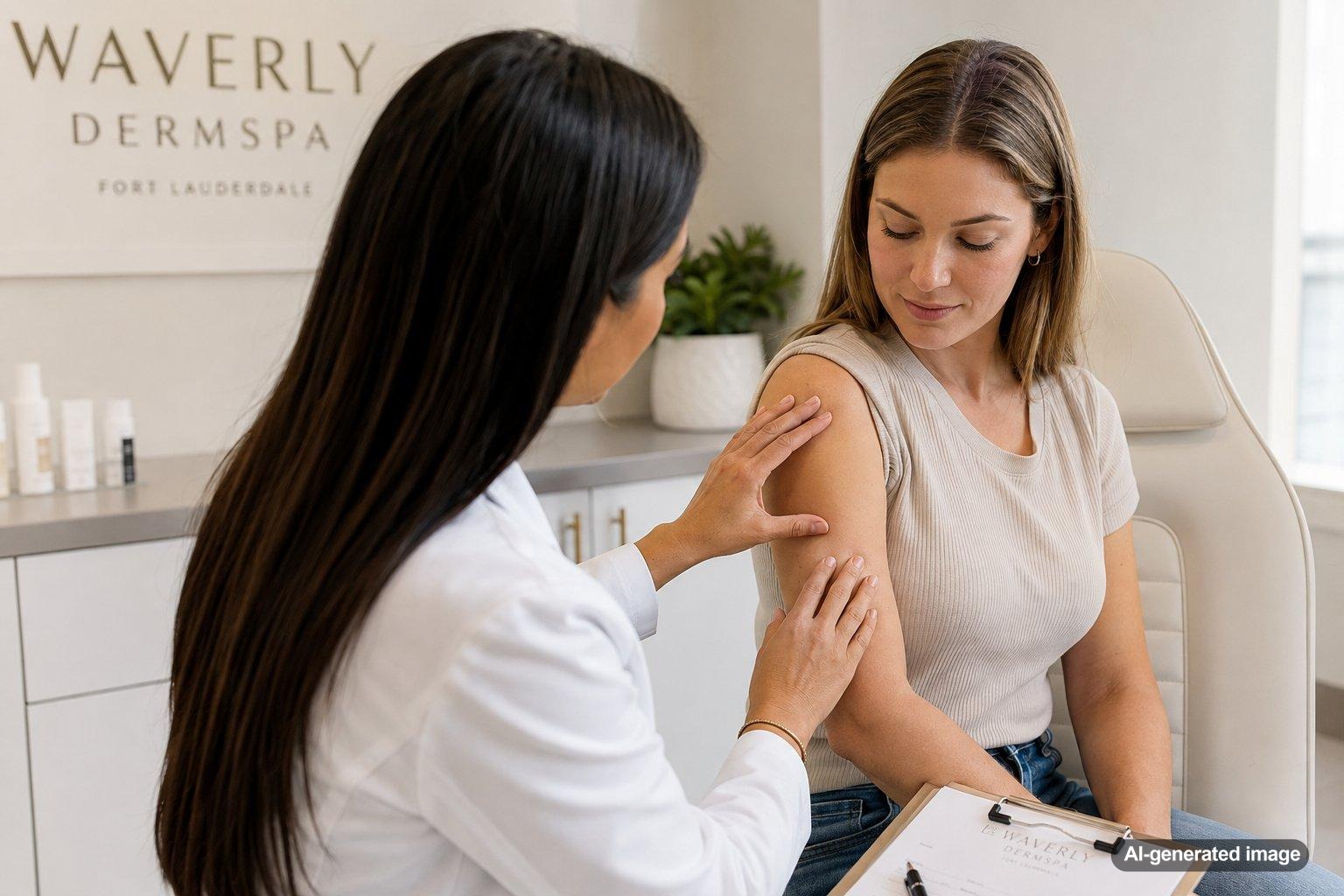
Seeing a new rash appear exactly where you received a vaccine years ago can feel unusually specific. In some situations, previously injured or inflamed skin can become a preferred location for a later inflammatory response, sometimes described as a recall-like phenomenon. However, the location alone does not prove that an old vaccination caused the new rash.
Skin can develop redness, itching, swelling, scaling, bumps, or tenderness for many reasons, and common conditions can coincidentally appear near an old injection site. A dermatologist can examine the pattern, timing, symptoms, and surrounding skin to help determine what is actually happening.
Quick answer
- A rash at a previous vaccination site may represent localized inflammation, but there are several possible explanations.
- Immune responses can sometimes involve areas of skin that were previously inflamed or injured.
- A years-old vaccination site does not necessarily mean the vaccine itself is still causing a reaction.
- Contact dermatitis, eczema, insect bites, infections, medication reactions, and other inflammatory conditions can resemble a recall reaction.
- Persistent, painful, blistering, rapidly spreading, or otherwise concerning rashes are worth having evaluated by a dermatologist.
What does “recall phenomenon” mean in the skin?
The term recall phenomenon is used broadly in medicine for reactions that reappear in a previously affected location after a later trigger. In the skin, the concept can describe inflammation that seems to return to an area that experienced an earlier inflammatory event, treatment, injury, injection, or other local change.
This does not necessarily mean that vaccine material has remained active in the skin for years. Rather, a previously affected area may sometimes respond differently during a later immune or inflammatory event. The exact mechanism can vary, and in an individual case the appearance of a rash in an old vaccination area may have an unrelated explanation.
DermNet notes that vaccines can be associated with several types of cutaneous reactions, including ordinary local inflammatory reactions and less common hypersensitivity patterns. The American Academy of Dermatology also describes a spectrum of skin responses following vaccination, illustrating that immune-related skin reactions do not all look or behave the same way.
Why might a rash appear in the same spot years later?
There is no single explanation that applies to every person. A dermatologist may consider several possibilities depending on how the rash looks and what was happening before it appeared.
- A localized inflammatory response: Previously affected skin may occasionally become a site where inflammation becomes noticeable again during another immune stimulus.
- An unrelated dermatitis: Fragrance, adhesive, topical medication, clothing, sunscreen, personal-care products, or another contact exposure can cause irritation or allergic contact dermatitis in the same general area.
- An underlying inflammatory skin condition: Conditions such as eczema or psoriasis can develop or flare in particular areas and may sometimes favor previously irritated skin.
- An infection or other skin eruption: Certain infections and inflammatory eruptions can be localized at first, making examination important when a rash is painful, warm, blistering, crusted, or spreading.
- Coincidence: Injection sites are often on the upper arm, which is also an area routinely exposed to friction, sun, personal-care products, insect bites, and other everyday triggers.
Is this the same as a normal vaccine injection-site reaction?
Not usually. Typical injection-site reactions occur soon after a vaccination and can include temporary redness, soreness, swelling, or tenderness. DermNet describes these local reactions as inflammatory responses that generally occur shortly after vaccination. Delayed reactions can also occur with some vaccines, but a brand-new eruption years later is a different clinical situation and should not automatically be labeled a routine vaccine reaction.
That distinction matters because focusing only on an old vaccination can distract from newer exposures or skin conditions that may better explain the rash.
What can you safely do at home?
If the area is mild and you otherwise feel well, simple skin-barrier care may be reasonable while you monitor it. Avoid scratching, fragranced products, strong exfoliants, and any new topical product that seems to make the area sting or become more irritated. A gentle cleanser and plain moisturizer can help minimize additional irritation.
It can also be useful to take a clear photo when the rash first appears and another if it changes. Make a note of recent vaccines, illnesses, medications, supplements, travel, insect exposure, adhesives, new skincare products, laundry products, or clothing that contacted the area. Those details can help a dermatologist identify patterns.
Avoid repeatedly applying multiple medicated creams simply to see what works. Different rashes can require different approaches, and some products can change the appearance of the eruption or aggravate sensitive skin.
How can a dermatologist evaluate the rash?
A dermatologist can look at the shape, color, surface texture, borders, distribution, and symptoms of the eruption. The evaluation may also include questions about when the original vaccination occurred, whether the exact same location has reacted before, whether other parts of the body are involved, and whether there was a recent illness, medication, vaccine, or environmental exposure.
Professional options depend on the suspected cause. Management may involve supportive skin care, treatment of an inflammatory rash, evaluation for contact allergy, or testing when the appearance suggests infection or another condition that requires confirmation. Prescription therapies should be selected after an appropriate clinical evaluation rather than based only on the location of the rash.
When should you see a dermatologist?
Consider scheduling an evaluation if the eruption persists, repeatedly returns in the same location, becomes increasingly uncomfortable, or is difficult to explain. It is also worth getting checked if the rash begins after a new medication, vaccination, illness, or other significant health event.
Seek prompt medical attention for concerning symptoms such as extensive blistering, skin peeling, involvement of the eyes or mouth, difficulty breathing, facial or throat swelling, rapidly worsening swelling, significant pain, fever with a spreading rash, or other symptoms that make you feel acutely unwell.
Because many different skin conditions can occupy the same patch of skin, an in-person examination is often more useful than trying to identify a recall phenomenon from location alone.
FAQ
Can a vaccine really cause a rash years later?
A new rash years later should not automatically be attributed to the old vaccine. A recall-like inflammatory pattern is one possible consideration, but other causes such as dermatitis, an inflammatory skin condition, infection, or an unrelated local exposure may be more relevant. A dermatologist can help distinguish among them.
Does a rash at an old injection site mean something is still in my skin?
Not necessarily. The appearance of inflammation in the same location does not by itself show that vaccine material remains active there. The relationship may involve how previously affected tissue responds to inflammation, or the location may be coincidental.
Can another vaccine or illness trigger the area?
Immune activation can be associated with a variety of skin reactions, and inflammatory skin conditions may sometimes flare around illnesses or other immune events. Whether a specific trigger caused a specific rash requires clinical evaluation.
Could this simply be eczema or contact dermatitis?
Yes. Eczema, irritation, and allergic contact dermatitis are among the possibilities a dermatologist may consider, especially when the area is itchy, dry, scaly, or associated with a new product or exposure.
Should I avoid future vaccines if this happens?
Do not make that decision based on the rash location alone. DermNet and the American Academy of Dermatology describe many vaccine-associated skin reactions as distinct from severe allergic reactions, and the implications for future vaccination depend on the type of reaction. Your clinician can help you decide what is appropriate based on your history and symptoms.
Ready to get help?
Schedule an appointment or send a message and our team will get back to you.
Prefer to call? 954-666-3736
This article is for educational purposes and is not medical advice. For diagnosis and personalized treatment, please book an appointment with a board-certified dermatologist.
Sources & further reading
- DermNet – Adverse skin reactions to vaccines
- American Academy of Dermatology (AAD) – Skin reactions to COVID-19 and its vaccines
