

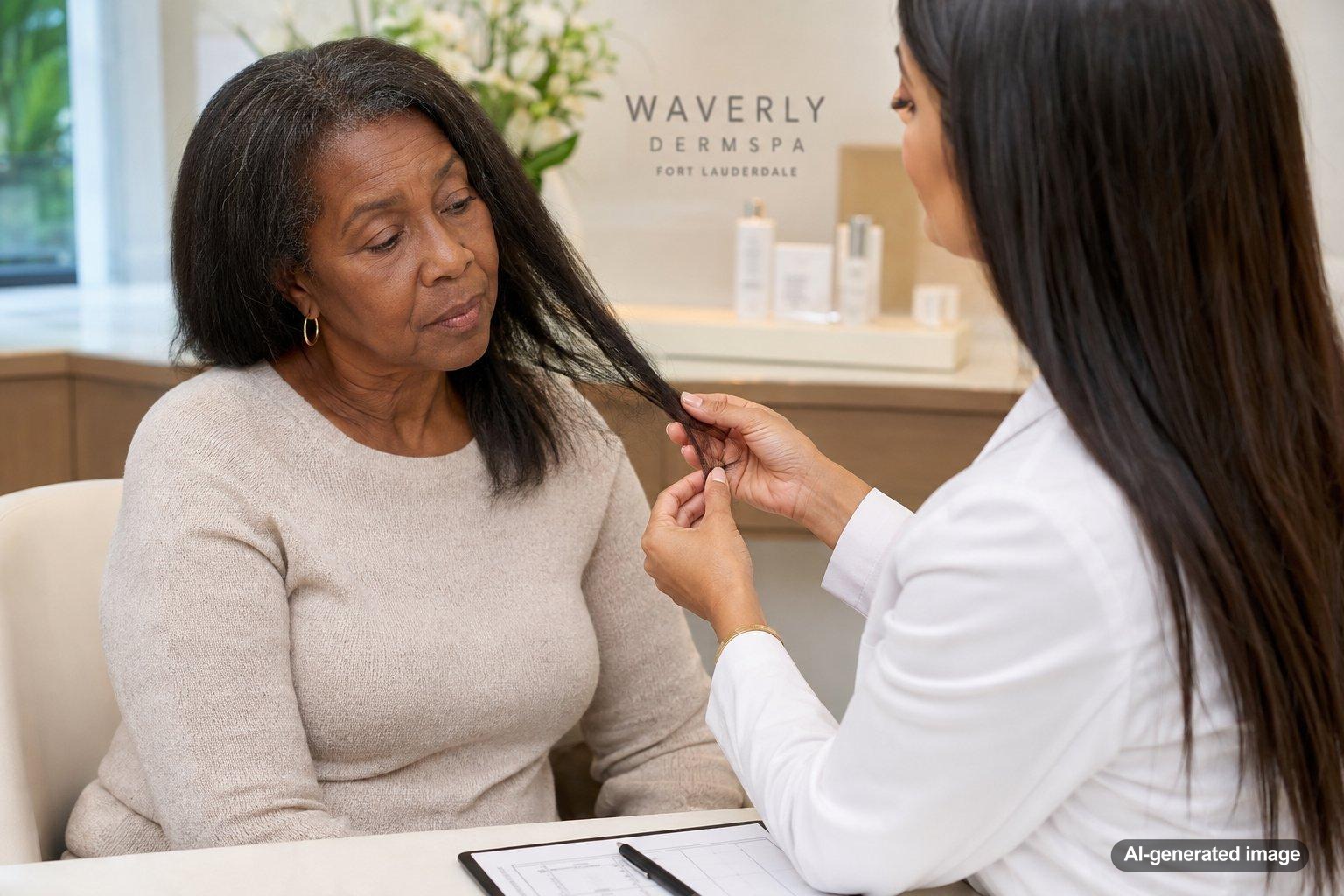
If your hair suddenly feels stiff, rough, or almost straw-like at the ends and seems to snap before it can grow longer, the problem may be happening within the hair shaft itself. One possible explanation is trichorrhexis nodosa, a type of hair-shaft fragility in which weakened areas form along individual strands and make them more likely to break. It can look as though the ends are simply splitting or breaking for no clear reason, even when the scalp looks normal.
In many cases, acquired trichorrhexis nodosa is associated with repeated physical, chemical, or heat-related stress rather than a disease of the scalp. A dermatologist can examine the pattern of breakage and help determine whether your hair changes fit this condition or whether another cause should be considered.
Quick answer
- Trichorrhexis nodosa is a hair-shaft problem that can make strands weak, rough, and prone to snapping.
- The damaged areas may create tiny weak points that make hair look frayed, dull, or uneven in length.
- Heat styling, chemical processing, friction, tight hairstyles, and repeated mechanical stress can contribute to acquired hair-shaft damage.
- Gentler hair care may help reduce additional breakage while the affected hair grows out.
- If breakage is persistent, severe, sudden, or accompanied by scalp symptoms or true hair loss from the root, a dermatologist can evaluate the cause.
What is trichorrhexis nodosa?
Trichorrhexis nodosa is a structural weakness in the hair shaft. Instead of remaining smooth and intact from root to tip, affected strands develop fragile points where the outer protective structure is disrupted. Under magnification, these areas can appear frayed. Because the strand is weaker at those points, it may snap with ordinary brushing, washing, styling, or friction.
That can create a confusing pattern. You may still be growing hair from the scalp, but the ends keep breaking off, so the overall length seems stuck. The hair may also feel coarse, dry, stiff, or rough even if you are using conditioner. Some people notice short broken pieces around the hairline, crown, or areas that receive the most styling stress.
Why can hair feel stiff and break at the ends?
Hair-shaft damage usually builds over time. Even when there was no single dramatic event, repeated low-level stress can weaken the same sections of hair again and again. Common contributors can include:
- Heat: Frequent flat irons, curling irons, hot combs, or very hot blow-drying can weaken the shaft, especially when used repeatedly on the same areas.
- Chemical processing: Bleaching, relaxing, perming, repeated coloring, and overlapping chemical treatments can make hair more vulnerable to fracture.
- Mechanical friction: Aggressive brushing, rough towel drying, tight elastics, backcombing, extensions, and repeated rubbing against clothing or bedding can add stress.
- Tension: Tight braids, ponytails, buns, or other styles that repeatedly pull on the hair may contribute to breakage and can also cause other hair problems.
- Dryness and weather exposure: Sun, salt water, chlorine, and dry indoor environments may leave already-fragile hair more difficult to manage.
Less commonly, unusually fragile hair can be associated with inherited hair-shaft disorders or broader medical conditions. That is one reason persistent or unexplained breakage deserves a professional evaluation rather than assuming it is only cosmetic damage.
What can you do at home?
The goal of home care is not to repair a strand that has already fractured. Hair outside the scalp is not living tissue, so once a section is significantly damaged, the practical focus is reducing additional stress while new hair grows. Conservative steps may include:
- Lower the temperature and frequency of heat styling, and avoid repeatedly passing hot tools over the same section.
- Space out bleaching, relaxing, perming, or other strong chemical services when possible.
- Use a gentle shampoo focused on the scalp and a conditioner on the mid-lengths and ends to improve manageability.
- Detangle slowly, starting near the ends and working upward rather than pulling through knots from the roots.
- Choose loose hairstyles and smooth accessories that do not repeatedly catch or pinch the same strands.
- Pat or squeeze excess water from the hair instead of aggressively rubbing it with a towel.
- Protect fragile ends from repeated sun, salt water, chlorine, and friction when practical.
Trimming visibly frayed or heavily split ends can make the hair look more even and may reduce tangling, but it does not address the reason the shaft became fragile. If the breakage continues despite gentler handling, an evaluation can help clarify what is happening.
What can a dermatologist do?
A dermatologist can look at whether the problem is true shedding from the root, breakage along the shaft, or a combination of both. The exam may include looking closely at the scalp and hair strands, reviewing styling and chemical-treatment history, and asking about the timing and distribution of the breakage.
If the pattern suggests a hair-shaft disorder, your clinician may use magnification or other office-based evaluation to look for structural changes. If there are signs that another condition could be contributing, the dermatologist can decide whether additional testing is appropriate. Treatment depends on the underlying cause and may focus on minimizing trauma, addressing scalp disease if present, or evaluating other medical factors when indicated.
When should you see a dermatologist?
Consider scheduling an evaluation if the breakage is new, worsening, or difficult to explain, especially if you are losing noticeable density or the hair is breaking close to the scalp. It is also worth getting checked if you have scalp pain, itching, scaling, redness, sores, patchy hair loss, eyebrow or eyelash changes, or breakage that began in childhood.
You should also mention any major changes in medications, nutrition, health, or hair-care practices around the time the problem began. Those details can help your dermatologist separate ordinary weathering from a hair or scalp condition that needs a closer look.
FAQ
Can trichorrhexis nodosa make my hair stop growing?
It can make hair seem as though it is not growing because strands may break before they retain much length. The follicle may still be producing hair normally, but repeated shaft breakage can make the ends look thin, uneven, or chronically short.
Does stiff hair always mean trichorrhexis nodosa?
No. Stiff or rough hair can have many causes, including dryness, product buildup, chemical damage, heat exposure, weathering, or other hair-shaft conditions. A dermatologist can evaluate persistent or unusual changes rather than relying on texture alone.
Can damaged hair be repaired?
Conditioners and styling products can temporarily improve smoothness, softness, and manageability, but they cannot permanently restore a hair shaft that has already fractured. Reducing ongoing stress can help protect newer growth and limit additional breakage.
Should I stop coloring or heat styling completely?
Not necessarily. The right approach depends on how fragile your hair is and what is contributing to the damage. Some people may benefit from reducing frequency, lowering heat, avoiding overlapping chemical treatments, or taking a temporary break while the hair grows out.
Is breakage the same as hair loss?
No. Breakage happens when a strand snaps along its length, while hair loss often refers to shedding from the follicle or reduced hair production. The two can look similar in the mirror, and they can sometimes occur together, which is why an examination can be useful.
Ready to get help?
Schedule an appointment or send a message and our team will get back to you.
Prefer to call? 954-666-3736
This article is for educational purposes and is not medical advice. For diagnosis and personalized treatment, please book an appointment with a board-certified dermatologist.
