

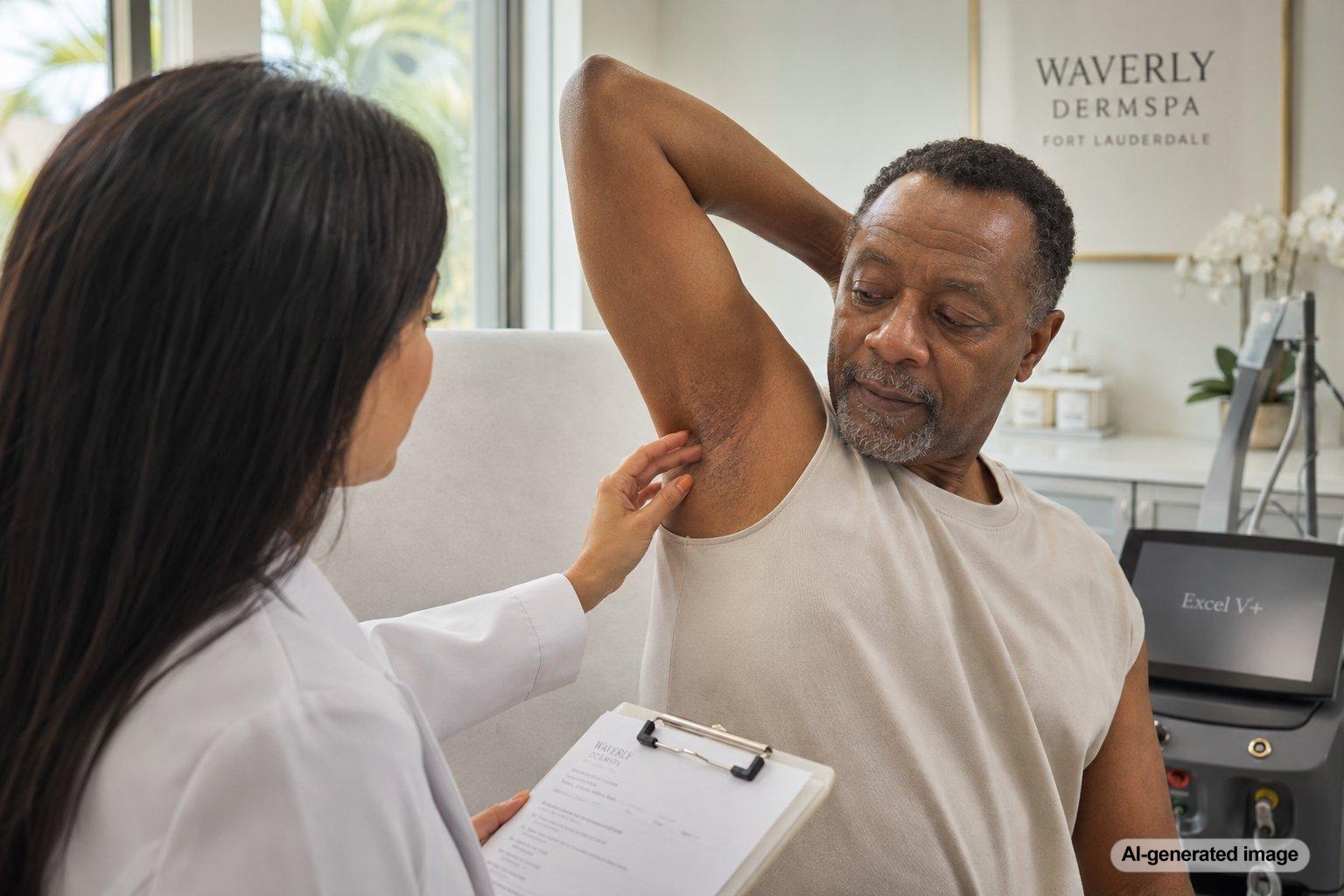
Red marks can remain in the armpits after hidradenitis suppurativa bumps have settled, even when the area is no longer painful or draining. Excel V+ may be considered for some of this lingering redness because the device can direct light toward visible blood vessels that contribute to a red or pink appearance. It is not a treatment for every type of mark, and it does not replace medical care for active hidradenitis suppurativa.
The first step is identifying what is actually visible: residual redness, brown or gray pigment, raised scar tissue, an active inflamed lesion, or a mixture of several changes. A dermatologist can examine the area and decide whether a vascular laser approach is reasonable and how cautiously the underarm skin should be treated.
Quick answer
- Excel V+ may help soften selected red or pink marks left after inflammation has calmed.
- It is generally more relevant to vascular redness than to brown or gray discoloration.
- Active, tender, draining, open, or infected-looking areas should be evaluated before cosmetic laser treatment.
- Results and the number of sessions vary based on skin tone, scar pattern, mark depth, and ongoing HS activity.
- A personalized test spot or conservative settings may be appropriate in this friction-prone area.
Why hidradenitis suppurativa can leave red marks
Hidradenitis suppurativa, often shortened to HS, is a chronic inflammatory condition that commonly affects skin-fold areas such as the armpits. Repeated inflammation can leave several visible changes behind. A recently healed spot may look pink, red, purple, brown, or gray. Some areas may also become thickened, indented, raised, or connected by tunnel-like scars.
Red or pink marks are often linked to persistent dilation of tiny blood vessels after inflammation. This is sometimes called post-inflammatory erythema. Darker brown, purple, or gray marks may involve post-inflammatory pigment instead. Because these changes can overlap, color alone is not always enough to choose a treatment.
How Excel V+ may address residual redness
Excel V+ is a laser platform used for selected vascular and pigment-related concerns. For a red mark, the goal is to deliver controlled light energy that is preferentially absorbed by blood within visible vessels. The treated vessels may gradually become less noticeable as the skin responds over time.
This approach is most relevant when the mark is flat, stable, and primarily red or pink. It may be less helpful when the main concern is deep scarring, an active HS nodule, a draining tunnel, or predominantly brown or gray pigment. A clinician may use visual examination, palpation, medical history, and sometimes a small test area to clarify what type of change is present.
What Excel V+ does not treat
Excel V+ should not be presented as a stand-alone treatment for the underlying inflammatory disease. HS management may involve medical therapy, procedural care, lifestyle support, or surgery depending on severity and individual needs. Treating a leftover red mark does not prevent a new flare in the same or nearby area.
The laser also cannot erase every form of scarring. Thick, rope-like, depressed, or tethered scars often require a different discussion. If redness sits over an active lesion, reducing its color would not address pain, drainage, odor, infection concerns, or ongoing tunnel formation.
Who may be a reasonable candidate
A dermatologist may consider vascular laser treatment when the HS is medically stable in the treatment zone and the remaining concern is a flat red or pink mark. The surrounding skin should be intact, without an open wound or active drainage. Expectations should also be realistic: improvement may be partial, gradual, and different from one mark to another.
Skin tone matters because laser energy can also interact with melanin. People with deeper skin tones may still be candidates, but careful device selection, settings, cooling, and treatment spacing are important. A test spot may help the clinician observe how the skin responds before treating a larger area.
What treatment in the armpit may feel like
During treatment, protective eyewear is used and the skin is cleaned. Patients may notice brief pulses that feel warm, sharp, or like a quick snap. Cooling may be used to improve comfort and protect the skin surface. The appointment length depends on how many marks are being treated and the size of the area.
Temporary redness, warmth, mild swelling, or darkening of a treated spot can occur. Less common risks can include blistering, crusting, pigment changes, or scarring. The armpit deserves extra care because heat, moisture, deodorant, shaving, friction, and tight clothing can irritate recently treated skin.
Preparing for an evaluation
- Share whether the area has recently been painful, swollen, draining, or treated with medication.
- Mention any history of poor wound healing, keloids, pigment changes, or reactions to lasers.
- Bring a list of prescription and over-the-counter products used on the underarms.
- Avoid assuming every dark or red spot is a scar; active disease can sometimes look subtle.
- Ask whether shaving, deodorant, antiperspirant, exfoliating acids, or retinoids should be paused around treatment.
Conservative care between visits
Until the area is evaluated, keep underarm care simple. Avoid picking, scrubbing, or repeatedly applying strong brightening products to irritated skin. Choose loose, breathable clothing when possible and minimize friction over tender areas. If a product burns or stings, stop using it and let the skin recover.
For active HS, follow the care plan provided by your dermatologist. Cosmetic treatment is usually easier to plan when inflammation is controlled and the clinician can clearly distinguish a residual mark from ongoing disease.
When to see a dermatologist before considering laser
Book a medical evaluation first if the armpit has a new or enlarging lump, significant pain, warmth, spreading redness, pus, bleeding, an open sore, fever, or a strong change in odor. These findings may need diagnosis and treatment rather than cosmetic laser care. You should also be evaluated if you are unsure whether a mark is from HS, an infection, contact irritation, or another skin condition.
Frequently asked questions
Can Excel V+ treat active hidradenitis suppurativa bumps?
Excel V+ should not be assumed to treat an active HS bump. Painful, swollen, draining, or open lesions require medical evaluation. A dermatologist can discuss appropriate HS treatment and whether any laser procedure belongs in the broader plan.
Will Excel V+ help brown marks?
It depends on the color source and the settings considered appropriate for your skin. Excel V+ may be used for selected pigment concerns, but a brown or gray mark is different from vascular redness. An examination is needed before choosing a wavelength or another treatment approach.
How many sessions are needed?
There is no single schedule that applies to everyone. The number and spacing of sessions can vary with the number of marks, their depth and color, skin tone, treatment response, and whether new HS inflammation continues to develop.
Can the marks return?
A treated red mark may improve, but new inflammation can create new discoloration. Ongoing control of HS is therefore separate from, and just as important as, treatment of residual redness.
Can laser be used on darker skin tones?
Many people with deeper skin tones can be evaluated for laser treatment, but settings and technique must be selected carefully to reduce the risk of burns or unwanted pigment changes. A conservative plan and test spot may be recommended.
Should I treat redness or scars first?
The sequence depends on what is active and what type of scar is present. Medical control of HS generally comes first. Once the area is stable, a dermatologist can prioritize redness, pigment, texture, or raised scarring based on your goals.
At Waverly DermSpa, we offer Excel V+ and can help you understand whether it may be appropriate.
Ready to get help?
Schedule an appointment or send a message and our team will get back to you.
Prefer to call? 954-666-3736
This article is for educational purposes and is not medical advice. For diagnosis and personalized treatment, please book an appointment with a board-certified dermatologist.
Sources & further reading
- American Academy of Dermatology (AAD) – Hidradenitis suppurativa: Diagnosis and treatment
- DermNet – Hidradenitis Suppurativa (Acne Inversa): A Complete Picture
- U.S. Food and Drug Administration (FDA) – Medical Lasers
