

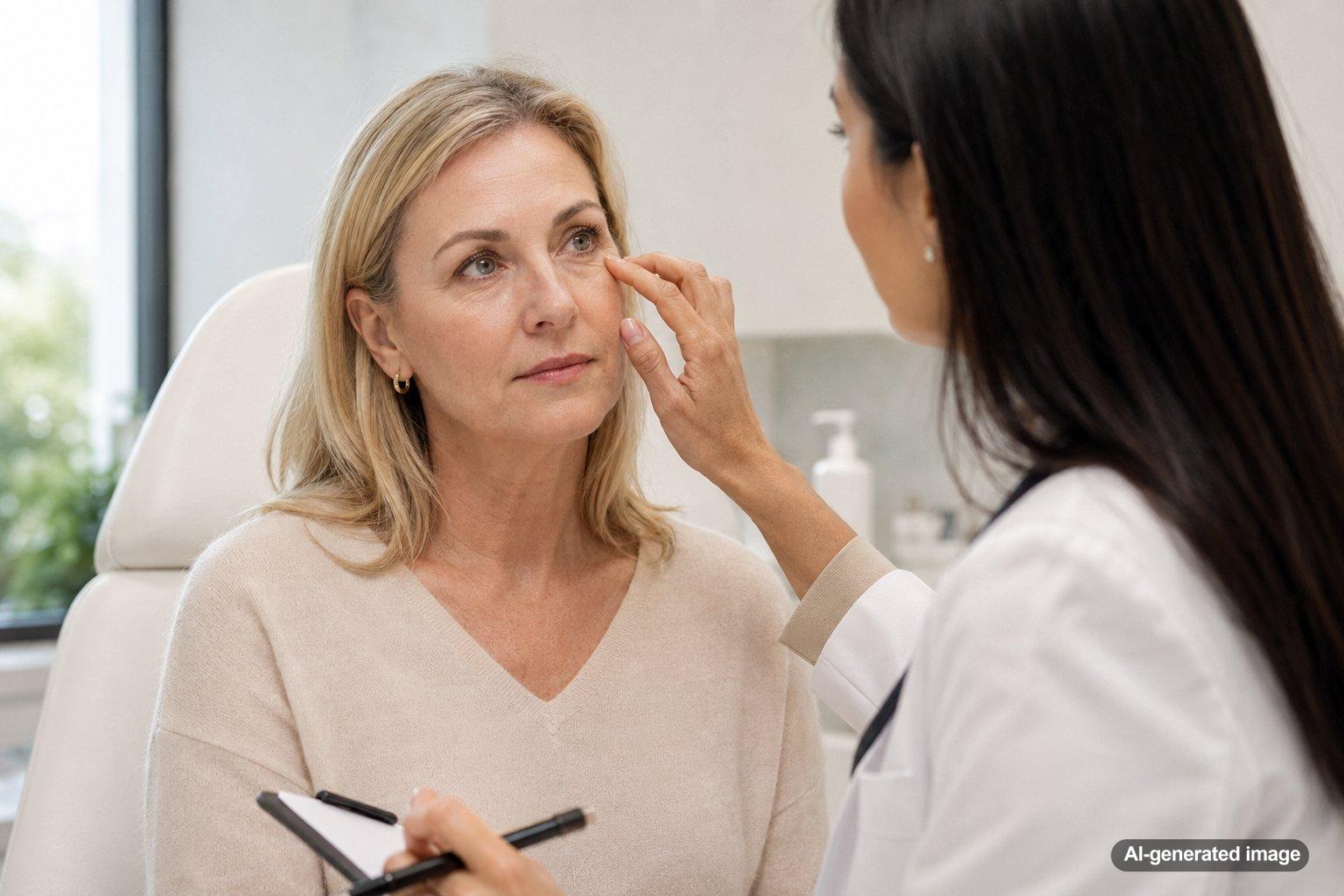
Yes, many flesh-colored bumps around the eyes can be removed or made less noticeable. The right approach depends on what the bumps are, their depth, their number, and how close they are to the eyelid margin. Several unrelated skin growths can look similar in this delicate area, including milia, syringomas, skin tags, sebaceous hyperplasia, and other benign lesions.
Because the skin around the eyes is thin and prone to swelling, discoloration, and scarring, it is safer to have the bumps evaluated before trying to remove them. A dermatologist can identify the most likely cause and explain which options are reasonable for your skin tone, goals, and the exact location of each bump.
Quick answer
- Many small, flesh-colored bumps near the eyes can be treated professionally.
- The removal method depends on the type and depth of the bump.
- Not every bump should be squeezed, cut, or treated with an over-the-counter acid.
- More than one treatment session may be needed when bumps are numerous or deeply rooted.
- A dermatology evaluation is especially important for bumps that are new, changing, irritated, or close to the lash line.
What might these bumps be?
Several common conditions can create small bumps that match or nearly match your skin color. Their appearance may overlap, so identifying them from a description alone is difficult.
Milia
Milia are tiny, firm cysts filled with keratin. They often look white, cream, or flesh-colored and may appear beneath the eyes or on the eyelids. They are not acne, and squeezing them at home can injure the surrounding skin.
Syringomas
Syringomas are small, benign growths related to sweat ducts. They commonly appear in clusters beneath the lower eyelids and may be skin-colored, yellowish, or slightly translucent. Because they extend into the skin, they can be more challenging to flatten than superficial milia.
Skin tags
Skin tags are soft growths that may be smooth or slightly pedunculated. They can occur on the eyelids and in nearby creases, particularly where skin rubs. Their shape and attachment influence how they may be removed.
Sebaceous hyperplasia
Sebaceous hyperplasia occurs when oil glands become enlarged. These bumps are usually soft, pale, or yellow-toned and may have a subtle central indentation. They are more common on the forehead and cheeks but can develop near the eyes.
Other benign growths
Small moles, warts, and other noncancerous growths may also resemble flesh-colored bumps. A dermatologist may use magnification and a careful examination to distinguish among these possibilities.
Why do they develop?
The cause depends on the type of bump. Common contributing factors may include:
- Keratin becoming trapped beneath the skin
- Genetic tendencies toward certain benign growths
- Natural changes in sweat ducts or oil glands
- Friction in the eyelid or under-eye area
- Prior irritation, inflammation, or skin procedures
- Normal changes associated with aging
Heavy eye creams are sometimes blamed for every bump around the eyes, but skincare products are not always the cause. Changing products may help when irritation or congestion is involved, although established growths may not disappear from skincare changes alone.
What can you safely do at home?
Home care should be gentle and focused on preventing irritation rather than attempting removal.
- Use a mild cleanser and avoid aggressive scrubbing around the eyes.
- Choose eye-area products labeled for sensitive skin if your current routine causes burning or redness.
- Avoid picking, squeezing, piercing, or cutting the bumps.
- Do not apply wart removers, strong acids, or harsh exfoliants close to the eyes.
- Use broad-spectrum sunscreen and sunglasses to help protect delicate skin after irritation or treatment.
Retinoids and exfoliating products may be discussed for certain types of bumps, but the eyelid area is easily irritated. A clinician can help determine whether a product is appropriate and where it can be applied safely.
How can a dermatologist remove bumps around the eyes?
Professional treatment is selected after the growth has been evaluated. Common options may include:
Careful extraction
Superficial milia may sometimes be opened and extracted with sterile instruments. This should be done with precise technique to reduce unnecessary trauma to the thin surrounding skin.
Electrosurgery
Controlled electrical energy may be used to treat selected small growths. The settings, treatment depth, and location must be chosen carefully, particularly near the eyelids.
Laser treatment
Certain lasers may help flatten or remove suitable lesions. Laser selection depends on the suspected diagnosis, skin tone, lesion depth, and risk of post-treatment pigment changes.
Minor surgical removal
Raised or attached growths may sometimes be removed with a small in-office procedure. This approach may be considered for individual lesions when it offers better control than treating the surface.
No method is ideal for every bump. With clustered or deeper lesions, the goal may be meaningful improvement rather than complete elimination. Recurrence or the development of new bumps is also possible.
What should you expect after treatment?
Temporary redness, tenderness, swelling, crusting, or darkening may occur after treatment. The degree of downtime varies with the procedure, the number of lesions, and individual skin response.
Your dermatologist may recommend simple aftercare, such as gentle cleansing, avoiding rubbing, using a protective ointment, and limiting sun exposure. Following the specific instructions you receive is important because eyelid and under-eye skin can react differently from thicker facial skin.
When should you see a dermatologist?
Schedule an evaluation when you are unsure what the bumps are or when they bother you cosmetically. Prompt assessment is especially worthwhile if a bump:
- Appears suddenly or changes noticeably
- Bleeds, crusts, becomes painful, or repeatedly irritates the eye
- Grows quickly or develops an irregular shape
- Causes lash loss or affects the eyelid margin
- Returns after previous removal
- Looks different from the other bumps nearby
A professional examination helps avoid treating the wrong condition and allows the procedure to be planned around the delicate structures of the eye area.
Frequently asked questions
Can an aesthetician remove flesh-colored bumps around my eyes?
An aesthetician may support gentle skincare and may address certain superficial concerns within their scope. However, bumps that require diagnosis, medical decision-making, electrical treatment, laser treatment, or removal near the eyelid should be evaluated by a dermatologist.
Will the bumps come back after removal?
Some treated bumps do not return in the same spot, while others may recur or be replaced by new growths over time. The likelihood depends on the specific condition and individual tendency to develop it.
Can eye cream make these bumps worse?
Rich or irritating products may contribute to congestion or sensitivity in some people, but they do not explain every type of bump. A dermatologist can help separate a product-related issue from a true skin growth.
Does removal leave a scar?
Any procedure that disrupts the skin carries some risk of scarring or pigment change. Careful diagnosis, conservative technique, appropriate aftercare, and attention to skin tone may help reduce that risk, but it cannot be eliminated entirely.
Can all the bumps be treated in one visit?
That depends on their number, location, depth, and the chosen method. Treating a smaller area first may sometimes be preferred so your clinician can observe how your skin responds.
Ready to get help?
Schedule an appointment or send a message and our team will get back to you.
Prefer to call? 954-666-3736
This article is for educational purposes and is not medical advice. For diagnosis and personalized treatment, please book an appointment with a board-certified dermatologist.
