

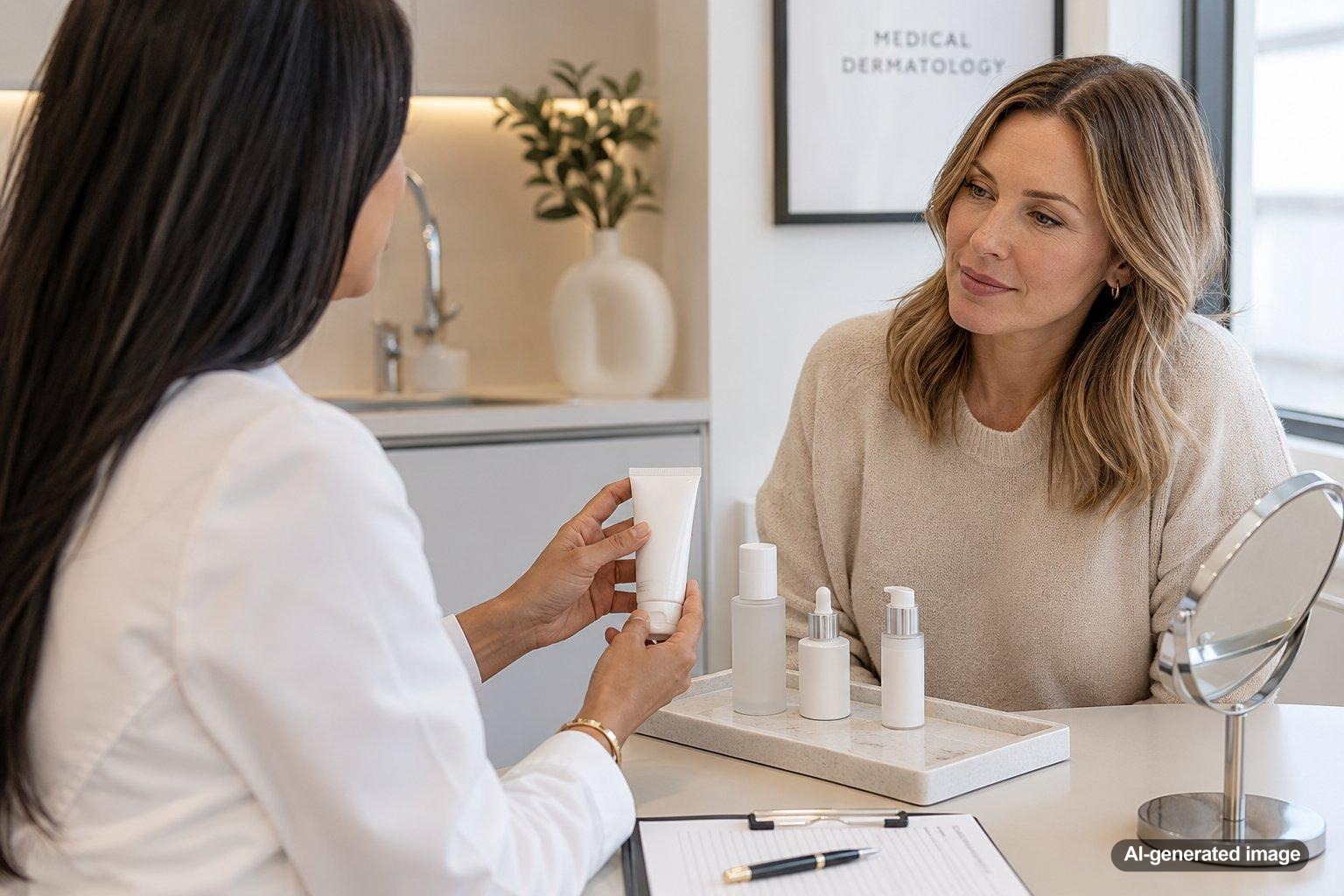
Non-comedogenic products are designed to be less likely to clog pores, but the label is not a perfect promise. It can be helpful, especially if you are acne-prone, oily, or sensitive, but it still needs to be interpreted in context.
The simplest way to think about it: non-comedogenic is a useful starting point, not the final word. Your skin type, the full formula, how much you apply, how often you use it, and what else is in your routine all matter.
Quick answer
- Non-comedogenic means a product is formulated to be less likely to clog pores.
- It does not mean a product is acne-proof, irritation-proof, or right for every skin type.
- Oil-free and non-comedogenic are related labels, but they do not mean the same thing.
- A simple routine is often easier to evaluate than layering many new products at once.
- If breakouts, stinging, redness, or clogged pores keep happening, a dermatologist can help narrow down the cause.
What non-comedogenic really means
A comedone is a clogged pore, often seen as a whitehead or blackhead. A non-comedogenic product is made with the goal of reducing the chance that the formula will contribute to clogged pores.
That label can be especially relevant for sunscreen, moisturizer, makeup, primer, facial oil, and rich creams because these are often left on the skin for many hours. Still, the claim does not tell you exactly how the product was tested, how your skin will respond, or whether the product will fit your entire routine.
Why the label is helpful but limited
Non-comedogenic labeling can guide better product choices, but it is not a personalized skin evaluation. A formula that works beautifully for one person may feel heavy, irritating, or breakout-prone for someone else.
Cosmetic labeling is regulated in the United States, but everyday marketing terms can still be confusing for patients. That is why it helps to look beyond the front label and pay attention to texture, ingredient pattern, fragrance, how your skin reacts, and whether the product fits your skin goals.
Oil-free is not the same as non-comedogenic
Oil-free usually means the product does not contain traditional oils. Non-comedogenic means the formula is intended to be less likely to clog pores. Those ideas can overlap, but they are not identical.
Some oil-free products may still feel occlusive or irritating for certain skin types. Some products that contain lightweight oils may be well tolerated by certain people. The overall formula matters more than one label on the front of the package.
Common reasons a product can still cause problems
- The texture is too heavy: Thick creams, balms, and long-wear makeup may feel congesting for some acne-prone skin.
- The routine is too crowded: Adding several new products at once makes it hard to identify what is helping or irritating.
- The product is irritating: Stinging, burning, redness, or peeling can make breakouts look worse or make the skin barrier feel stressed.
- It is not removed well: Makeup, sunscreen, sweat, and residue can build up if cleansing is inconsistent or too harsh.
- The issue is not only skincare: Hormones, medications, stress, hair products, sweating, and underlying skin conditions can all play a role.
How to choose non-comedogenic products at home
Start with the basics: a gentle cleanser, a lightweight moisturizer, and daily sunscreen. If you are acne-prone, look for products that say non-comedogenic, oil-free, or suitable for acne-prone skin, but introduce them one at a time.
- Patch test a new product on a small area if your skin is reactive.
- Give your skin time to show whether a product is comfortable, unless irritation develops.
- Avoid scrubbing, harsh exfoliation, and over-cleansing, which can make the skin feel more inflamed.
- Keep makeup brushes, pillowcases, and phone screens clean.
- Check hair products, styling creams, and leave-in conditioners if breakouts cluster along the forehead, temples, or jawline.
Professional options if products keep breaking you out
If you have tried multiple non-comedogenic products and still feel stuck, a dermatologist or skincare professional can help review your routine. The goal is not only to remove products, but to understand your skin pattern.
Common next steps may include simplifying your routine, adjusting moisturizer or sunscreen texture, reviewing makeup and hair products, or discussing acne-focused treatment options when appropriate. If there is irritation, sensitivity, rosacea-like redness, or inflamed acne, a dermatologist can evaluate what may be contributing.
When to see a dermatologist
Consider scheduling a visit if acne is painful, leaving dark marks or scars, worsening despite a careful routine, or affecting your confidence. It is also worth being evaluated if you have sudden breakouts as an adult, persistent redness, burning, scaling, or bumps that do not behave like typical acne.
A board-certified dermatologist can help determine whether your skin needs a different product strategy, prescription options, in-office treatments, or a more targeted diagnosis.
FAQ
Does non-comedogenic mean it will not cause acne?
No. It means the product is formulated to be less likely to clog pores, but acne can have many triggers. Your skin can still react to texture, fragrance, irritation, or the way products combine in your routine.
Should everyone use non-comedogenic products?
Not necessarily. They are most helpful for people who are oily, acne-prone, or easily congested. Someone with very dry or non-acne-prone skin may tolerate richer products well.
Can moisturizer be non-comedogenic?
Yes. Many lightweight lotions, gel-creams, and barrier-supporting moisturizers are labeled non-comedogenic. Moisturizer is still important because overly dry or irritated skin can feel more reactive.
Is mineral sunscreen non-comedogenic?
Some mineral sunscreens are non-comedogenic, but not all. Texture and formula still matter. Look for a sunscreen that your skin tolerates and that you are willing to use consistently.
What should I do if a non-comedogenic product breaks me out?
Stop using the product if it seems to trigger irritation or clogged pores, then simplify your routine. If the pattern continues or you are unsure what is causing it, a dermatologist can help you sort through possible triggers.
Ready to get help?
Schedule an appointment or send a message and our team will get back to you.
Prefer to call? 954-666-3736
This article is for educational purposes and is not medical advice. For diagnosis and personalized treatment, please book an appointment with a board-certified dermatologist.
Sources & further reading
- American Academy of Dermatology (AAD) – Skin care for acne-prone skin
- U.S. Food and Drug Administration (FDA) – Cosmetics Labeling Guide
