

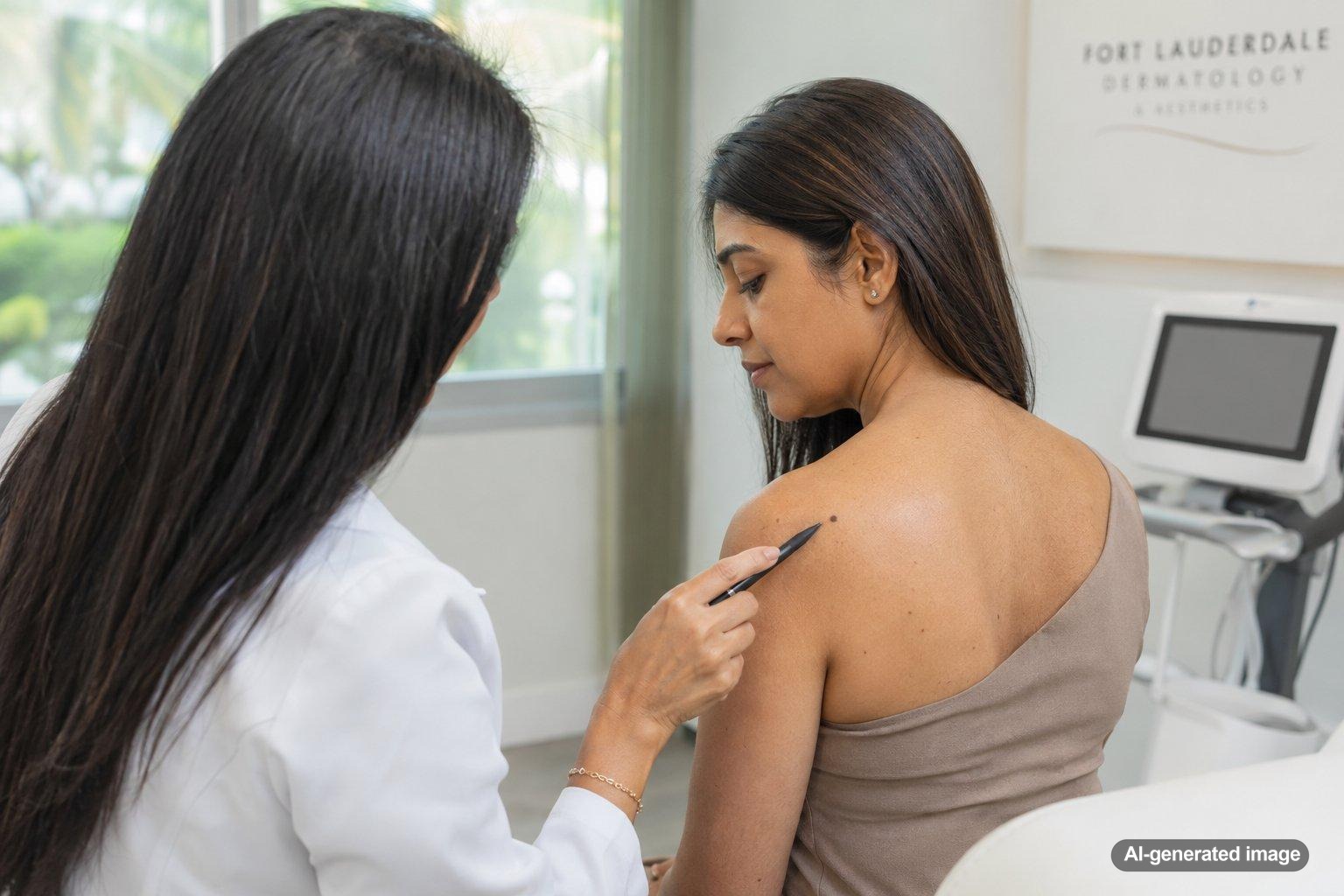
An “ugly duckling” mole is a mole or spot that looks noticeably different from the other spots on your skin. It may be darker, lighter, larger, smaller, oddly shaped, newly appearing, or simply unlike the surrounding pattern of moles on your body.
The phrase does not mean the spot is automatically skin cancer. It means the spot deserves attention because dermatologists often look for outliers, not just individual features. If a mole stands apart from the rest, especially if it is new, changing, itching, bleeding, or not healing, it is worth having a board-certified dermatologist evaluate it.
Quick answer
- An “ugly duckling” mole is one that looks different from your personal pattern of moles.
- It can be a helpful warning sign because many harmless moles on the same person tend to look similar.
- A spot can be concerning even if it does not match every ABCDE feature.
- Photos, body maps, and regular self-checks can help you notice changes.
- If a mole is new, changing, bleeding, painful, itchy, or clearly different, schedule a dermatology visit.
What the ugly duckling sign means
The ugly duckling sign is a simple visual concept: compare a mole to the other moles around it and to the overall pattern on your body. If most of your moles are small, round, and evenly brown, but one is larger, darker, irregular, or multicolored, that mole may be the outlier. If most of your moles are darker and one is pale, pink, or oddly textured, that can also stand out.
This matters because melanoma and other concerning lesions do not always look exactly like the textbook images people expect. Some spots are subtle. Some appear where you may not look often, such as the scalp, back, feet, or behind the ears. The ugly duckling approach helps you notice what does not fit your own skin’s usual pattern.
How it fits with the ABCDEs
The ugly duckling sign is not a replacement for the ABCDEs of melanoma. It is another way to think about your skin. The ABCDEs stand for asymmetry, border irregularity, color variation, diameter, and evolving. The ugly duckling sign asks a different but very useful question: “Does this spot look unlike my other spots?”
Many people find that comparison easier than judging one mole in isolation. A mole may not look extremely abnormal on its own, but it may still stand apart when viewed next to nearby moles or compared with older photos.
Common ways an ugly duckling mole can stand out
- Color: It may be much darker, much lighter, pink, red, blue-black, or unevenly colored compared with your other moles.
- Shape: It may be more irregular, jagged, or asymmetric than the surrounding spots.
- Size: It may be noticeably larger or growing compared with nearby moles.
- Texture: It may become raised, crusted, scaly, tender, or rough.
- Symptoms: It may itch, hurt, bleed, ooze, or fail to heal.
- Timing: It may be new or changing, especially in adulthood.
- Location: It may appear in an overlooked area, such as the back, scalp, soles, toes, or under a nail.
What you can do at home
At-home checks are helpful, but they should not replace a dermatology exam when a spot seems unusual. Use a mirror, good lighting, and a phone camera if needed. Ask a partner, family member, or trusted person to help check hard-to-see areas such as the back, scalp, and backs of the legs.
- Look for spots that do not match your usual mole pattern.
- Take clear photos of moles you are watching so you can compare them over time.
- Check areas that do not get much sun, including the soles, between toes, and under nails.
- Do not pick, shave down, freeze, or try to remove a changing mole at home.
- Use daily sun protection, including broad-spectrum sunscreen, protective clothing, shade, and avoiding tanning beds.
Professional evaluation and what may happen
A dermatologist can examine the spot, compare it with your overall mole pattern, review your history, and use tools such as dermoscopy when appropriate. If a lesion looks suspicious, your dermatologist may recommend monitoring, clinical photography, or a biopsy. A biopsy is a way to remove a sample or the full spot so it can be evaluated under a microscope.
The goal is not to remove every mole. The goal is to identify the spots that need closer attention and avoid guessing. At Waverly DermSpa, we offer skin cancer screening and can help you understand whether a mole or changing lesion should be evaluated further.
When to see a dermatologist
Schedule a dermatology visit if you notice a mole or spot that is new, changing, bleeding, painful, itchy, crusting, not healing, or clearly different from the rest. You should also consider routine skin checks if you have many moles, a history of atypical moles, significant sun exposure, tanning bed exposure, a personal or family history of skin cancer, or a suppressed immune system.
If you are unsure whether a spot is meaningful, it is worth getting checked. A calm, careful evaluation can give you clearer next steps than trying to judge the mole on your own.
FAQ
Does an ugly duckling mole always mean melanoma?
No. A mole that looks different is not automatically melanoma. It is a reason to pay closer attention and consider a professional skin exam, especially if the spot is new, changing, symptomatic, or very different from your other moles.
Can a normal mole be an ugly duckling?
Yes. Some harmless moles look unusual or different from nearby spots. A dermatologist can help determine whether the pattern is reassuring or whether the mole should be monitored or biopsied.
What if I only have one mole?
If a mole appears by itself and you do not have many others for comparison, pay attention to change over time, symptoms, and ABCDE features. A new or changing isolated spot should be checked.
Should I take photos of my moles?
Photos can be helpful when they are clear, dated, and taken in similar lighting. They can make it easier to notice whether a mole has changed. Photos should support, not replace, a dermatologist’s evaluation.
How often should I check my skin?
Many people benefit from regular self-checks, especially if they have risk factors or many moles. Your dermatologist can recommend a skin check schedule based on your skin type, mole pattern, history, and risk factors.
Ready to get help?
Schedule an appointment or send a message and our team will get back to you.
Prefer to call? 954-666-3736
Disclaimer
This article is for educational purposes and is not medical advice. For diagnosis and personalized treatment, please book an appointment with a board-certified dermatologist.
Sources & further reading
- The Skin Cancer Foundation – Melanoma Warning Signs and Images
- American Academy of Dermatology (AAD) – What to Look For: ABCDEs of Melanoma
- American Academy of Dermatology (AAD) – Skin Cancer: Body Mole Map
- Mayo Clinic – Melanoma: Symptoms and Causes
