

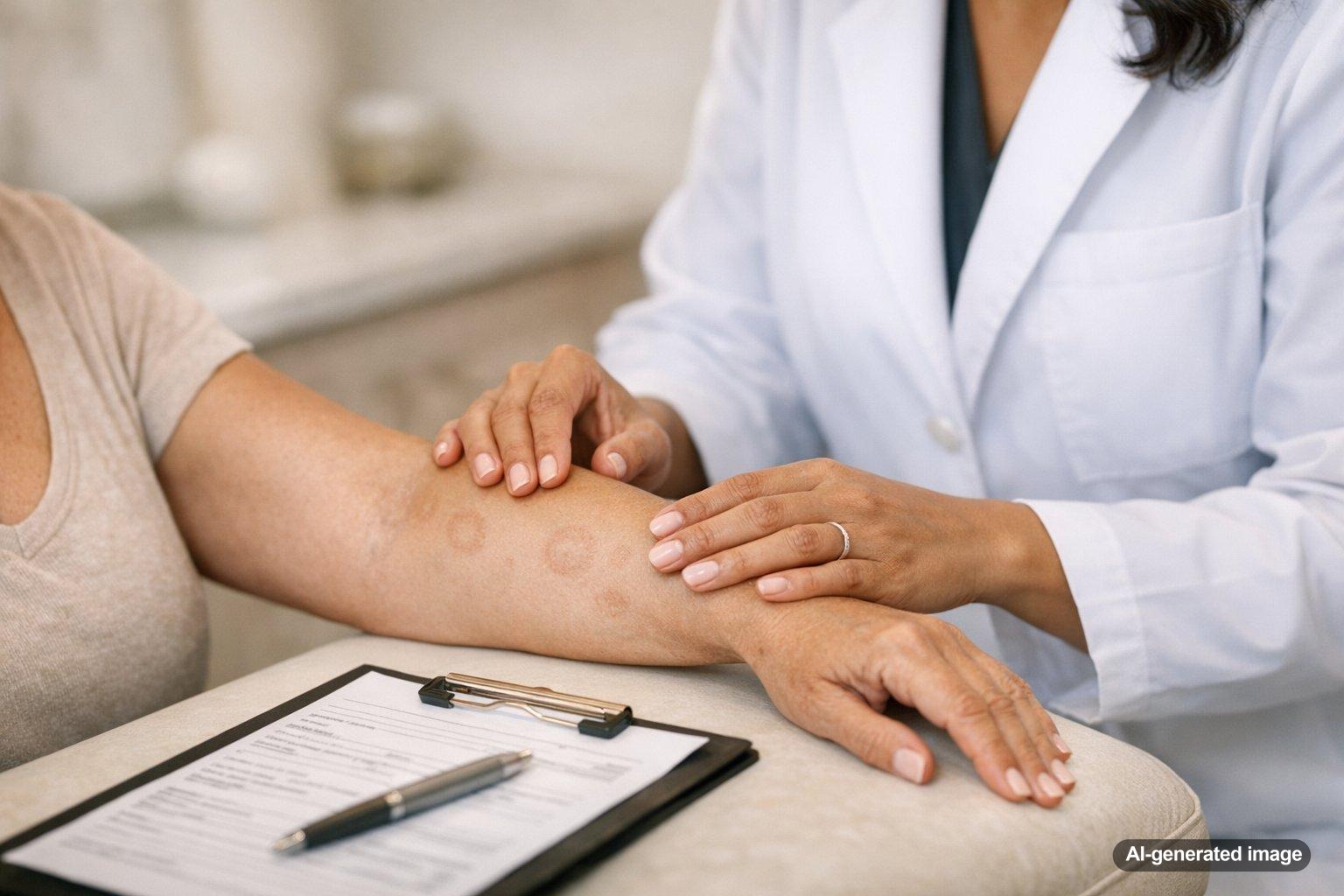
A round, red, or scaly patch can make many people think of ringworm right away. Sometimes that guess is correct, but not every ring-shaped rash is fungal. Eczema, psoriasis, contact irritation, granuloma annulare, and other inflammatory skin conditions can sometimes create circles, arcs, or raised borders that look similar at first glance.
Because ringworm can be contagious and some look-alikes need a different approach, the safest next step is careful evaluation rather than guessing. A dermatologist can examine the pattern, ask about exposures, and when appropriate, perform a simple skin scraping or other testing to help clarify what is going on.
Quick answer
- Ringworm is a fungal infection, but several non-fungal rashes can look circular or ring-like.
- Scale at the edge, spreading borders, itch, recent exposure to pets, gyms, shared towels, or close contact can raise suspicion for fungus.
- Steroid creams can sometimes change the appearance of fungal rashes or make them harder to recognize, so avoid treating an unknown rash aggressively on your own.
- A dermatologist can help distinguish ringworm from look-alikes such as eczema, psoriasis, contact dermatitis, granuloma annulare, and other annular rashes.
- Seek prompt care if the rash is painful, rapidly spreading, draining, near the eye, on the scalp, or associated with fever or a weakened immune system.
What ringworm is, and why it can be confusing
Ringworm, also called tinea corporis when it affects the body, is caused by dermatophyte fungi rather than a worm. On the skin, it often appears as an itchy, round or oval patch with a more active, scaly edge and some clearing toward the center. That pattern can be helpful, but it is not perfect.
Many rashes can form rings because inflammation expands outward, the center calms down, or the skin reacts in a curved pattern. Lighting, skin tone, scratching, prior creams, and the location of the rash can also change how it looks. That is why visual comparison alone is often not enough.
Common ringworm look-alikes
These conditions can sometimes resemble ringworm, especially early on or after over-the-counter treatments have changed the surface of the skin:
- Eczema: Dry, itchy, inflamed patches may become round or coin-shaped, especially in nummular eczema.
- Psoriasis: Raised, scaly plaques can have defined edges and may appear on elbows, knees, scalp, or other areas.
- Contact dermatitis: A reaction to fragrance, metals, plants, adhesives, or skincare ingredients may create a localized red or itchy patch.
- Granuloma annulare: This can form smooth rings or arcs, often without the surface scale that is typical of many fungal rashes.
- Pityriasis rosea: This inflammatory rash can begin with a larger oval patch before more spots appear on the trunk.
- Annular erythema patterns: Some inflammatory rashes spread in ring shapes and may need a dermatologist’s evaluation to narrow the cause.
Common causes or triggers
Possible clues depend on whether the rash is fungal, inflammatory, allergic, or irritation-related. Helpful details include:
- Recent contact with someone who has a fungal infection.
- Exposure to pets, especially if an animal has patchy hair loss or scaling.
- Gym, locker room, pool, or shared towel exposure.
- New skincare products, fragrances, detergents, adhesives, or topical medications.
- History of eczema, psoriasis, sensitive skin, or allergies.
- Heat, sweating, friction, or tight clothing.
- Use of steroid creams before the rash was evaluated.
What you can do at home
While you are waiting to be evaluated, keep the area clean and dry, avoid scratching when possible, and avoid sharing towels, clothing, or personal items if fungus is a possibility. Wash workout clothing, towels, and bedding regularly, and consider whether a new product or exposure may have triggered irritation.
If the rash is mild and clearly resembles a common superficial fungal rash, some people consider an over-the-counter antifungal product according to label directions. However, if the area is on the face, scalp, groin, nails, near the eye, widespread, painful, worsening, or not improving, it is better to get checked. Avoid using a steroid cream on an undiagnosed ring-shaped rash unless your clinician has recommended it, because steroids can sometimes mask or worsen a fungal infection.
Professional options
At a dermatology visit, evaluation may include a close skin exam, discussion of exposures, and sometimes a gentle scraping of surface scale to look for fungus. Depending on the findings, common options may include topical antifungal medication, prescription antifungal medication for certain locations or more extensive cases, anti-inflammatory treatment for non-fungal rashes, or changes to skincare and irritant exposure.
The right plan depends on the diagnosis, body area, severity, medical history, and whether the rash has been treated before. A dermatologist can help you avoid unnecessary products and choose a focused approach.
When to see a dermatologist
Consider scheduling a visit if the rash is new and you are unsure what it is, if it is spreading, or if it has not improved with simple conservative care. Prompt evaluation is especially important when a rash is painful, blistering, draining, crusting, near the eye, on the scalp or nails, affecting a child, or occurring with fever or a weakened immune system.
In Fort Lauderdale, visitors, snowbirds, and local residents may also have changing exposures from travel, humidity, shared fitness spaces, and sun or sweat-related irritation. If you are unsure, it is worth getting checked before layering on multiple creams.
FAQ
Can ringworm look like eczema?
Yes. Some eczema patches can be round, itchy, and scaly. A dermatologist can look at the edge, pattern, location, and history, and may test for fungus when needed.
Is every circular rash contagious?
No. Ringworm can be contagious, but many circular or ring-like rashes are inflammatory or irritation-related and are not spread from person to person.
Should I use a steroid cream on a ring-shaped rash?
It is best to be cautious. Steroid creams can calm inflammation, but they may also change the appearance of a fungal rash or make it harder to recognize. Ask a clinician if you are unsure.
How can a dermatologist tell the difference?
A dermatologist may examine the rash closely, ask about exposures and prior treatments, and sometimes perform a skin scraping or other testing to look for fungus.
When is ringworm more likely?
Ringworm may be more likely when there is a scaly advancing edge, itch, recent contact with an infected person or animal, shared towel or gym exposure, or a rash that keeps spreading outward.
Ready to get help?
Schedule an appointment or send a message and our team will get back to you.
Prefer to call? 954-666-3736
This article is for educational purposes and is not medical advice. For diagnosis and personalized treatment, please book an appointment with a board-certified dermatologist.
Sources & further reading
- American Academy of Dermatology (AAD) – Ringworm: Diagnosis and treatment
- Centers for Disease Control and Prevention (CDC) – Treatment of Ringworm
- DermNet – Tinea corporis
- Cleveland Clinic – Ringworm (Tinea Corporis): What It Looks Like, Causes & Treatment
