

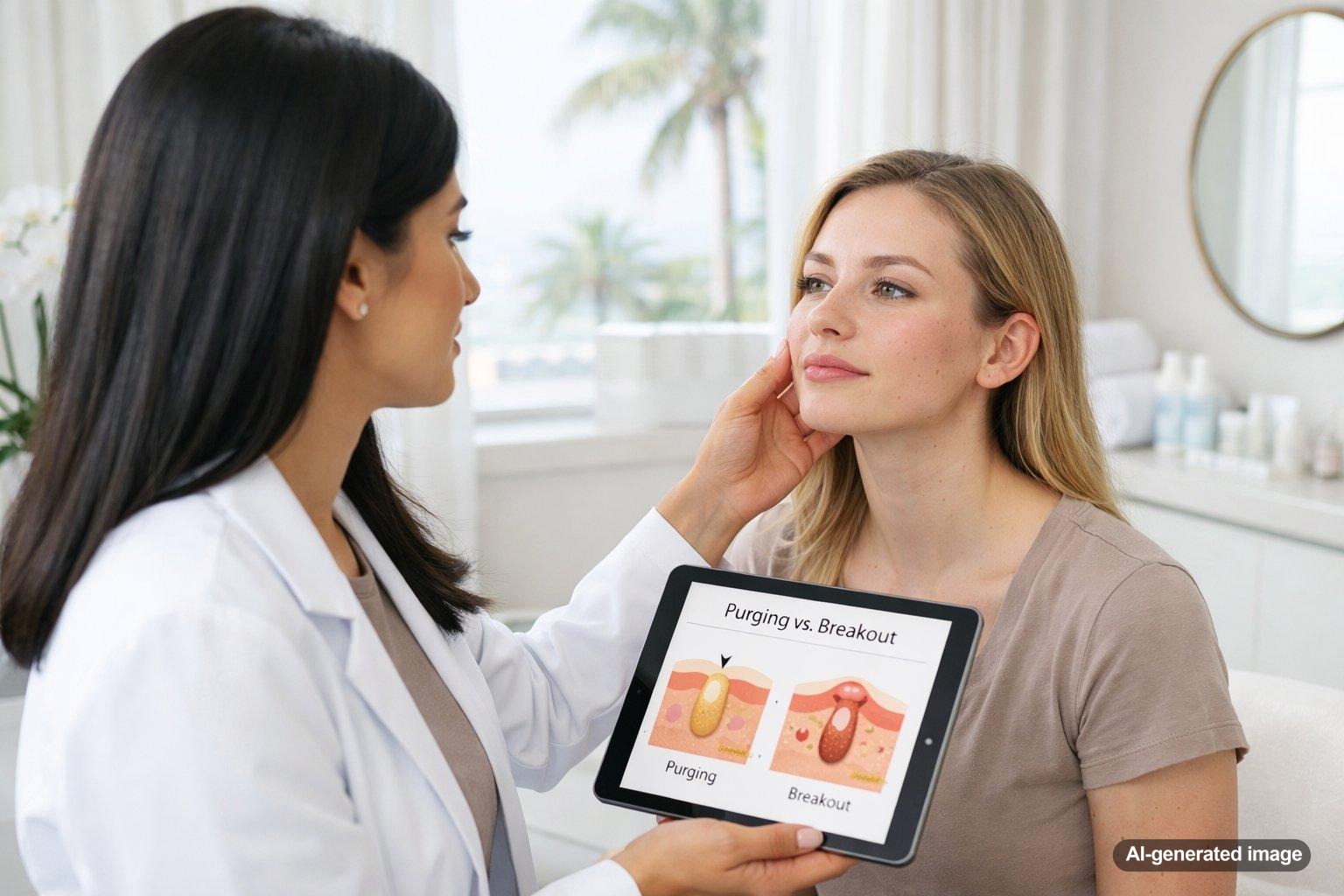
When new bumps appear after starting an acne product, it can be hard to know whether your skin is adjusting or simply reacting poorly. The difference matters because purging is usually linked to ingredients that speed up surface cell turnover, while a breakout can be triggered by irritation, clogged pores, hormones, stress, travel, sweat, makeup, or a product that is not a good fit.
A helpful way to think about it: purging tends to show up in familiar acne-prone areas and has a more predictable relationship to a new active ingredient. Breakouts are more likely when blemishes appear in unusual places, feel unusually inflamed, or continue worsening. If you are unsure, a dermatologist can evaluate your skin and help you decide whether to continue, pause, or adjust your routine.
Quick answer
- Purging may happen after starting ingredients that increase skin cell turnover, such as retinoids or exfoliating acids.
- Breaking out can happen from many triggers, including pore-clogging products, irritation, hormones, stress, sweat, or acne that was already developing.
- Purging usually appears where you commonly break out; a new breakout pattern in unusual areas is less likely to be purging.
- If bumps are painful, cyst-like, spreading, crusting, or leaving dark marks or scars, it is worth booking a dermatology visit.
| Clue | More like purging | More like breaking out |
|---|---|---|
| Where it appears | Your usual acne-prone zones | New or unexpected areas |
| Recent change | Started a turnover-focused active | Started a heavy, occlusive, fragranced, or irritating product |
| Skin feel | Mild dryness or flaking may be present | Burning, swelling, intense itching, or worsening irritation |
What purging means
Purging is a term often used when acne-like bumps appear after starting an ingredient that encourages faster surface cell turnover. These ingredients can bring existing clogged pores to the surface sooner than expected. Common examples include retinoids and exfoliating acids. This does not mean every new pimple after a new product is purging, and it does not mean the product is automatically right for your skin.
Because purging and acne can look similar, context is important. The product type, where the bumps appear, how your skin feels, and whether the pattern is improving or worsening all help guide the next step.
What breaking out means
A breakout means new acne lesions are forming or existing acne is worsening. Breakouts can include whiteheads, blackheads, inflamed bumps, pustules, nodules, or cyst-like lesions. They may be related to clogged pores, inflammation, bacteria, hormones, stress, friction, sweat, travel, certain hair or skin products, or a routine that is too aggressive for the skin barrier.
Breaking out is more likely when blemishes appear in places where you do not usually get acne, when irritation is significant, or when the issue keeps expanding despite simplifying the routine.
Common causes and triggers
- Starting several active products at the same time, making it difficult to tell what your skin is responding to.
- Using retinoids, exfoliating acids, or acne medications too frequently at the beginning.
- Heavy moisturizers, oils, sunscreens, or makeup that may not suit acne-prone skin.
- Hair products that transfer to the forehead, temples, cheeks, neck, or back.
- Heat, humidity, sweating, masks, hats, helmets, or other friction.
- Hormonal changes, stress, sleep disruption, or travel-related routine changes.
What you can do at home
- Simplify your routine for a short period: gentle cleanser, lightweight moisturizer, and daily sunscreen.
- Avoid starting multiple new actives at once. Introduce one product at a time when possible.
- Use potentially irritating actives gradually unless your clinician gave you different instructions.
- Do not scrub, pick, or over-exfoliate. That can make irritation and post-acne marks more likely.
- Choose products labeled non-comedogenic when acne-prone skin is a concern.
- If a product causes burning, swelling, severe redness, or a rash-like reaction, stop using it and contact a clinician.
Professional options
A dermatologist can help determine whether your skin is purging, breaking out, irritated, or reacting to something else. Common acne care options may include topical prescriptions, oral medications for selected patients, in-office procedures, or a skincare plan designed around your skin type, sensitivity level, and goals.
For supportive skin maintenance, an aesthetician may help with gentle, non-medical skincare guidance, barrier-friendly facials, and product selection. At Waverly DermSpa, we offer Chemical Peels and can help you understand whether they may be appropriate.
When to see a dermatologist
- Breakouts are painful, deep, cyst-like, or leaving scars or persistent dark marks.
- Your skin is burning, swelling, crusting, or intensely itchy.
- Acne is spreading quickly or appearing in a pattern that is new for you.
- You are pregnant, nursing, trying to conceive, or using prescription acne therapy and need personalized guidance.
- You are not sure whether to continue a new retinoid, exfoliant, or acne medication.
FAQ
Can purging happen with any skincare product?
Purging is most associated with products that affect skin cell turnover. A rich moisturizer, facial oil, sunscreen, or makeup product is less likely to cause true purging and may be more likely to clog pores or irritate certain skin types.
Should I stop the product if I think I am purging?
Not always, but it depends on your skin, the product, and the severity of the reaction. If irritation is significant or the bumps are painful, spreading, or unusual for you, pause and ask a dermatologist for guidance.
How long does purging last?
Timing varies. Avoid relying on a strict deadline. Instead, watch the pattern: familiar acne-prone areas, gradual calming, and manageable dryness may be more reassuring than worsening inflammation or new breakouts in unexpected areas.
Can retinoids make acne look worse at first?
Some people notice dryness, sensitivity, or an initial increase in blemishes when starting retinoid-based care. A dermatologist can help adjust frequency, moisturizer support, and prescription strength when needed.
Is purging a sign that the product is working?
Not necessarily. A temporary adjustment period can happen with some active ingredients, but irritation or new acne can also mean the product is not the right fit. The safest answer depends on your skin and the full routine.
Ready to get help?
Schedule an appointment or send a message and our team will get back to you.
Prefer to call? 954-666-3736
Disclaimer
This article is for educational purposes and is not medical advice. For diagnosis and personalized treatment, please book an appointment with a board-certified dermatologist.
Sources & further reading
- American Academy of Dermatology (AAD) – Acne: Diagnosis and treatment
- Cleveland Clinic – Retinol: Cream, Serum, What It Is, Benefits, How To Use
