

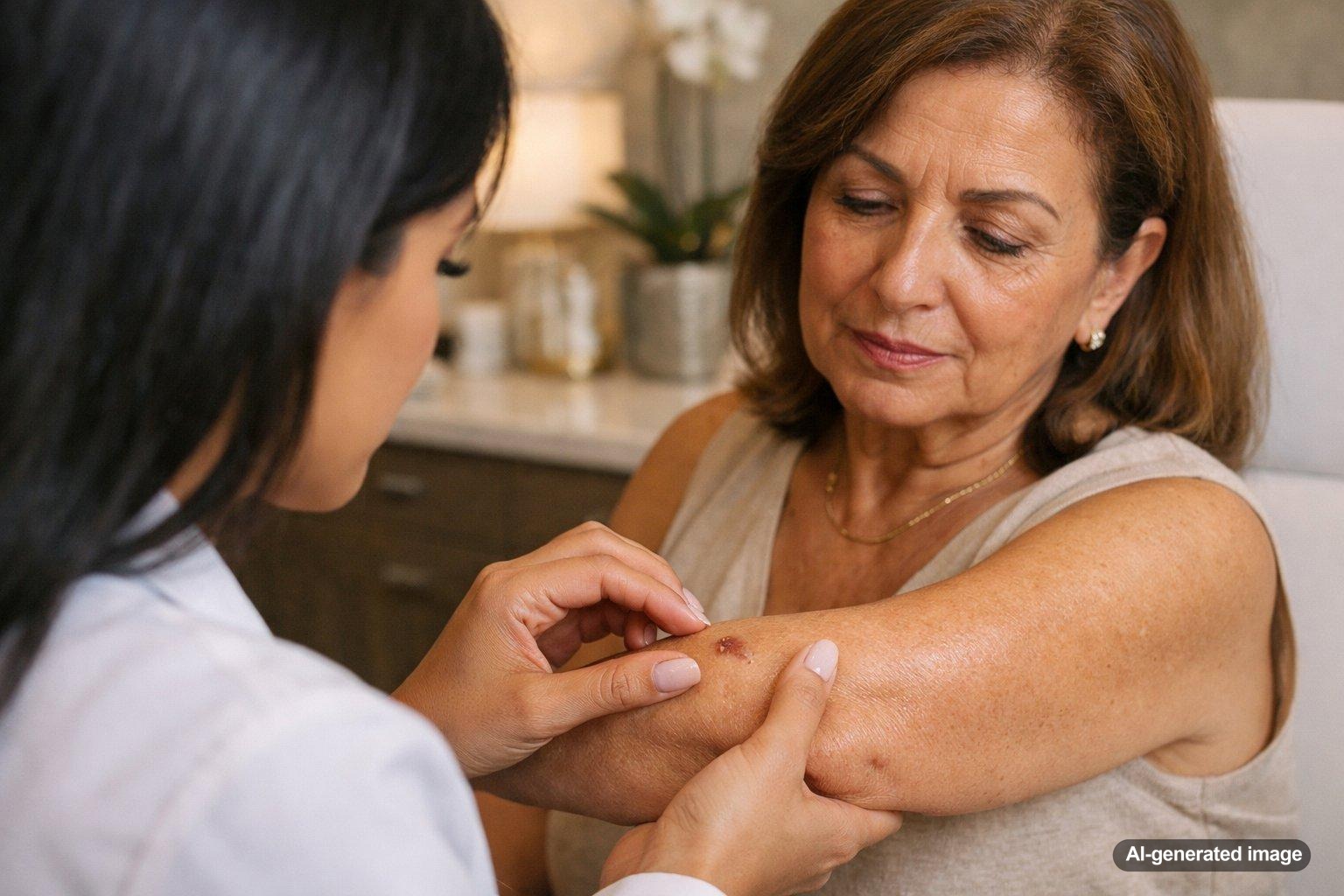
A scab that lingers for weeks, keeps crusting over, or seems to heal and then come right back is worth paying attention to. Sometimes the cause is minor, like irritation, picking, or slow healing after a scrape. But in some cases, a non-healing spot can be associated with skin cancer, especially basal cell carcinoma or squamous cell carcinoma.
The key is not to panic and not to ignore it. A stubborn scab does not automatically mean cancer, but it does deserve a closer look if it is changing, bleeding, tender, or simply not resolving. If you’re unsure, it’s worth getting checked.
Quick answer
- A scab that will not heal can be a sign of skin cancer, but it is not the only possible cause.
- Warning signs include a spot that bleeds easily, crusts repeatedly, grows, feels tender, or heals and then returns.
- Basal cell carcinoma and squamous cell carcinoma often show up as a sore, crusted patch, or irritated area that does not fully go away.
- You cannot diagnose a suspicious spot by appearance alone. A dermatologist can evaluate it and decide whether a biopsy is needed.
- If a scab has lasted more than a few weeks or keeps recurring in the same place, schedule an exam.
What a non-healing scab can mean
In plain English, a non-healing scab is a spot where the skin is not repairing itself the way you would expect. That can happen for several reasons. Sometimes the area is being repeatedly irritated by shaving, scratching, friction, or sun exposure. Sometimes it is an inflamed growth, a precancerous spot, or a skin cancer that keeps breaking down on the surface instead of healing normally.
Skin cancers do not all look the same. Some appear pearly or shiny. Some look pink or scaly. Others can resemble a dry patch, a pimple that never clears, or a crusted sore. That is one reason self-diagnosis is so unreliable.
Common causes or triggers
- A minor injury that keeps getting irritated
- Picking or scratching at the same area
- Dry, fragile, or sun-damaged skin
- An inflamed or irritated benign growth
- Actinic keratosis, which is a precancerous rough patch
- Basal cell carcinoma
- Squamous cell carcinoma
- Less commonly, melanoma or another skin cancer
What you can do at home
Keep the area clean and avoid picking, scrubbing, or trying to peel the scab off. Use bland moisture support, such as plain petroleum jelly, and protect the spot from additional trauma. If it is on a sun-exposed area, daily sun protection matters because UV exposure can make healing harder and can contribute to skin damage over time.
What you do not want to do is keep treating the same spot indefinitely with random creams while it continues to bleed, crust, or recur. If it has not improved within a reasonable time or it keeps returning, an exam is the safer next step.
Professional options
A dermatologist will usually look at the spot closely, ask how long it has been there, whether it has changed, and whether it bleeds or feels sore. Common next steps may include monitoring, treating a precancerous lesion, or performing a biopsy if the spot looks suspicious. A biopsy is the only way to confirm exactly what it is.
If a skin cancer is diagnosed, treatment depends on the type, size, location, and how early it was found. Many skin cancers are very manageable when identified early, which is one reason not to delay evaluation.
When to see a dermatologist
- The scab has not healed after several weeks
- It heals and then comes back in the same place
- It bleeds easily, oozes, or crusts over again and again
- The spot is growing, changing color, or developing a raised edge
- It feels painful, tender, itchy, or irritated without a clear reason
- It sits on an area with lots of past sun exposure, such as the face, scalp, ears, chest, or arms
- You have a personal history of skin cancer or a lot of cumulative sun damage
FAQ
Can a skin cancer look like a simple scab?
Yes. Some skin cancers can look like a sore, crusted patch, or irritated area rather than a dramatic lump or dark mole. That is why persistent spots are easy to dismiss at first.
How long is too long for a scab to stay?
There is no single rule that fits every situation, but a spot that lasts for weeks, repeatedly reopens, or keeps returning deserves medical attention.
Does a suspicious scab always hurt?
No. Some concerning lesions hurt, itch, sting, or bleed, while others cause little or no discomfort at all.
Is every non-healing scab cancer?
No. Many non-healing scabs are not cancer. But because some skin cancers can present this way, it is smart to have a stubborn or changing area evaluated rather than assuming it is harmless.
Ready to get help?
Schedule an appointment or send a message and our team will get back to you.
Prefer to call? 954-666-3736
This article is for educational purposes and is not medical advice. For diagnosis and personalized treatment, please book an appointment with a board-certified dermatologist.
Sources & further reading
- American Academy of Dermatology (AAD) – How can I tell if I have skin cancer?
- The Skin Cancer Foundation – Basal Cell Carcinoma Warning Signs and Images
- MedlinePlus (NIH) – Skin Cancer
