

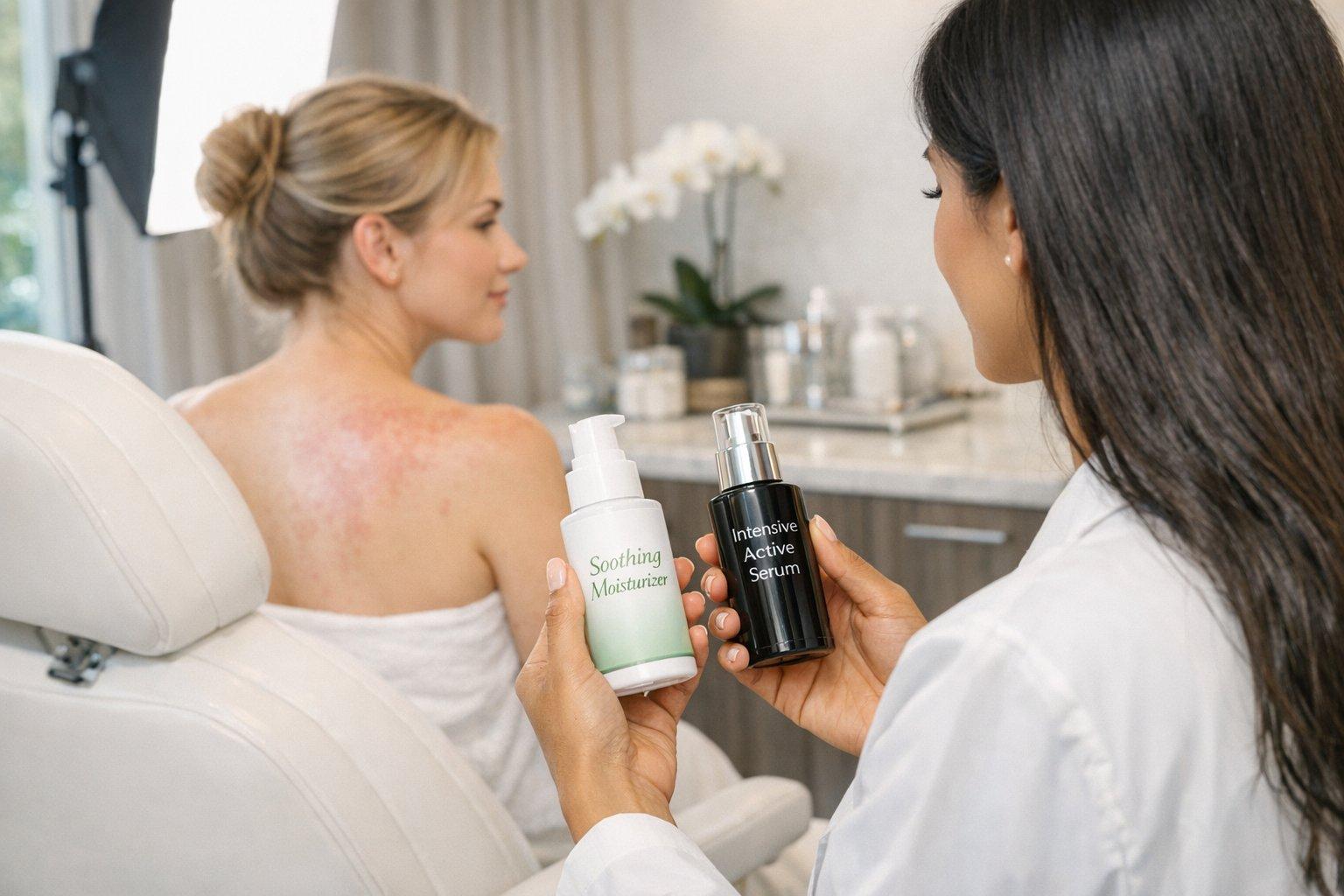
Psoriasis can make even a simple skincare routine feel complicated. A product that seems gentle for someone else may sting, dry, or leave your skin feeling more reactive. The goal is usually not to chase trends or overload your routine, but to protect the skin barrier, reduce unnecessary irritation, and support the treatment plan your dermatologist recommends.
The most helpful approach is usually simple: lukewarm water, fragrance-free cleansing, rich moisturizing, and avoiding harsh scrubs or strong actives on irritated areas. Because psoriasis is an inflammatory condition, skincare can support comfort, but it does not replace medical evaluation when flares are persistent, painful, widespread, or hard to control.
Quick answer
- Helpful: fragrance-free cleansers, thick moisturizers, short lukewarm showers, and gentle daily habits that protect the skin barrier.
- Often irritating: scrubs, hot water, fragranced products, over-exfoliation, and using too many active ingredients at once.
- Best routine: keep it simple, moisturize right after bathing, and patch test new products carefully.
- Important note: skincare may help comfort and dryness, but psoriasis often needs evaluation and a personalized treatment plan.
| Skincare factor | More likely helpful | More likely irritating |
|---|---|---|
| Cleansing | Gentle, fragrance-free cleanser used lightly | Deodorant soaps, foaming harsh cleansers, vigorous rubbing |
| Bathing | Short showers or baths with lukewarm water | Long, hot showers that leave skin tight and dry |
| Moisturizing | Thick cream or ointment applied after bathing | Skipping moisturizer or relying only on light, alcohol-heavy formulas |
| Exfoliation | Minimal or avoided unless your clinician advises otherwise | Scrubs, brushes, picking, and aggressive peels on active areas |
| Product selection | Simple routines with fragrance-free, non-irritating products | Fragrance, strong acids, retinoids, or too many new products at once |
What tends to be helpful
For many people, the most helpful skincare for psoriasis is boring in the best way. Think gentle cleansing, consistent moisturizing, and avoiding friction. A rich cream or ointment can help reduce dryness, support the skin barrier, and make skin feel less tight and uncomfortable. Applying moisturizer right after bathing, while skin is still slightly damp, is often one of the simplest habits that makes a noticeable difference.
It can also help to keep showers short and use lukewarm rather than hot water. Soft towels, gentle patting instead of rubbing, and loose, breathable clothing may also reduce day-to-day irritation. If your skin is very reactive, choosing products labeled for sensitive skin or psoriasis-prone skin may be useful, especially when they are fragrance-free and designed to be non-irritating.
What commonly irritates psoriasis-prone skin
One of the most common problems is doing too much. Over-cleansing, layering multiple active products, scrubbing away flakes, or trying to force smoothness can leave skin more inflamed. Fragrance is another frequent issue, especially in washes, lotions, and body products used every day.
Hot water, rough exfoliation, picking at plaques, and using strong acids or retinoids on already irritated areas can also make skin feel worse. Even products marketed as “refreshing” or “deep cleaning” may be too harsh when the skin barrier is already struggling. If a product burns, stings, or seems to leave skin angrier each time you use it, that is usually a sign to stop and simplify.
How to build a calmer routine at home
- Use a gentle cleanser only where you need it instead of over-washing the entire area.
- Take short, lukewarm showers rather than long, hot ones.
- Apply a thick moisturizer soon after bathing.
- Avoid scrubs, rough washcloths, and picking at scale.
- Introduce one new product at a time so it is easier to spot irritation.
- Be extra careful with fragranced products and strong actives on active patches.
If your dermatologist has prescribed a topical treatment, it is worth following their directions closely. In many cases, medical treatment and supportive skincare work best together rather than as separate strategies.
Professional options
When psoriasis is persistent or more uncomfortable than a basic routine can handle, professional care matters. Common options include prescription topicals, light-based treatment, and other therapies chosen based on the location, severity, and pattern of symptoms. A dermatologist can also help determine whether something that looks like psoriasis may actually be another condition, or whether more than one issue is happening at the same time.
At Waverly DermSpa, we offer Photodynamic Therapy (PDT) and can help you understand whether it may be appropriate.
When to see a dermatologist
- If skin is painful, cracked, bleeding, or interfering with sleep or daily life
- If symptoms are widespread or affecting the scalp, nails, face, or skin folds
- If over-the-counter skincare keeps failing or seems to make things worse
- If you are unsure whether it is psoriasis or another type of rash
- If joint pain, stiffness, or swelling is happening along with skin symptoms
FAQ
Can moisturizer cure psoriasis?
No. Moisturizer can help with dryness, discomfort, and barrier support, but it does not cure psoriasis. Many people still need medical evaluation and a personalized treatment plan.
Are natural products always safer for psoriasis?
Not necessarily. Natural ingredients can still irritate sensitive skin, especially if they contain fragrance, essential oils, or multiple botanical extracts. Simpler formulas are often easier to tolerate.
Should I exfoliate psoriasis flakes?
Usually, aggressive exfoliation is more likely to irritate than help. Scrubbing, picking, or using harsh peel products can make inflamed skin feel worse. If you are unsure what is safe, a dermatologist can guide you.
Is fragrance-free always the better choice?
For psoriasis-prone or highly sensitive skin, fragrance-free products are often a safer starting point. They are not a guarantee, but they may reduce one common source of irritation.
Ready to get help?
Schedule an appointment or send a message and our team will get back to you.
Prefer to call? 954-666-3736
This article is for educational purposes and is not medical advice. For diagnosis and personalized treatment, please book an appointment with a board-certified dermatologist.
Sources & further reading
- American Academy of Dermatology (AAD) – Psoriasis: Tips for managing
- American Academy of Dermatology (AAD) – 8 ways to stop baths and showers from worsening your psoriasis
- National Institute of Arthritis and Musculoskeletal and Skin Diseases (NIAMS) – Psoriasis Symptoms, Causes, & Risk Factors
- National Psoriasis Foundation – Moisturizing Sensitive Skin with Psoriasis
