

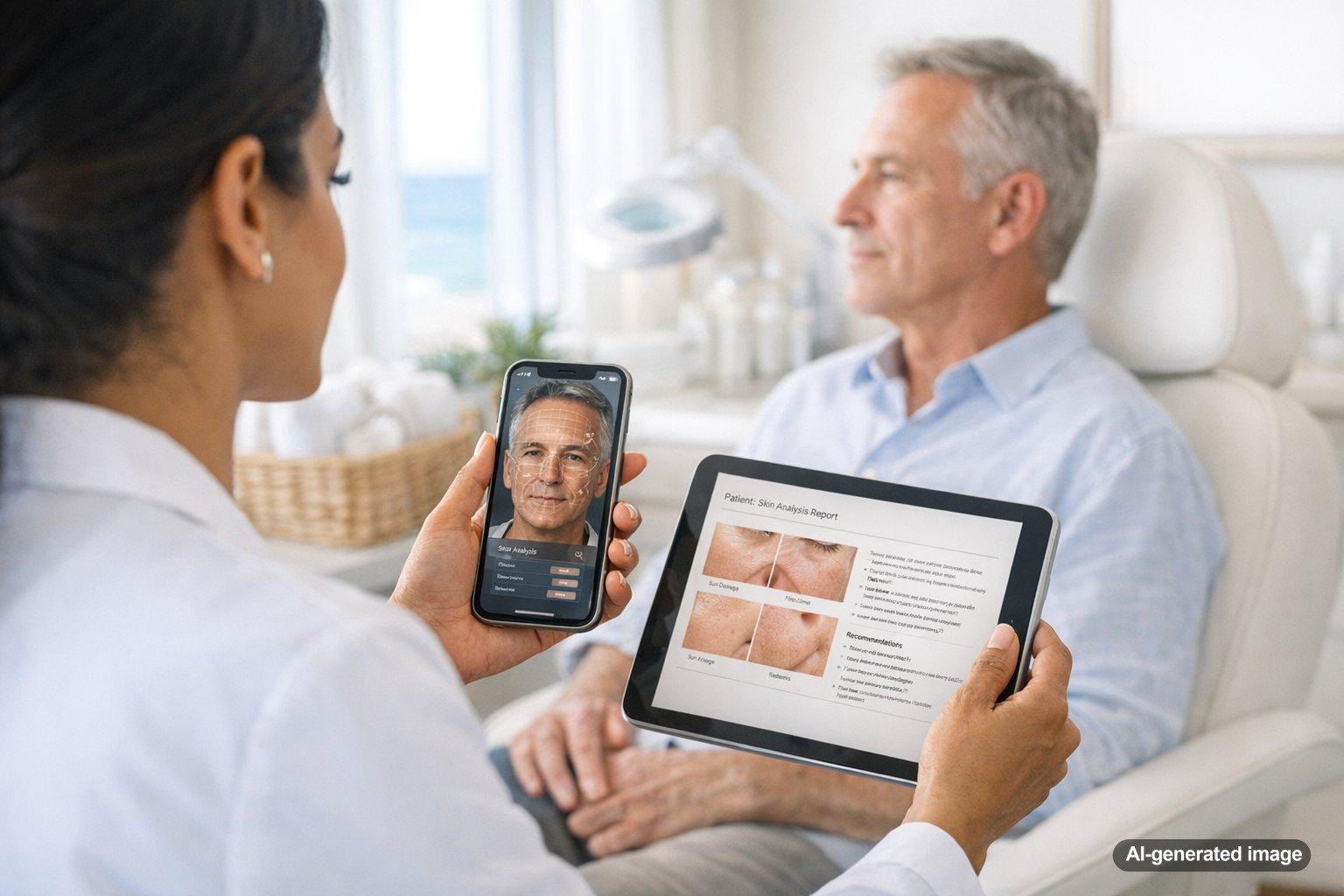
At-home AI skin analysis apps are everywhere right now, and it’s easy to see the appeal. You snap a photo, answer a few questions, and get a fast read on concerns like breakouts, redness, dark spots, texture, or visible aging. For people who want a starting point, that convenience can feel useful.
But an app is not the same as an in-person consultation. In most cases, AI tools are better thought of as screening or skincare guidance tools, not as a replacement for a dermatologist’s trained eye. They can help you notice patterns and organize your thoughts, but they cannot fully evaluate context, examine your skin up close, or make personalized medical decisions.
Quick answer
- AI skin apps can be helpful for tracking changes, spotting broad patterns, and building questions for an appointment.
- They are limited by lighting, camera quality, skin tone variation, makeup, filters, and the angles you capture.
- They cannot feel a lesion, examine scalp or nails properly, or assess the full medical context behind a skin change.
- They should not replace a professional evaluation for a new, changing, painful, bleeding, or persistent concern.
- The best use is as a supplement to care, not a stand-in for it.
What an AI skin analysis app can do well
These tools are often best at recognizing visible surface-level patterns. That may include noticing uneven tone, acne-prone areas, visible pores, fine lines, dryness, or redness. Some apps can also help you log photos over time, which can be useful if you’re trying to understand whether a routine is irritating your skin or whether a product seems to be helping.
For busy patients, that sort of tracking can be practical. It may make it easier to walk into an appointment with a timeline, a set of comparison photos, and a clearer description of what you’ve been noticing at home.
Where an app falls short
Skin is not just an image. A consultation includes details that a phone camera often misses: texture, tenderness, distribution, timing, medication history, sun exposure, travel, stress, hormones, and whether something is itchy, burning, bleeding, or changing quickly. A dermatologist also knows how to weigh small clues together rather than relying on one photo alone.
Apps can also struggle when the image quality is inconsistent. Harsh bathroom lighting, a recent workout, self-tanner, sunscreen residue, makeup, or even the angle of your phone can change what the app thinks it sees. That means the result may be interesting, but it is not the same as an actual evaluation.
Why a consultation is still different
A real consultation is more than identification. It is interpretation. Your dermatologist can ask follow-up questions, compare possibilities, decide whether something looks routine or worth closer attention, and help build a plan that matches your skin, goals, lifestyle, and tolerance for downtime or maintenance.
That matters because many concerns overlap visually. Redness could be sensitivity, irritation, rosacea, or an overused active. Breakouts can be acne, folliculitis, product-related congestion, or something else entirely. Pigment can look simple in a selfie and still require a more careful, individualized approach.
How to use an AI app wisely at home
- Use it in consistent lighting and without makeup when possible.
- Take photos from the same angles each time so your comparisons are more meaningful.
- Treat recommendations as general guidance, not a diagnosis.
- Be cautious about overhauling your routine based on one scan.
- Bring your app results or photo log to your appointment if you’ve been tracking changes.
This approach keeps the tool in its most helpful lane: organization and observation.
What you can do at home before booking
If your concern seems mild and recent, it can be reasonable to simplify your routine for a short period. Use a gentle cleanser, moisturizer, daily sunscreen, and avoid stacking too many new actives at once. A calmer routine often makes it easier to tell whether your skin is reacting to products, friction, heat, or over-exfoliation.
If an app flags several concerns at once, resist the urge to chase all of them immediately. Layering acids, retinoids, brighteners, and exfoliants all at once can make your barrier angrier and the picture less clear.
When an office visit makes more sense
Book an evaluation if something is new, changing, persistent, painful, bleeding, spreading, or simply not making sense. The same is true if a rash keeps returning, your acne is leaving marks, your redness is becoming more constant, or pigment changes are becoming more noticeable. If you’re unsure, it’s worth getting checked.
A consultation is also the better next step when you’ve already tried over-the-counter products without much success, or when you want a plan that balances visible results with skin comfort and realism.
So, can an app replace a consultation?
For most people, no. An app can be a helpful assistant, but not a substitute for clinical judgment. It may help you notice patterns, track progress, and ask better questions. What it cannot do is fully examine, diagnose, or personalize care the way a dermatologist can.
The most useful mindset is simple: let technology help you stay observant, then let a professional help you make sense of what you are seeing.
FAQ
Are AI skin analysis apps accurate?
They can be directionally helpful for broad cosmetic concerns, but accuracy varies. Lighting, camera quality, skin tone, product residue, and image angle can all influence the result.
Can an app tell me if something is serious?
An app should not be relied on to decide that. If a spot or rash is changing, painful, bleeding, or persistent, a dermatologist should evaluate it.
Can I use one to improve my skincare routine?
Yes, as a general feedback tool. It may help you track whether your skin looks more dry, red, or congested over time, but major routine changes are best made thoughtfully.
Should I bring app results to my appointment?
Absolutely. Progress photos, routine notes, and app summaries can be helpful conversation starters during a visit.
Ready to get help?
Schedule an appointment or send a message and our team will get back to you.
Prefer to call? 954-666-3736
Disclaimer
This article is for educational purposes and is not medical advice. For diagnosis and personalized treatment, please book an appointment with a board-certified dermatologist.
