

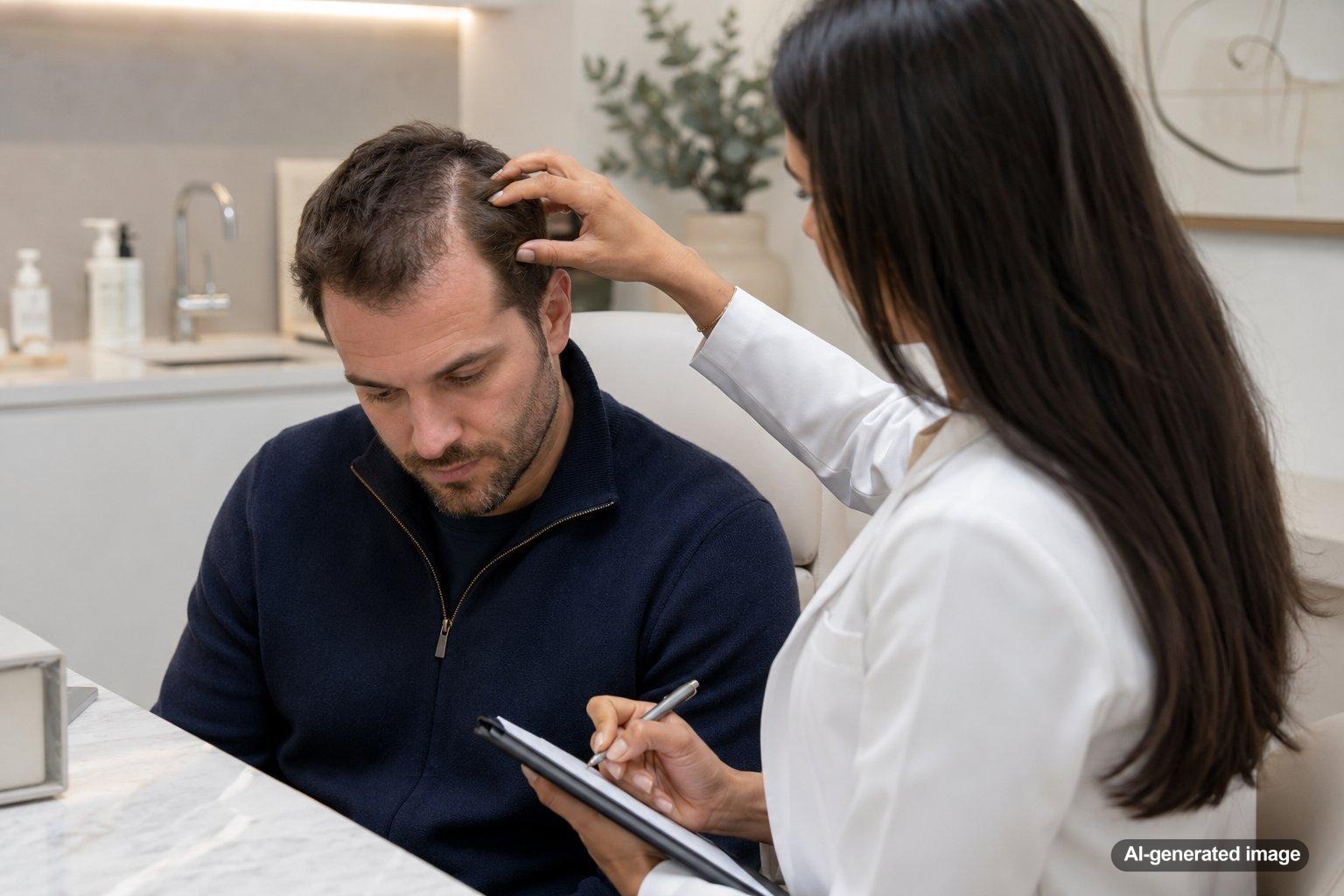
Hair falling out in patches can feel unsettling, especially when the change seems sudden. Patchy hair loss can happen for several reasons, including immune-related hair loss, irritation, infection, tight hairstyles, inflammation, or less commonly, scarring conditions that affect the hair follicle.
The important first step is not to panic or self-diagnose. A dermatologist can look closely at the scalp, review the pattern of hair loss, check for scaling or inflammation, and help determine what type of evaluation or treatment may be appropriate.
Quick answer
- Round or oval smooth patches can be associated with alopecia areata, an immune-mediated form of hair loss.
- Scaling, itching, tenderness, pustules, or broken hairs may point toward inflammation, infection, irritation, or breakage.
- Tight hairstyles, extensions, harsh styling, or repeated pulling can contribute to patchy thinning around high-tension areas.
- Sudden, spreading, painful, or scarring-looking hair loss should be checked promptly by a dermatologist.
- At-home care should focus on gentle scalp and hair habits while you arrange a proper evaluation.
What patchy hair loss can look like
Patchy hair loss means hair is missing in one or more defined areas rather than thinning evenly across the scalp. Some patches are smooth and round. Others may look flaky, red, tender, irritated, shiny, or broken off close to the scalp.
The pattern matters. A single smooth patch is different from multiple spreading patches, hair loss with scaling, hair loss along the hairline from tension, or areas where the scalp looks scarred. Those details help your dermatologist narrow the possibilities.
Common causes or triggers
- Alopecia areata: This immune-mediated condition can cause sudden round or oval patches of hair loss on the scalp, beard, eyebrows, or other hair-bearing areas.
- Scalp infection: Certain fungal or inflammatory scalp conditions can cause patchy loss, especially when there is scaling, itching, tenderness, swelling, or broken hairs.
- Traction: Tight ponytails, braids, buns, extensions, or repeated tension can stress follicles, especially around the hairline, temples, or part line.
- Inflammatory scalp conditions: Psoriasis, eczema-like irritation, seborrheic dermatitis, or allergic reactions may contribute to shedding or breakage when the scalp is inflamed.
- Breakage from styling or chemicals: Heat tools, bleaching, relaxers, tight brushing, or harsh treatments may make hair snap in sections, which can look like patchy loss.
- Scarring forms of hair loss: Some inflammatory conditions can damage follicles over time. Early evaluation is important because these may need medical attention.
What you can do at home
While waiting for an appointment, keep your routine simple and gentle. Avoid tight hairstyles, heavy extensions, aggressive brushing, scratching, and harsh chemical or heat styling on the affected area. Use a mild shampoo, avoid picking at flakes or scabs, and take photos every week in similar lighting so your dermatologist can see whether the area is changing.
It is also wise to avoid starting multiple hair growth products at once before you are evaluated. That can irritate the scalp or make it harder to tell what is helping, what is causing irritation, and what the original problem looked like.
Professional options
A dermatologist may examine the scalp closely, ask about timing and triggers, review medical history and medications, and sometimes recommend lab work, a fungal test, or a small scalp biopsy if the diagnosis is not clear. Treatment depends on the cause and may include prescription topical medications, injections, oral medications, antifungal treatment, anti-inflammatory care, or changes to hair practices.
For some patients with hair loss concerns, regenerative options may also be discussed as part of a broader plan. At Waverly DermSpa, we offer PRFM for Hair Loss and can help you understand whether it may be appropriate.
When to see a dermatologist
Patchy hair loss deserves a dermatology evaluation, especially if it is new, spreading, recurring, or emotionally distressing. It is worth scheduling sooner if you notice redness, pain, burning, itching, scaling, pus, crusting, shiny skin, loss of follicle openings, eyebrow or eyelash loss, or hair loss in a child.
You should also seek care promptly if the patch appeared after a new medication, illness, major stressor, chemical service, or tight hairstyle, or if you are unsure whether the hair is shedding from the root or breaking along the shaft.
FAQ
Is patchy hair loss always alopecia areata?
No. Alopecia areata is one common reason for smooth round patches, but patchy hair loss can also be related to infection, traction, inflammation, breakage, or scarring conditions. A dermatologist can evaluate the pattern and scalp changes.
Can hair grow back after patchy hair loss?
It depends on the cause. Some types of patchy hair loss may improve, while others require treatment or ongoing management. Conditions that scar the follicle need timely evaluation because regrowth may be limited if follicles are damaged.
Should I use over-the-counter hair growth products right away?
It is better to be cautious. Some products may irritate the scalp or may not address the cause of patchy loss. A dermatologist can help you decide what fits your specific situation.
Is patchy hair loss contagious?
Some causes are not contagious, including alopecia areata. Certain infections can spread, which is one reason scaling, itching, broken hairs, or tender patches should be evaluated rather than ignored.
What should I bring to my appointment?
Bring a list of medications and supplements, recent illnesses or stressors, hair styling practices, chemical treatments, family history of hair loss or autoimmune conditions, and photos showing when the patch first appeared.
Ready to get help?
Schedule an appointment or send a message and our team will get back to you.
Prefer to call? 954-666-3736
Disclaimer
This article is for educational purposes and is not medical advice. For diagnosis and personalized treatment, please book an appointment with a board-certified dermatologist.
Sources & further reading
- American Academy of Dermatology (AAD) – Hair loss types: Alopecia areata overview
- National Alopecia Areata Foundation – Understanding Alopecia Areata
- Cleveland Clinic – Alopecia Areata: Symptoms, Causes, Treatment & Regrowth
