

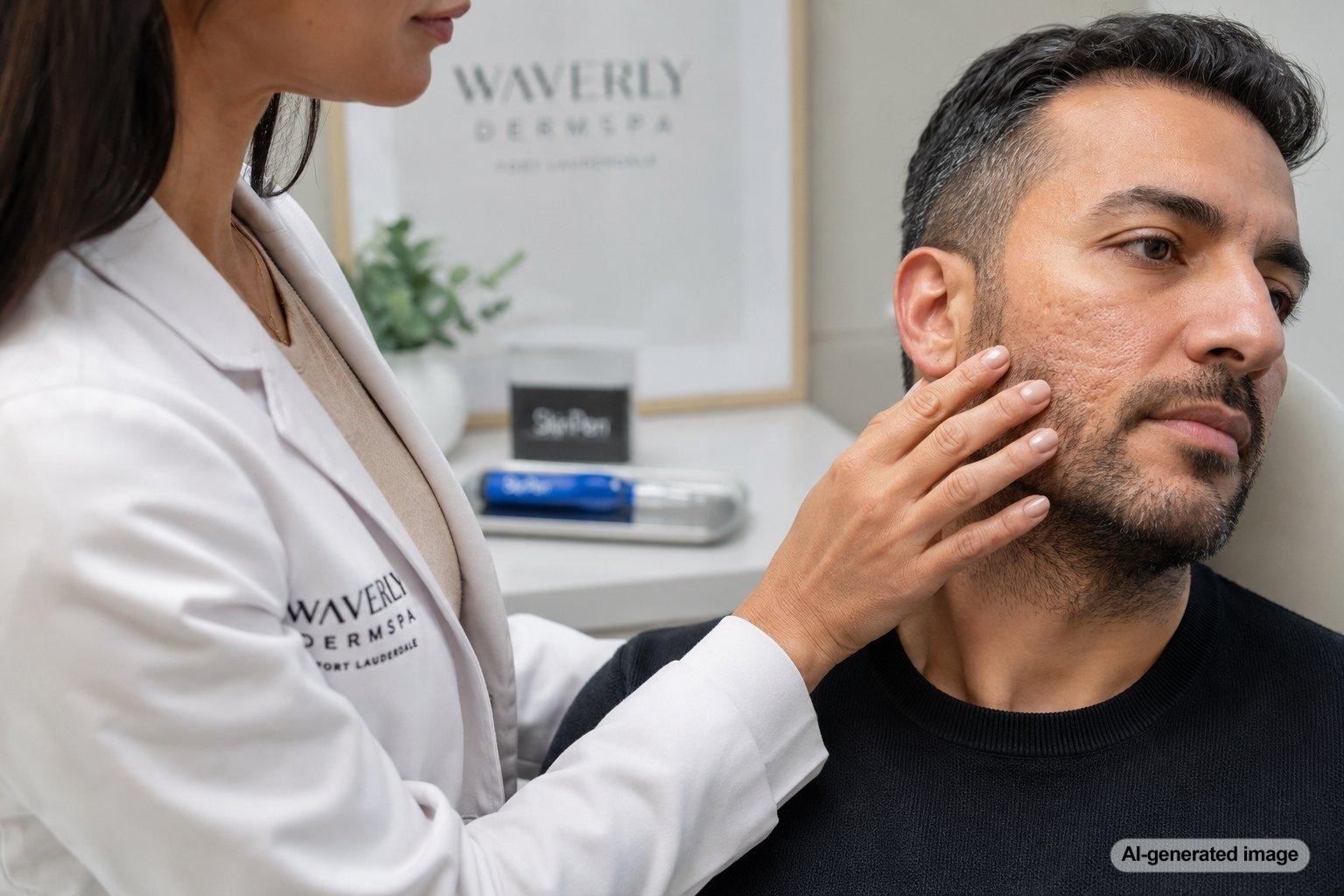
Deep boxcar acne scars commonly require a series of SkinPen treatments rather than a single session. Many treatment plans begin with about three to six sessions, but deeper, sharply defined scars may need additional care or a combination of procedures. The right number depends on scar depth, skin type, healing response, treatment intensity, and your goals.
A dermatologist should examine the scars before recommending a plan. Some depressions that look like boxcar scars may respond well to microneedling, while others may benefit from treatments that address deeper scar edges or tethering.
Quick answer
- Many SkinPen plans involve approximately three to six sessions.
- Deep boxcar scars may require more sessions than mild, shallow scars.
- Treatments are typically spaced apart to allow the skin time to heal and remodel.
- Progress is gradual, and individual responses vary.
- Combination treatment may be considered when microneedling alone is unlikely to address every scar.
Why deep boxcar scars can take longer to treat
Boxcar scars are broad, depressed acne scars with relatively defined edges. Shallow boxcar scars may soften with collagen-stimulating treatments, while deeper scars can be more resistant because the depression extends farther into the skin.
SkinPen creates controlled microchannels that support the skin’s natural repair response. Collagen remodeling develops gradually, so improvement is usually evaluated across a treatment series rather than immediately after one appointment.
What determines the number of SkinPen sessions?
- Scar depth: Deeper depressions often require a longer or more customized treatment plan.
- Scar pattern: A few isolated scars may be approached differently from widespread textural scarring.
- Skin characteristics: Skin tone, sensitivity, thickness, and tendency toward discoloration can influence treatment settings and spacing.
- Healing response: Collagen remodeling varies from person to person.
- Previous treatments: Prior microneedling, peels, lasers, fillers, or scar procedures may affect the next step.
- Desired degree of improvement: Some patients want subtle softening, while others are interested in a more comprehensive scar plan.
How treatments are usually spaced
SkinPen sessions are generally separated by several weeks so redness can settle and the skin can move through its repair process. Your clinician may adjust the interval based on treatment depth, recovery, skin sensitivity, and how your skin responds.
Because collagen development continues between appointments, judging the final value of a treatment series too early can be misleading. Follow-up photographs taken under consistent lighting may help your clinician evaluate gradual changes in texture and shadowing.
Can SkinPen treat deep boxcar scars by itself?
SkinPen may help soften texture and make some boxcar scars less noticeable, but deep scars do not always respond fully to microneedling alone. A dermatologist may discuss a combination plan when different scars have different depths or structures.
Common professional options may include targeted scar procedures, resurfacing treatments, chemical peels, injectable approaches, or other collagen-stimulating treatments. The appropriate choice depends on the scar type, skin tone, medical history, downtime preferences, and risk of post-inflammatory discoloration.
What to expect during a SkinPen series
A typical appointment includes cleansing, preparation of the treatment area, microneedling, and post-procedure instructions. Temporary redness, warmth, tightness, dryness, or mild swelling can occur. Your clinician will explain which skincare products to pause and when you can resume your usual routine.
Gentle cleansing, moisturizer, sun protection, and avoiding unnecessary irritation are commonly emphasized after treatment. Do not pick, scrub, exfoliate, or apply strong active ingredients unless your clinician says they are appropriate.
When to see a dermatologist
Schedule an evaluation if your scars are deep, changing, associated with active acne, or causing significant distress. It is also helpful to see a dermatologist if you have a history of keloids, delayed healing, frequent cold sores, pigment changes after inflammation, or a medical condition that may affect recovery.
A dermatologist can confirm the scar pattern, distinguish boxcar scars from rolling or ice-pick scars, and explain which procedures may be appropriate for your skin.
Frequently asked questions
Is one SkinPen session enough for deep boxcar scars?
One session may begin the remodeling process, but deep boxcar scars commonly require a series. The number cannot be determined accurately without examining the scars and monitoring how the skin responds.
How soon will I notice a change?
Some people notice early textural changes as the skin recovers, but collagen remodeling is gradual. Timing and degree of improvement vary, and results cannot be guaranteed.
Will additional sessions always create more improvement?
Not necessarily. Your clinician should reassess progress throughout the series. If improvement plateaus, a different technique or combination approach may be more appropriate than repeating the same treatment indefinitely.
Can SkinPen be used on darker skin tones?
Microneedling may be considered for a range of skin tones, but settings, preparation, and aftercare should be personalized. A dermatologist can evaluate the risk of irritation and post-inflammatory hyperpigmentation.
Should active acne be treated first?
Active inflamed acne often needs to be addressed before scar-focused procedures. Treating ongoing breakouts may help reduce the chance of developing additional scars.
At Waverly DermSpa, we offer SkinPen and can help you understand whether it may be appropriate.
Ready to get help?
Schedule an appointment or send a message and our team will get back to you.
Prefer to call? 954-666-3736
This article is for educational purposes and is not medical advice. For diagnosis and personalized treatment, please book an appointment with a board-certified dermatologist.
