

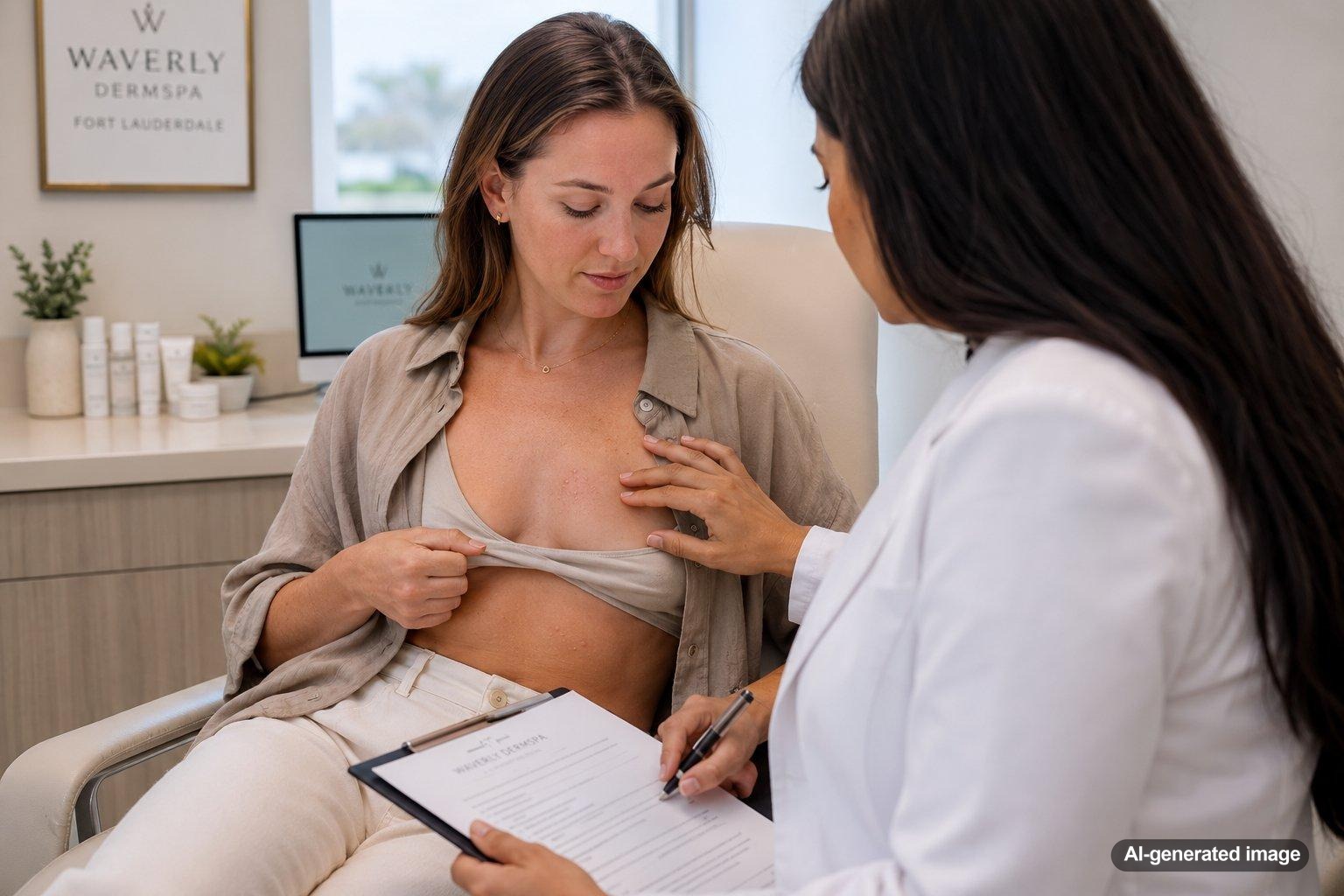
A group of smooth, shiny, or waxy-looking bumps on the chest or abdomen may have several possible explanations. One condition a dermatologist may consider is steatocystoma multiplex, which causes multiple cysts connected to the skin’s oil gland and hair follicle units.
These bumps are often skin-colored or yellowish, grow slowly, and cause few symptoms unless they become inflamed. Their appearance can overlap with acne, epidermoid cysts, eruptive vellus hair cysts, and other skin growths, so an in-person examination is important before deciding what they are or how to manage them.
Quick answer
- Steatocystoma multiplex can cause clusters of smooth, round, skin-colored, yellowish, or semi-translucent bumps.
- The chest and abdomen are common locations, although the bumps can also appear on the arms, underarms, face, thighs, or other areas.
- The cysts are typically benign and are not caused by poor hygiene.
- Some cases run in families, while others occur without a known family history.
- A dermatologist can distinguish these cysts from acne and other growths and discuss whether observation or treatment is appropriate.
What is steatocystoma multiplex?
Steatocystoma multiplex is a condition involving multiple cysts that form around the junction between a hair follicle and a sebaceous, or oil-producing, gland. A single lesion is known as steatocystoma simplex. When numerous lesions develop, the condition is called steatocystoma multiplex.
The cysts can feel soft, rubbery, or firm beneath the skin. They are often smooth and mobile, and some have a faint yellow or translucent quality because they contain oily material. Unlike a typical pimple, a steatocystoma usually does not have an obvious inflamed whitehead. A central opening may be absent or difficult to see.
Many people first notice the bumps during adolescence or early adulthood, although they can become apparent at other ages. The number and distribution of cysts vary considerably. Some people have a small, localized cluster, while others develop lesions across several body areas.
Why do these bumps develop?
The bumps are thought to result from an abnormality in the lining of the channel associated with the skin’s oil glands. This allows a cystic structure containing oily material to form beneath the surface.
Possible contributing patterns include:
- Inherited changes: Familial cases can be associated with changes involving the keratin 17 gene. A parent or another relative may have similar bumps, although their symptoms may be milder or more extensive.
- Sporadic development: Many people have no known family history. In these cases, the condition appears without a clear inherited pattern.
- Hormonal activity: The tendency for lesions to become noticeable around puberty may relate to increased activity within hair follicles and sebaceous glands.
- Inflammation: Friction, pressure, or disruption of a cyst may cause tenderness, redness, drainage, or scarring. This does not happen in every case.
Steatocystoma multiplex is not a sign that the skin is dirty. Scrubbing harder, using harsh cleansers, or repeatedly applying acne products will not remove the cyst wall and may irritate the surrounding skin.
How can the bumps look and feel?
Common features can include multiple round or oval bumps that are:
- Skin-colored, cream-colored, or yellowish
- Smooth, shiny, waxy, or semi-translucent
- Soft to firm when touched
- Freely movable or slightly tethered beneath the skin
- Usually painless when not inflamed
- Slow-growing and persistent
The chest is a classic location, and the abdomen may also be involved. Lesions can appear on the upper arms, underarms, neck, face, thighs, scalp, groin, or genital skin. Their size may range from tiny bumps to more noticeable nodules.
When a cyst becomes inflamed, it may turn red, feel sore, rupture, or release an oily yellow material. Repeated inflammation can leave dark marks or scars, particularly if lesions are squeezed or picked.
What else can resemble steatocystoma multiplex?
Several skin conditions can create a group of similar-looking bumps. A dermatologist may consider:
- Epidermoid cysts: These often contain thicker keratin material and may have a visible central opening.
- Eruptive vellus hair cysts: These are small follicular cysts that may look very similar but contain fine hairs and keratin rather than predominantly oily material.
- Acne nodules or closed comedones: Acne is more likely to include blackheads, whiteheads, redness, or a mixture of different lesion types.
- Milia: These are usually tiny, firm, white keratin cysts close to the skin’s surface.
- Hidradenitis suppurativa: This inflammatory condition can cause painful, recurring nodules, drainage, tunnels, and scars, especially in skin folds.
- Other benign growths: Lipomas, follicular growths, and additional cyst types can occasionally produce a similar appearance.
Because visual clues can overlap, photographs and online descriptions are not enough to confirm the diagnosis.
How does a dermatologist evaluate the bumps?
Your dermatologist will usually begin by asking when the bumps appeared, whether they have changed, and whether anyone in your family has similar lesions. The examination may focus on their color, texture, mobility, distribution, and signs of inflammation.
In some cases, the clinical pattern is distinctive. When the diagnosis remains uncertain, a dermatologist may recommend sampling or removing one lesion for examination under a microscope. This can help distinguish steatocystoma from other cysts and growths that require a different approach.
It is helpful to mention episodes of pain, drainage, odor, rapid enlargement, or scarring. You should also tell your dermatologist about changes involving the nails, palms, soles, teeth, or hair, since uncommon inherited conditions can occasionally include additional findings.
What can you do at home?
Home care cannot remove the cyst lining, but gentle habits may reduce irritation and lower the chance of avoidable inflammation:
- Do not squeeze, puncture, cut, or attempt to drain the bumps yourself.
- Wash with a mild cleanser and avoid aggressive scrubs or picking tools.
- Reduce repeated friction from tight clothing, backpack straps, or athletic equipment when possible.
- Choose non-irritating skin products if the surrounding area becomes sensitive.
- Use a warm, clean compress for brief comfort when a bump is mildly tender, without pressing or trying to express its contents.
- Schedule an evaluation if lesions repeatedly become red, painful, or draining.
Strong acne treatments, acids, and abrasive exfoliation may irritate the surface without addressing a deeper cyst. Ask a dermatologist before applying prescription products or combining several active ingredients over the affected area.
What professional options may be considered?
Treatment is not always medically necessary. Some people prefer observation when the cysts are stable and comfortable. Others seek treatment because of inflammation, scarring, drainage, clothing friction, or concern about appearance.
Professional options depend on the number, size, location, and behavior of the lesions. They may include:
- Small-incision removal: A clinician creates a small opening and carefully removes the cyst contents and lining.
- Surgical excision: Complete excision may be considered for an isolated, larger, or firmly attached lesion.
- Laser or electrosurgical approaches: These methods may help address multiple lesions in selected cases.
- Cryotherapy: Controlled freezing is sometimes considered, although pigment changes or scarring may be concerns.
- Medication for inflammation: A dermatologist may discuss oral or topical treatment when lesions are inflamed or when secondary infection is suspected.
No single approach is ideal for every person. Removing many cysts can require more than one session, and new lesions may still develop in untreated areas. Your dermatologist can explain expected benefits, healing considerations, recurrence, pigment changes, and scarring risk based on your skin and the selected method.
When should you see a dermatologist?
Arrange an examination when you have a new cluster of unexplained bumps, especially if the number is increasing or the diagnosis is uncertain. More prompt attention is appropriate when a lesion:
- Becomes painful, hot, swollen, or increasingly red
- Drains repeatedly or develops an unpleasant odor
- Grows rapidly or looks different from the surrounding bumps
- Bleeds without a clear injury
- Leaves repeated scars or dark marks
- Interferes with movement, clothing, exercise, or daily comfort
These changes do not automatically indicate a serious condition, but they are reasons to have the area assessed rather than attempting treatment at home.
Frequently asked questions
Is steatocystoma multiplex contagious?
No. It is not an infection and does not spread through touching, shared towels, swimming pools, or close contact.
Are the bumps caused by oily skin?
Not simply. The cysts involve structures connected to sebaceous glands, but ordinary oily skin, sweating, or an inconsistent skincare routine does not by itself explain the condition.
Can steatocystoma multiplex be mistaken for acne?
Yes. Inflamed cysts can resemble acne nodules, while smaller lesions may look like closed comedones. The absence of typical blackheads and whiteheads, the smooth uniform appearance, and the long-term pattern may provide clues, but an examination is needed for confirmation.
Should I pop a steatocystoma?
No. Squeezing or puncturing a cyst may cause inflammation, infection, pigment changes, and scarring. Even if oily material comes out, the cyst lining may remain beneath the skin.
Can the bumps go away without treatment?
Individual lesions commonly persist. They may remain stable for long periods, and some never cause symptoms. A dermatologist can help you decide whether monitoring or professional treatment better fits your concerns.
Does every bump need to be removed?
No. Treatment can be focused on lesions that are painful, repeatedly inflamed, cosmetically bothersome, or located where friction is a problem. The decision is individualized.
Ready to get help?
Schedule an appointment or send a message and our team will get back to you.
Prefer to call? 954-666-3736
This article is for educational purposes and is not medical advice. For diagnosis and personalized treatment, please book an appointment with a board-certified dermatologist.
