

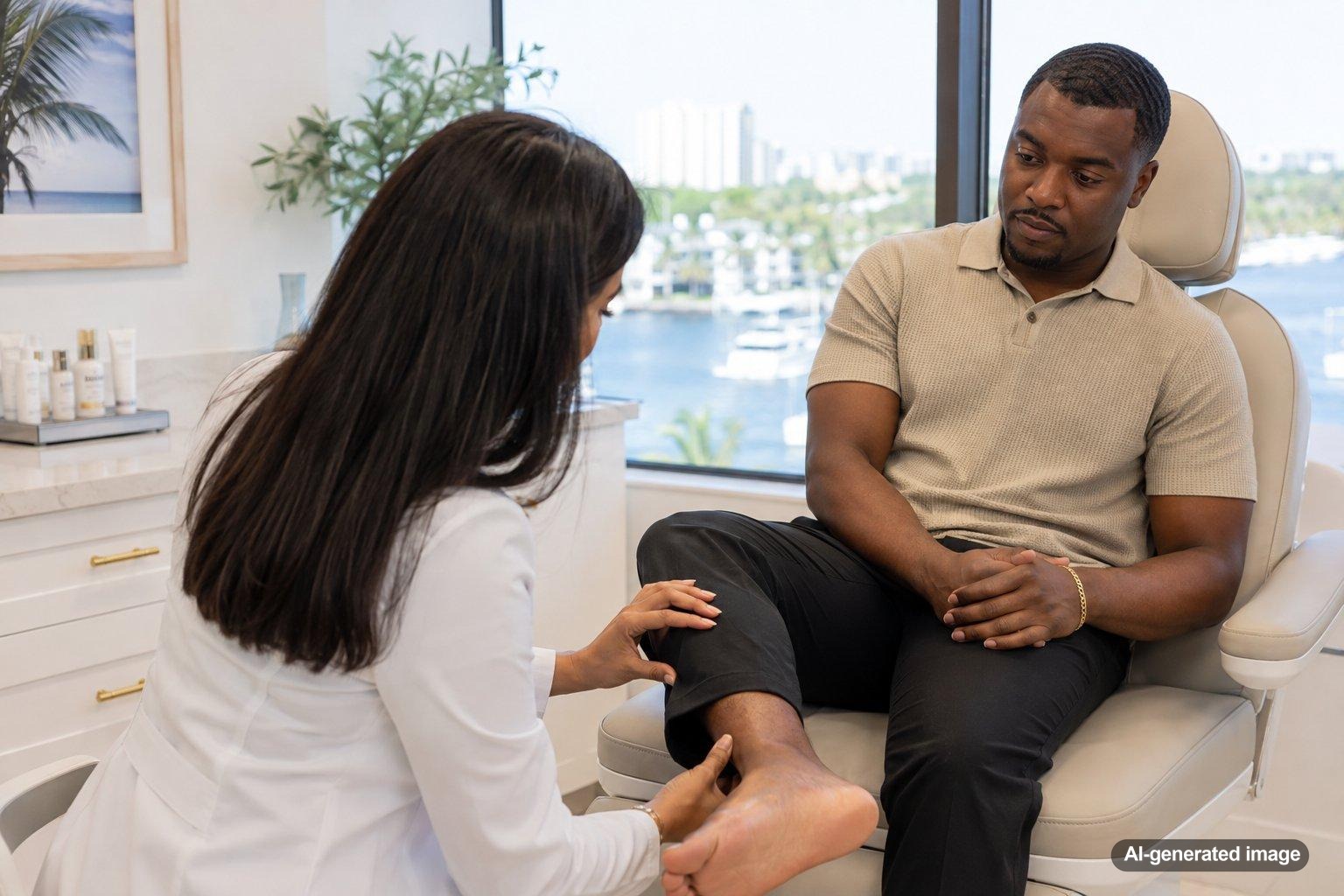
A rough, firm, warty-looking bump on the heel can become surprisingly painful, especially when shoes rub against it or pressure lands directly on the area. One possible explanation is porokeratosis plantaris discreta, a small, sharply defined area of thickened skin that may be tender with pressure. However, several different skin problems can look similar, so appearance alone is not enough to identify the cause.
A dermatologist can examine the spot, consider other possibilities such as a corn, callus, wart-like growth, or another keratotic lesion, and recommend an appropriate next step based on what the area actually is.
Quick answer
- Porokeratosis plantaris discreta may appear as a small, round, firm area of thickened skin that can hurt when pressure is applied.
- It can be confused with other common heel lesions because several conditions can look rough, hard, or warty.
- Repeated friction and pressure may make discomfort more noticeable.
- Do not cut, dig, or aggressively file a painful heel growth at home.
- If the spot is persistent, changing, bleeding, or increasingly painful, a dermatologist can evaluate it.
What is porokeratosis plantaris discreta?
Porokeratosis plantaris discreta is a term used for a small, localized keratotic lesion that most often develops on a weight-bearing area of the foot. It can feel like a tiny hard plug or sharply defined callused spot. Some people describe significant tenderness when standing, walking, or pressing directly on it.
The appearance can be subtle. A lesion may be only a few millimeters across yet still be uncomfortable because pressure is concentrated over a very small area. Despite the name, a dermatologist still needs to assess a suspicious or persistent heel bump rather than assuming the diagnosis based on texture or location.
Why can a rough heel bump hurt?
Heel skin regularly handles pressure, friction, heat, moisture, and repeated contact with footwear. When a small area becomes unusually thick or develops a dense central core, normal pressure can become focused on that spot. This can make walking, exercise, or certain shoes uncomfortable.
Common factors that may aggravate a painful thickened area include:
- Repeated rubbing from shoes or sandals
- Standing or walking for long periods
- Pressure concentrated on one part of the heel
- Dry, thickened skin around the lesion
- Picking, shaving, or filing the area too aggressively
What else can look like porokeratosis plantaris discreta?
Several skin findings can create a rough or warty-looking bump on the heel. A dermatologist may consider a corn, callus, wart-like lesion, another form of localized keratosis, or a different skin growth depending on the location, surface pattern, tenderness, and how the lesion has changed over time.
This overlap is one reason self-treatment can be frustrating. A product intended for one type of lesion may irritate another, and repeated scraping can alter the surface enough to make the area harder to assess.
What can you do at home?
Until the area has been evaluated, conservative care is usually the safest approach. The goal is to reduce irritation rather than aggressively remove the bump.
- Choose shoes that do not rub directly against the painful area.
- Consider soft cushioning or heel padding to reduce localized pressure.
- Keep dry, thickened skin moisturized with a simple fragrance-free moisturizer.
- Avoid cutting the lesion with scissors, blades, or nail tools.
- Avoid repeatedly digging at a central core or trying to pull the growth out.
- Stop any home treatment that causes significant burning, bleeding, or worsening pain.
If you have reduced sensation in your feet, poor circulation, or another condition that makes foot wounds harder to notice or heal, it is especially important to speak with your clinician before attempting home removal techniques.
How can a dermatologist evaluate a painful heel bump?
A dermatologist can inspect the lesion closely and evaluate features that may help distinguish one type of thickened growth from another. The surrounding skin, distribution, tenderness pattern, and surface details can all provide useful clues.
Depending on the findings, professional options may include careful removal of excess keratin, pressure-reducing strategies, topical therapies, or other office-based approaches. If the appearance is unusual or the diagnosis remains uncertain, your clinician can decide whether additional evaluation is appropriate. Treatment varies because the correct approach depends on what the lesion actually represents.
When should you see a dermatologist?
It is worth getting a painful heel bump checked when it does not improve with simple pressure reduction or when you are unsure what it is. Schedule an evaluation sooner if the lesion:
- Is becoming larger or changing in appearance
- Bleeds without an obvious reason
- Develops an open sore or drainage
- Becomes increasingly painful
- Returns quickly after repeated home removal
- Has an unusual color, border, or surface
- Interferes with walking or normal footwear
A professional evaluation can also help prevent repeated cycles of filing, cutting, and irritation when the underlying diagnosis is uncertain.
FAQ
Is porokeratosis plantaris discreta the same as a wart?
No. They are different types of skin findings, although they can sometimes look similar to a non-specialist. A dermatologist can examine the lesion and help distinguish between possible causes.
Can porokeratosis plantaris discreta feel like a pebble in my shoe?
It can. A very small area of dense, thickened skin may concentrate pressure enough to create a sharp or pebble-like sensation when standing or walking.
Should I cut a painful heel bump off myself?
No. Cutting or digging into a heel lesion can cause bleeding, irritation, and injury. It may also make the area more difficult to evaluate. Conservative cushioning is a safer option while you arrange an assessment.
Why does the bump hurt more in certain shoes?
Shoes with stiff heel counters, tight edges, or pressure points can place extra force directly over the lesion. Changing footwear or using cushioning may reduce irritation, although persistent pain still deserves evaluation.
Can a dermatologist remove the hard center?
In some cases, carefully reducing excess keratin may be part of professional management. Whether that is appropriate depends on the diagnosis, the location, your skin, and other health considerations.
What if the bump keeps coming back?
Recurring thickened skin may reflect ongoing pressure, friction, or a lesion that has not been correctly identified. A dermatologist can reassess the area and help you decide on the next step.
Ready to get help?
Schedule an appointment or send a message and our team will get back to you.
Prefer to call? 954-666-3736
This article is for educational purposes and is not medical advice. For diagnosis and personalized treatment, please book an appointment with a board-certified dermatologist.
