

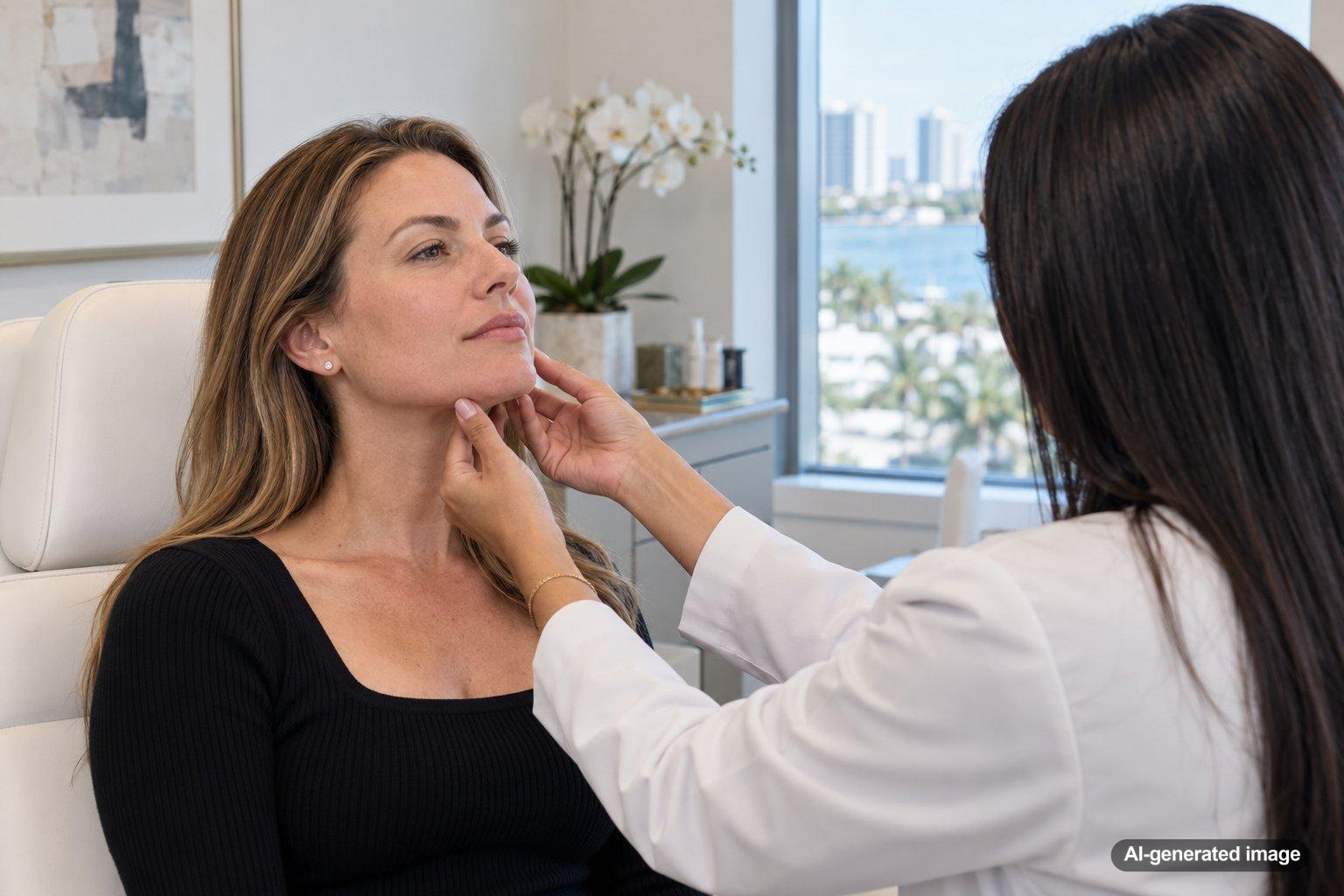
Changes along the jawline can be subtle at first. A once-crisp transition between the lower face and neck may look softer as facial volume, skin support, and tissue position change over time. For women with mild laxity, Radiesse may be considered as part of a personalized approach to creating more visible structure along selected areas of the jawline.
Radiesse is an injectable treatment that requires careful assessment because adding volume is not the right solution for every type of lower-face change. A dermatologist can evaluate facial proportions, skin quality, tissue laxity, and bone structure before recommending whether Radiesse or another approach makes sense.
Quick answer
- Radiesse may be used to add structural support and improve the appearance of jawline definition in appropriately selected patients.
- It tends to make the most sense when mild laxity is accompanied by a loss of contour or support rather than significant loose skin.
- Placement, depth, amount, and overall facial balance are important considerations.
- Results vary, and injectable treatment cannot reproduce the effects of surgery for more advanced tissue laxity.
- A dermatologist can determine whether Radiesse fits your anatomy and cosmetic goals.
What Radiesse is
Radiesse is an injectable filler made with calcium hydroxylapatite microspheres suspended in a gel carrier. In aesthetic treatment, it may be used in selected areas where additional structural support or contour is desired. Its physical characteristics are different from those of many hyaluronic acid fillers, which is one reason product selection should be based on the treatment area and the individual patient’s anatomy.
For jawline treatment, the goal is generally not to make the lower face look fuller everywhere. Instead, a clinician may consider strategic placement to reinforce portions of the jawline where definition has softened. The treatment plan can vary substantially from one person to another.
Why mild laxity can soften the jawline
A less defined jawline is rarely caused by one factor alone. Several age-related and anatomical changes may contribute at the same time.
- Changes in facial support: Shifts in underlying bone, fat, and soft tissue can affect the shape of the lower face.
- Skin laxity: Skin may become less firm and may drape differently along the jaw.
- Volume changes: Loss or redistribution of facial volume can reduce visible definition.
- Natural anatomy: Some people have a softer jawline because of their inherited facial structure rather than aging alone.
- Changes beneath the chin: Fullness under the chin or changes in neck contour can influence how sharply the jawline appears.
Because these factors can overlap, adding filler without first identifying the main reason for the softened contour can produce an unbalanced result. Evaluation is an important part of treatment planning.
How Radiesse may help with jawline definition
In a woman with mild laxity and an appropriate facial structure, Radiesse may help emphasize selected points along the lower face by adding support and contour. Depending on the treatment plan, attention may be directed toward areas such as the back of the jaw, the jawline itself, or transitions where definition has become less distinct.
The objective is usually proportional improvement rather than simply adding more product. A thoughtful plan considers the jawline in relation to the chin, cheeks, neck, and overall facial shape. Creating too much width or volume in the wrong location can change facial proportions in ways that may not match the patient’s goals.
What Radiesse cannot address by itself
Injectable contouring has limitations. If the dominant concern is substantial loose skin, pronounced jowling, significant neck laxity, or another structural issue, filler alone may not provide the type of change a patient is seeking.
There are also situations in which adding volume near the lower face could make heaviness look more noticeable rather than improving definition. This is why a dermatologist may recommend a different strategy, a combination approach, or no filler at all after examining the area.
What happens during a consultation
A jawline consultation should involve more than looking at one isolated area. Your clinician may assess your face from the front, side, and angled views while considering how the skin and underlying tissues move naturally.
Topics worth discussing include:
- Which part of the jawline bothers you most
- Whether your concern is primarily laxity, volume loss, shape, or a combination
- How much change you would consider natural-looking
- Whether other areas, such as the chin, influence the appearance of the jawline
- Your previous injectable treatments and relevant medical history
- The expected limitations, possible risks, and aftercare associated with the proposed treatment
Photos from a few years earlier can sometimes help communicate how your facial contours have changed, although treatment should still be based on your current anatomy rather than an attempt to recreate an earlier face exactly.
What to do before and after treatment
Before treatment, give your clinician an accurate history of medications, supplements, allergies, prior cosmetic procedures, and any previous reactions to injectable treatments. Do not stop prescribed medication unless the clinician who manages that medication tells you to do so.
After treatment, follow the specific instructions provided by your treating clinician. Temporary swelling, tenderness, redness, or bruising can occur after injectable procedures. Your clinician should explain which reactions are expected and which symptoms require prompt medical attention.
When to see a dermatologist
If you are considering an injectable for jawline definition, a dermatologist can evaluate whether your concern is primarily related to skin laxity, facial structure, volume changes, or another factor. This assessment can help determine whether injectable treatment is reasonable and which approach may be most appropriate.
You should also contact your treating medical professional promptly if you develop an unexpected or concerning reaction after any injectable procedure. Instructions for urgent concerns should be reviewed with you as part of informed consent before treatment.
Frequently asked questions
Is Radiesse a good option for every woman with a soft jawline?
No single injectable is appropriate for everyone. The appearance of a soft jawline can result from different combinations of anatomy, skin laxity, volume changes, and tissue position. A dermatologist can evaluate the cause before recommending treatment.
Can Radiesse tighten loose skin?
Radiesse is not a surgical skin-tightening procedure. In selected patients, improving underlying support and contour may make the jawline appear more defined, but significant loose skin may require a different treatment strategy.
Will jawline filler make my face look wider?
It can affect facial shape depending on where and how much product is placed. Careful planning is important, particularly for women who want definition without creating excessive width in the lower face.
Is the chin considered when treating the jawline?
Often, yes. Chin projection and shape can influence how the jawline appears from the front and side. Your clinician may assess the chin even if your main concern is the jawline.
How long does Radiesse last in the jawline?
Duration varies among patients and depends on factors such as treatment area, amount used, individual biology, and the treatment plan. Your clinician can discuss realistic expectations based on your situation.
How do I know whether filler or another treatment is more appropriate?
The answer depends on what is causing the change in contour. Mild structural softening may be approached differently from substantial skin laxity, prominent jowling, or fullness beneath the chin. An in-person evaluation helps distinguish among these possibilities.
At Waverly DermSpa, we offer Radiesse and can help you understand whether it may be appropriate.
Ready to get help?
Schedule an appointment or send a message and our team will get back to you.
Prefer to call? 954-666-3736
This article is for educational purposes and is not medical advice. For diagnosis and personalized treatment, please book an appointment with a board-certified dermatologist.
