

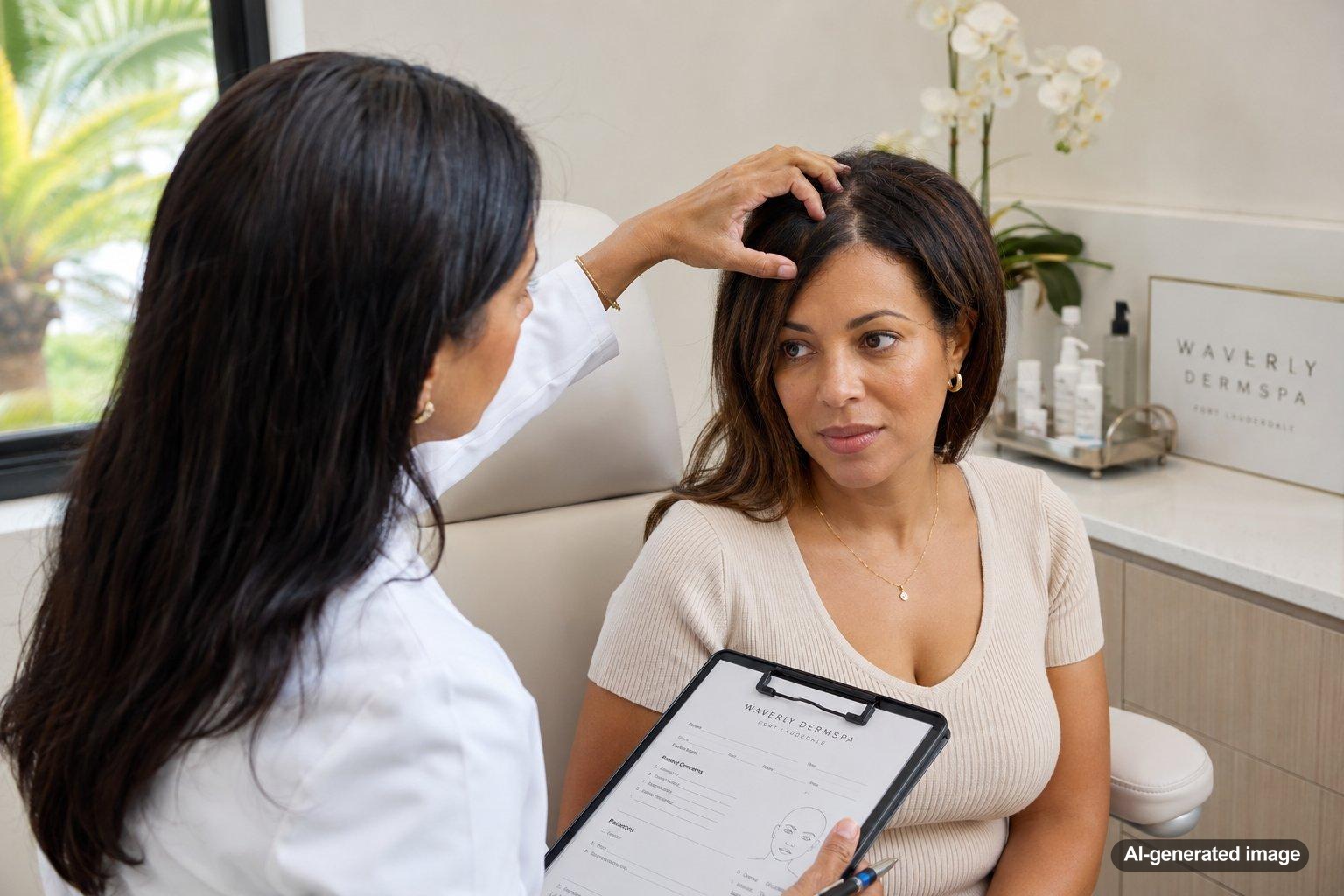
Hair loss within or around a scalp scar can be especially frustrating because the area may look and behave differently from ordinary thinning. Platelet-rich fibrin matrix, commonly called PRFM, may be considered as part of a carefully selected treatment plan, but its potential depends heavily on whether functioning hair follicles remain in the affected area.
PRFM cannot recreate follicles that have been completely replaced by scar tissue. Its role is more likely to involve supporting the surrounding scalp environment, addressing overlapping nonscarring thinning, or complementing other approaches after a dermatologist has identified the cause and extent of the hair loss.
Quick answer
- PRFM is prepared from a patient’s own blood and contains concentrated platelets within a fibrin-based matrix.
- It may help support existing, weakened follicles near a scar, but outcomes vary.
- Completely destroyed follicles generally cannot produce new hair.
- Scar alopecia must be distinguished from active inflammatory hair loss before cosmetic treatment is considered.
- A scalp examination, dermoscopy, and sometimes a biopsy may be needed to determine whether PRFM is appropriate.
What is PRFM?
PRFM is an injectable material created by processing a small blood sample to concentrate platelets and form a fibrin matrix. Platelets release signaling proteins that participate in normal tissue repair. The fibrin structure is intended to hold the platelets within the treated area and allow their contents to be released over time.
PRFM is related to platelet-rich plasma, or PRP, but the preparation process and final consistency are different. Both are autologous treatments, meaning the material comes from the patient’s own blood. These treatments are used in several medical and cosmetic settings, although the quality of evidence and expected benefits differ by condition.
Why scar-related scalp hair loss is different
Hair grows from follicles located within the skin. When inflammation, trauma, burns, surgery, or another process severely damages a follicle, it may be replaced by fibrous scar tissue. A smooth or shiny area with few visible follicular openings may indicate that many follicles have been lost.
This distinction matters because a blood-derived treatment cannot generate entirely new follicles. PRFM may be more relevant when the scar is surrounded by miniaturized or stressed follicles, when some follicles remain within the affected area, or when another treatable form of hair thinning exists nearby.
Scar alopecia versus a surgical scalp scar
Scar alopecia, also called cicatricial alopecia, refers to a group of disorders in which inflammation damages and destroys hair follicles. Some forms may cause itching, tenderness, burning, scaling, redness, or expanding hair loss. Controlling active inflammation is generally the priority because stimulating procedures alone do not address the underlying disease.
A surgical scar forms after an incision, injury repair, tumor removal, hair transplant procedure, or another operation involving the scalp. Hair loss may be limited to the incision line, extend around it because of tension or temporary shedding, or reflect reduced blood supply and direct follicle injury.
A dermatologist should determine which process is present. Treating an active inflammatory alopecia as though it were only a stable cosmetic scar may delay the medical care needed to protect nearby follicles.
When PRFM may be considered
PRFM may be discussed when the scalp condition is stable and an examination suggests that viable follicles remain. Potential treatment goals may include supporting hair density around the scar, improving the appearance of overlapping nonscarring thinning, or preparing the surrounding scalp as part of a broader restoration plan.
A clinician may consider factors such as:
- The age, size, thickness, and location of the scar
- Whether follicular openings are still visible
- Whether hair loss is stable or continuing to expand
- The presence of redness, scaling, tenderness, or other inflammatory signs
- Hair caliber and density around the scar
- Previous surgery, injections, medications, or hair restoration procedures
- Medical conditions and medications that could affect healing or bleeding
Important limitations to understand
PRFM should not be presented as a way to erase a scalp scar or restore every missing hair. Research involving platelet-based treatments is more established for certain nonscarring forms of hair loss than for fully scarred scalp tissue. Evidence specifically involving PRFM for surgical scalp scars and cicatricial alopecia remains limited and continues to evolve.
Results may be subtle, inconsistent, or absent when few functioning follicles remain. Multiple sessions may be discussed, but the number and timing depend on the treatment plan, the scalp diagnosis, and the response over time. A dermatologist can help set realistic expectations before treatment begins.
What an evaluation may include
A careful evaluation usually begins with the history of the scar and hair loss. Your dermatologist may ask when the area developed, whether it has changed, what symptoms are present, and which treatments or surgeries have already been performed.
The scalp may be examined with magnification to look for follicular openings, miniaturized hairs, inflammation, scaling, broken hairs, and the boundaries of the scar. If the diagnosis remains uncertain or an inflammatory form of scarring alopecia is suspected, a scalp biopsy may be recommended before PRFM or another cosmetic procedure is considered.
What you can do at home
Home care cannot restore follicles that have been destroyed, but gentle habits may help reduce unnecessary irritation around a vulnerable scalp area.
- Avoid repeatedly scratching, picking, or rubbing the scar.
- Limit tight hairstyles that place tension on the scar and surrounding hair.
- Use mild hair and scalp products if the area is easily irritated.
- Protect an exposed scalp scar from strong sun with a hat or clinician-recommended sunscreen.
- Take clear photographs under consistent lighting if you are monitoring changes.
- Do not apply harsh acids, essential oils, or at-home needling devices to the scar.
Other professional options
The most appropriate option depends on whether the follicles are active, damaged, or absent. Medical treatment may be necessary when inflammation is present. For a stable surgical scar, options may include camouflage techniques, carefully planned hair transplantation, scalp micropigmentation, laser-based scar care, or surgical scar revision. Some treatment plans combine approaches rather than relying on PRFM alone.
At Waverly DermSpa, we offer PRFM for Hair Loss and can help you understand whether it may be appropriate.
When to see a dermatologist
Arrange a dermatology evaluation if hair loss is expanding, a scalp scar is changing, or the area is painful, itchy, tender, red, crusted, draining, or persistently inflamed. Prompt evaluation is also important when hair loss appears beyond the original incision or when additional patches develop elsewhere on the scalp.
Earlier assessment may help identify active inflammation while nearby follicles can still be protected. It can also prevent time and money from being spent on a procedure that does not match the underlying cause.
Frequently asked questions
Can PRFM grow hair directly through a scalp scar?
It may support follicles that remain within or near the scar, but it cannot be expected to recreate follicles that have been completely destroyed. The amount of viable follicular tissue is a key factor.
Is PRFM appropriate for every form of scarring alopecia?
No. Scarring alopecia includes several conditions with different causes and levels of activity. Active inflammatory disease usually requires diagnosis and medical management before an elective regenerative procedure is considered.
How can a dermatologist tell whether follicles remain?
The dermatologist may examine the area with a dermatoscope, which provides a magnified view of the scalp. A biopsy may be recommended when the diagnosis or level of inflammation is unclear.
Can PRFM remove the scar itself?
PRFM is not a scar-removal procedure. Depending on the scar’s characteristics, other treatments may be considered to address color, texture, thickness, or visibility.
Could hair transplantation be a better option?
Hair transplantation may be considered for some mature, stable scars, but scar tissue can have different blood supply and graft survival characteristics. A hair-loss specialist should evaluate whether transplantation is suitable.
Is there downtime after scalp PRFM?
Temporary tenderness, pinpoint bleeding, swelling, or redness may occur after injections. Your clinician should review expected aftercare and any individual precautions before treatment.
Ready to get help?
Schedule an appointment or send a message and our team will get back to you.
Prefer to call? 954-666-3736
This article is for educational purposes and is not medical advice. For diagnosis and personalized treatment, please book an appointment with a board-certified dermatologist.
Sources & further reading
- American Academy of Dermatology (AAD) – Hair loss: Who gets and causes
- Cleveland Clinic – Platelet-Rich Plasma (PRP Injection): What It Is and Uses
