

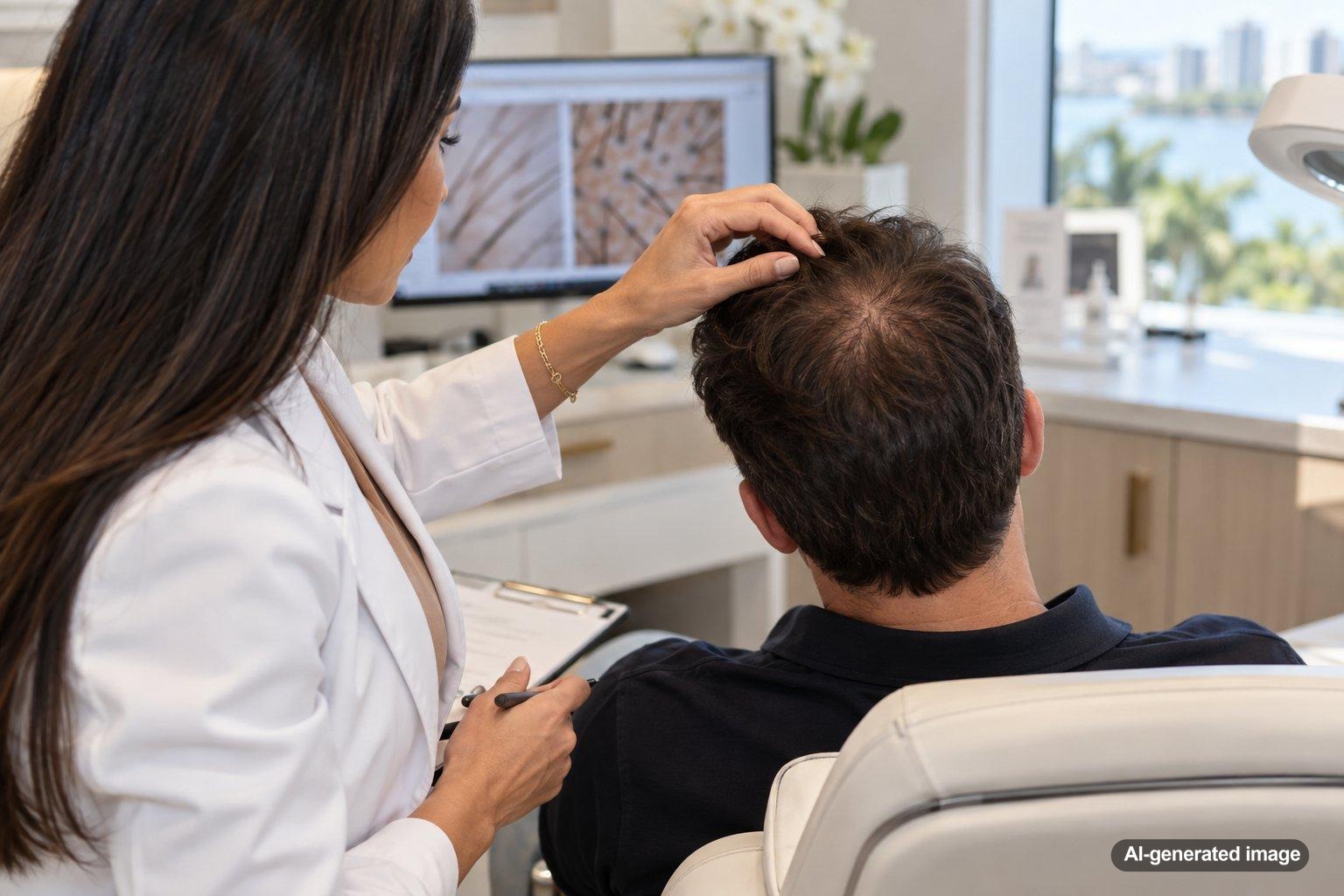
Noticing more scalp showing through at the crown can be frustrating, especially when the change still feels subtle. PRFM, or platelet-rich fibrin matrix, is one office-based option that may be considered for some men with early thinning. It uses a preparation made from your own blood and is placed into targeted areas of the scalp, but whether it makes sense depends on the cause, pattern, and stage of the hair loss.
A dermatologist can examine the scalp, review your history, and help determine whether PRFM fits into a broader hair-loss plan rather than treating crown thinning as a one-size-fits-all problem.
Quick answer
- PRFM is an autologous treatment, meaning the material is prepared from your own blood.
- It may be considered for some men with early patterned thinning, including changes at the crown.
- Results vary, and PRFM is not appropriate for every cause of hair loss.
- A dermatologist should evaluate new or progressive thinning before a treatment plan is chosen.
- Hair-loss care may involve more than one approach depending on your diagnosis, goals, and medical history.
What PRFM is
PRFM stands for platelet-rich fibrin matrix. A small blood sample is processed so that a concentrated portion containing platelets and a fibrin matrix can be prepared for use on the scalp. The goal is to place this material into areas of thinning where it may support the local environment around existing hair follicles.
Because the preparation comes from your own blood, PRFM is different from a synthetic filler or transplanted hair. It also does not create new follicles. The practical question is whether the follicles in the thinning area are still present and whether your particular type of hair loss may respond to this kind of treatment.
Why early crown thinning deserves an evaluation
Crown thinning in men is often associated with patterned hair loss, but appearance alone does not establish the cause. A widening area of visible scalp can also be influenced by shedding, scalp inflammation, nutritional issues, medications, illness, stress, or other conditions.
An evaluation is especially useful when thinning seems sudden, patchy, accompanied by itching or scaling, or noticeably different from the gradual pattern you expected. Identifying the likely cause helps avoid spending time on a procedure that may not match the underlying problem.
Who might consider PRFM
PRFM may be discussed when a man has relatively early thinning and still has existing hairs throughout the affected crown. It can be more difficult to influence areas where follicles have been inactive for a long time or where the scalp is already extensively bare.
Your clinician may also consider factors such as how quickly the thinning is progressing, whether other scalp symptoms are present, previous treatments, medical history, and your expectations. A consultation is the appropriate setting to decide whether PRFM is reasonable for your situation.
What happens during treatment
A typical visit involves drawing a small amount of blood and processing it in the office. The prepared PRFM is then placed into selected areas of the scalp using injections. The exact technique, number of treatment areas, and treatment schedule can vary based on the clinician’s approach and the individual’s needs.
Because comfort, bruising, tenderness, swelling, and recovery experiences can vary, your clinician should review what to expect before treatment and explain any instructions that apply to you.
What you can do at home
Home care cannot determine the cause of hair thinning, but a few practical habits can make it easier to monitor changes and protect the scalp while you pursue an evaluation.
- Take consistent photos of the crown under similar lighting rather than checking it repeatedly throughout the day.
- Avoid aggressive pulling, tight hairstyles, or harsh scalp practices that increase breakage or irritation.
- Use gentle hair and scalp care if the area feels sensitive or dry.
- Make a list of medications, supplements, recent illnesses, major stressors, and family history to discuss at your visit.
- Ask before starting multiple hair-loss products at once, since using several approaches together can make it harder to understand what is helping or causing irritation.
Professional options for crown thinning
PRFM is one possible category of treatment, not the only one. Depending on the cause of thinning, a dermatologist may discuss topical approaches, prescription therapies, procedural options, or a combination plan. The right choice depends on factors such as diagnosis, degree of thinning, scalp health, medical history, and personal preferences.
If PRFM is being considered, it is reasonable to ask what role it would play in the overall plan, how progress will be assessed, and what alternatives are available if the response is limited.
When to see a dermatologist
Consider a dermatology evaluation if crown thinning is new, progressing, or concerning to you. It is particularly important to seek evaluation when hair loss is sudden, sharply patchy, associated with redness, pain, scaling, sores, significant itching, or loss of hair in other body areas.
A dermatologist can also help distinguish gradual patterned thinning from other types of hair loss and discuss whether additional evaluation is appropriate before beginning a procedure.
Frequently asked questions
Can PRFM regrow a completely bald crown?
PRFM does not create new hair follicles, and response can be limited in areas with longstanding or extensive hair loss. An examination can help determine whether there are still active or miniaturized hairs in the area that might influence treatment planning.
Is PRFM the same as PRP?
They are related autologous treatments because both are prepared from a person’s own blood, but the processing and final preparation differ. Your clinician can explain which approach is used in the practice and why it may be considered.
How soon should I address crown thinning?
You do not need to panic over mild thinning, but earlier evaluation can be useful because it establishes the likely cause and gives you a baseline for monitoring change. That can make treatment decisions more informed.
Will I need more than one PRFM session?
Treatment schedules vary, and there is no single schedule that is appropriate for everyone. Your clinician can recommend a plan based on your examination, goals, response, and overall hair-loss strategy.
Can PRFM be combined with other hair-loss treatments?
In some cases, clinicians may use more than one approach. Any combination should be personalized after reviewing your diagnosis, medications, health history, and tolerance for treatment.
At Waverly DermSpa, we offer PRFM for Hair Loss and can help you understand whether it may be appropriate.
Ready to get help?
Schedule an appointment or send a message and our team will get back to you.
Prefer to call? 954-666-3736
This article is for educational purposes and is not medical advice. For diagnosis and personalized treatment, please book an appointment with a board-certified dermatologist.
