

If one patch of hair seems to grow in a different direction from the rest of your scalp, it may simply be part of your natural growth pattern. Hair follicles are not all positioned at exactly the same angle, and whorls, cowlicks, and small directional changes can make one area behave very differently when you brush, part, or style your hair.
The more important question is whether the pattern has always been there or represents a new change. A long-standing patch with normal hair density and normal-looking scalp is often less concerning than a newly noticeable area accompanied by thinning, breakage, scaling, redness, tenderness, or changes in the skin.
Quick answer
- A natural hair whorl or cowlick can make a small patch grow sideways, backward, or in the opposite direction from nearby hair.
- The angle of individual follicles determines the direction in which hairs emerge from the scalp.
- Haircuts, part changes, heat styling, hats, and repeated tension can make an existing growth pattern more noticeable.
- A new directional change with thinning, scalp symptoms, or altered skin deserves a closer look.
- A dermatologist can examine the scalp and hair follicles if you are unsure whether the change is simply your normal anatomy.
What determines the direction your hair grows?
Each strand of hair emerges from a follicle in the scalp. Those follicles sit at different angles, so neighboring hairs do not necessarily point in precisely the same direction. Across the scalp, these angles create recognizable patterns such as whorls, spirals, cowlicks, and changes in the direction of the part.
A whorl is especially common around the crown, where hair may radiate outward from a central point. Smaller directional patterns can appear near the hairline, temples, sides of the scalp, or elsewhere. Depending on your haircut and hair texture, you may not notice one until your hair becomes shorter, longer, curlier, straighter, or styled in a new way.
Why might one patch suddenly look different?
Sometimes the growth direction itself has not changed. Instead, something has made a preexisting pattern easier to see.
- A shorter haircut: Short hair tends to reveal the angle at which each strand exits the scalp, making cowlicks and whorls more obvious.
- A new part: Changing where you divide your hair may expose a directional pattern that was previously hidden.
- Different hair texture: Changes in curl, wave, thickness, or overall styling can affect how strongly an area follows its natural follicle direction.
- Heat or repeated styling: Blow-drying and repeatedly training hair in one direction may temporarily influence how it lies without changing the follicle itself.
- Pressure or friction: Sleeping in the same position, wearing snug headwear, or frequently using certain hairstyles can change how a section of hair sits during the day.
- Changes in hair density: If surrounding hair becomes less dense, a natural whorl can become more noticeable even when the direction of the remaining follicles has not changed.
Is a cowlick the same thing as a scalp problem?
Not necessarily. A cowlick is a growth pattern in which a section of hair naturally points differently from the surrounding hair. It can be frustrating when styling, but the direction alone does not automatically indicate that anything is wrong with the scalp.
What matters is the complete picture. If the hairs appear healthy, the density is similar to surrounding areas, and the scalp underneath looks and feels normal, the pattern may simply be an individual variation. If the patch is new or is accompanied by other changes, an examination can help clarify what is happening.
Can hair actually change the direction it grows?
The underlying follicle angle is generally an anatomical feature, so styling does not permanently rotate a follicle into a new position. However, the way hair appears can change substantially over time. Hair length, texture, density, breakage, styling habits, and the condition of the surrounding scalp can all affect how a patch lies.
This is why someone may feel that a section has begun growing in a new direction when the more noticeable change is actually in how the hair is sitting, how much hair is present around it, or how the strands are behaving after they emerge.
What can you do at home?
If the patch looks healthy and has no other symptoms, simple observation is reasonable. A few practical steps can also make it easier to tell whether the pattern is stable.
- Take a clear photo of the area in consistent lighting so you can compare it over time.
- Look at the scalp as well as the hair. Notice whether there is redness, flaking, crusting, irritation, or a visibly different skin texture.
- Compare the density with nearby areas rather than focusing only on which direction the strands point.
- Avoid repeatedly pulling the section tightly in the opposite direction in an effort to flatten it.
- Use gentle brushing and reasonable heat when styling, particularly if the strands seem fragile.
- If you recently changed your haircut or part, give yourself time to see whether the area simply reflects a newly visible natural growth pattern.
When might a dermatologist want to examine it?
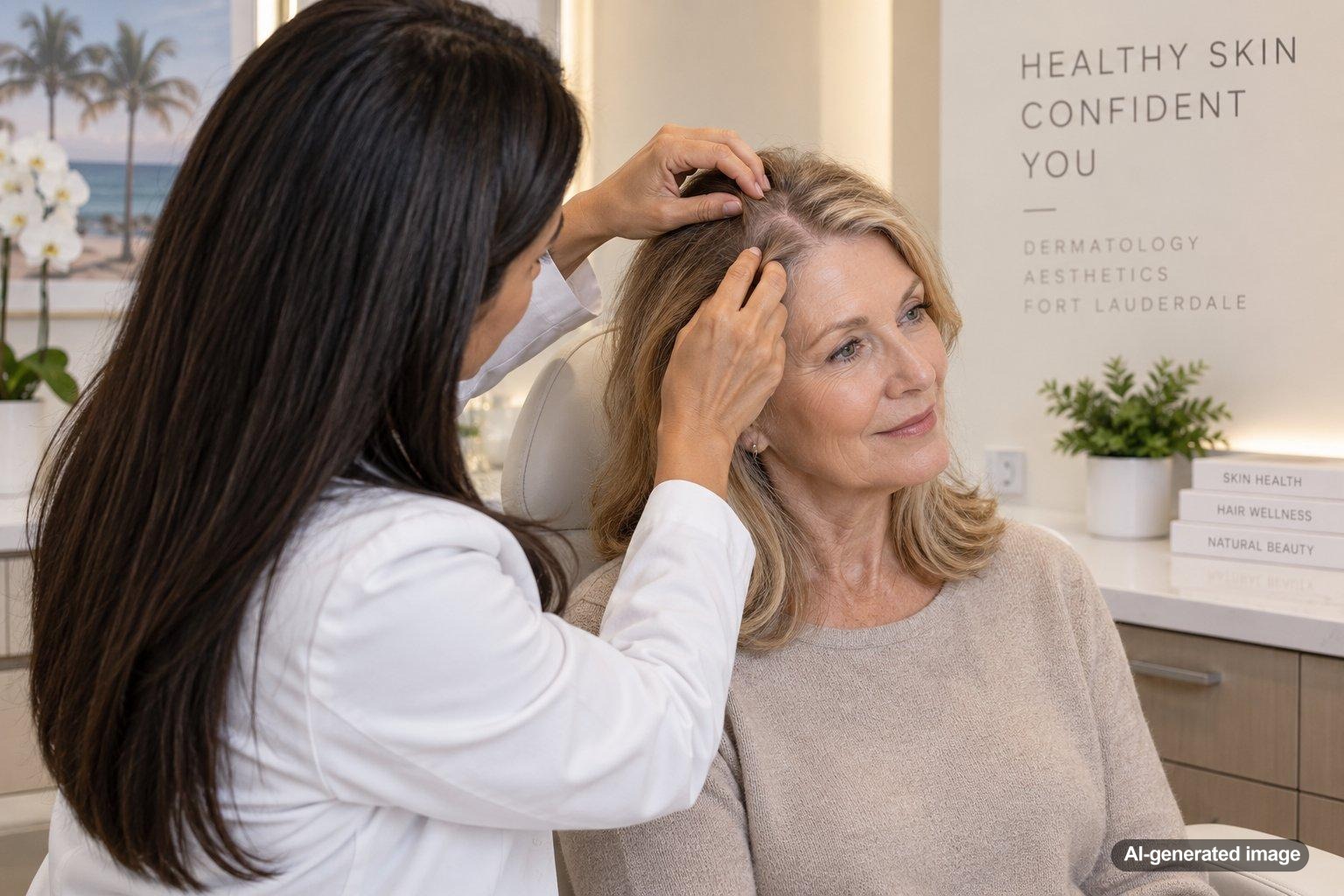
A dermatologist can evaluate the scalp when the directional change is new, unexplained, or associated with other symptoms. The goal is not to assume that an unusual growth pattern represents a disorder, but to distinguish a harmless anatomical pattern from a change involving the hair follicles or scalp.
It is especially worth getting checked if you notice reduced density, a widening area, increased shedding, broken hairs, tenderness, itching, persistent scaling, redness, bumps, crusting, or skin that appears unusually smooth, shiny, or otherwise different from the surrounding scalp. An examination can also be useful if the change continues progressing or you cannot tell whether the area has always been present.
What happens during a professional scalp evaluation?
A dermatologist typically considers the pattern of hair growth, density, strand quality, follicle openings, and the appearance of the scalp itself. They may compare the area with other parts of the scalp and ask when you first noticed the change, whether it has progressed, and whether there are accompanying symptoms.
Depending on what is seen, no treatment may be necessary. If another scalp or hair concern is suspected, your dermatologist can discuss whether additional evaluation or treatment options are appropriate for your individual situation.
FAQ
Is it normal for one section of scalp hair to point the opposite way?
Yes. Natural follicle angles can create small areas where hair grows sideways, backward, or in another direction. This is particularly noticeable with cowlicks and whorls.
Why did I never notice the patch before?
A haircut, new part, styling change, different hair length, or change in surrounding density may make a long-standing growth pattern easier to see.
Can I train the hair to grow in another direction?
Styling may help hair lie differently temporarily, especially with brushing and blow-drying, but it does not necessarily change the underlying angle of the follicle.
Does a different growth direction mean I am losing hair?
Not by itself. Direction and density are separate characteristics. If the area also looks thinner, is expanding, or has increased shedding or breakage, a dermatologist can evaluate it more closely.
Should I worry if the scalp underneath looks normal?
A stable patch with normal density, healthy-looking strands, and normal skin may simply represent a natural growth pattern. A new or changing area is still reasonable to mention during a dermatology visit if you are concerned.
What should make me schedule an appointment sooner?
Consider an evaluation if the area is changing noticeably or is accompanied by hair loss, breakage, pain, persistent itching, redness, scaling, crusting, bumps, or a visible change in the scalp skin.
Ready to get help?
Schedule an appointment or send a message and our team will get back to you.
Prefer to call? 954-666-3736
Disclaimer
This article is for educational purposes and is not medical advice. For diagnosis and personalized treatment, please book an appointment with a board-certified dermatologist.
