

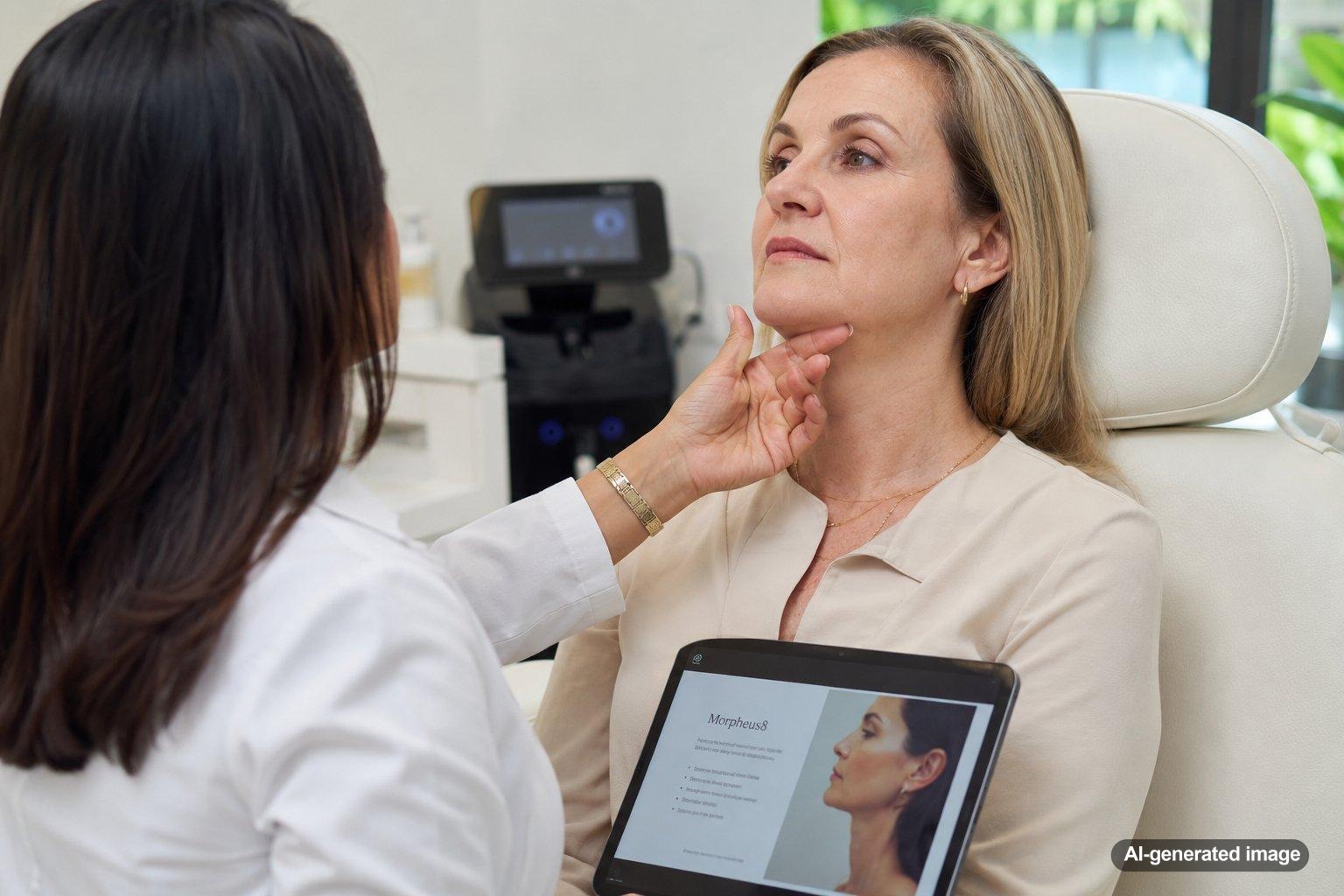
Morpheus8 may help improve mild to moderate skin laxity beneath the chin by combining microneedling with controlled radiofrequency energy. It is generally better suited to crepey texture and loose skin than to a prominent pocket of submental fat, so the cause of the fullness matters.
A careful evaluation can distinguish skin laxity from fat, muscle anatomy, gland prominence, fluid retention, or a naturally less-defined jawline. That distinction helps determine whether Morpheus8 is a reasonable option or whether another approach may be more appropriate.
Quick answer
- Morpheus8 combines microneedles with radiofrequency energy delivered beneath the skin.
- It may improve mild under-chin laxity, crepey texture, and reduced definition caused partly by loose skin.
- It is not a substitute for substantial fat removal or surgical lifting.
- Treatment depth, energy, anatomy, and provider experience are important safety considerations.
- Results, downtime, and the number of sessions needed vary from person to person.
What causes fullness beneath the chin?
The area beneath the chin is often described as a single concern, but several different factors may contribute to its appearance. Some people primarily have a localized fat pocket. Others have lax skin, reduced collagen support, a less prominent chin, visible neck muscle bands, or a combination of these features.
Age-related changes may also affect the jawline. Collagen and elastin support gradually decline, while changes in fat distribution and underlying facial structure can soften the transition between the chin and neck. Weight changes, genetics, sun exposure, smoking, and repeated stretching of the skin may influence how noticeable these changes become.
Because Morpheus8 does not address every cause in the same way, an examination is more useful than choosing treatment based only on a photograph or online description.
How Morpheus8 works
Morpheus8 is a form of radiofrequency microneedling. Small needles enter the skin and deliver controlled radiofrequency energy at selected depths. This creates targeted heat within the tissue and initiates a healing response that may support collagen remodeling over time.
For the under-chin area, a clinician may customize needle depth, energy, treatment pattern, and the number of passes according to skin thickness, anatomy, treatment goals, and the amount of laxity present. These settings should not be identical for every patient or every part of the face and neck.
The gradual remodeling response means Morpheus8 should not be viewed as an instant mechanical lift. Any improvement typically develops progressively, and the degree of change is variable.
Can Morpheus8 reduce under-chin fat?
Morpheus8 is often discussed in connection with tissue remodeling, but it should not automatically be treated as a fat-removal procedure. Depending on the device configuration and settings, radiofrequency energy may reach deeper tissue. However, deliberately treating fat beneath the chin requires careful planning because excessive or poorly placed energy may create an unwanted hollow, uneven contour, or tissue injury.
If a distinct fat pocket is the main concern, a dermatologist or other appropriately trained clinician may discuss options specifically intended for submental fat. If loose skin is the dominant issue, collagen-remodeling procedures may make more sense. When both are present, a staged or combined plan may be considered, but more treatment is not always better.
Who may be a reasonable candidate?
Morpheus8 may be considered for an adult with mild to moderate under-chin laxity, early jawline softening, or crepey skin who prefers a minimally invasive option and has realistic expectations. It may also appeal to someone who understands that improvement is generally more subtle than the change possible with surgery.
A clinician will need to review your health history, skin condition, medications, previous procedures, tendency to scar or develop pigment changes, and any implanted medical devices. Active infection, open wounds, certain inflammatory skin conditions, impaired healing, pregnancy, or other medical considerations may affect whether treatment should be postponed or avoided.
People with substantial skin excess, pronounced neck banding, a recessed chin, or a larger fat deposit may not receive the contour change they want from RF microneedling alone.
What the procedure may feel like
A topical numbing medication is commonly applied before treatment. During the procedure, patients may feel pressure, warmth, brief pinching, or a stamping sensation as the handpiece moves across the treatment area. Comfort varies based on individual sensitivity and the settings used.
Temporary redness, swelling, tenderness, pinpoint bleeding, dryness, or a rough texture can occur afterward. Small crusts or grid-like marks may also appear temporarily. Your clinician should provide instructions for cleansing, moisturizing, sun protection, makeup, exercise, and the timing of active skincare products.
Avoid picking, scrubbing, or applying harsh acids and retinoids until your clinician says the skin is ready. Contact the treating office if symptoms appear severe, worsen unexpectedly, or do not follow the recovery pattern you were given.
Important risks and safety considerations
RF microneedling is a medical procedure and should be performed by a licensed health care provider with appropriate training and experience. The U.S. Food and Drug Administration has reported serious complications associated with certain uses of RF microneedling devices, including burns, scarring, fat loss, disfigurement, and nerve damage.
Those reports do not mean that every treatment causes a serious complication. They do reinforce the importance of patient selection, facial and neck anatomy, appropriate settings, sterile technique, authentic equipment, and a clear plan for managing adverse reactions.
Before treatment, consider asking:
- Who will perform the procedure, and what training do they have with this device?
- Why is Morpheus8 being recommended for the specific cause of my under-chin concern?
- What tissue depth is the treatment intended to reach?
- What changes are realistic for my anatomy?
- What are the risks of pigment changes, burns, scars, fat loss, or nerve injury?
- What should I do if I develop an unexpected reaction?
How many treatments might be discussed?
There is no universal treatment schedule. Some patients may be offered a series, while others may begin with one session and reassess after healing and remodeling have progressed. The recommendation may depend on the degree of laxity, treatment intensity, skin response, tolerance for downtime, and whether other procedures are part of the plan.
Maintenance may eventually be discussed because skin continues to age. A responsible consultation should avoid promising a fixed number of sessions, a precise percentage of tightening, or a specific result by a guaranteed date.
Morpheus8 compared with other under-chin options
The most appropriate approach depends on what is creating the contour concern:
- Primarily loose or crepey skin: Energy-based collagen remodeling may be considered.
- Primarily submental fat: A clinician may discuss treatments designed specifically to reduce or remove fat.
- Reduced chin projection: Structural support options may sometimes improve the profile more effectively than treating the neck alone.
- Visible muscle bands: A different treatment category may be needed.
- Significant skin excess: A surgical consultation may provide a more meaningful assessment of possible improvement.
These categories can overlap. A dermatologist can evaluate the skin and help coordinate care when another specialist’s input would be useful.
When to contact a dermatologist
Before treatment, schedule an evaluation if you are unsure whether the fullness represents fat, lax skin, a lump, an enlarged gland, or another change beneath the surface. A new, firm, painful, one-sided, or rapidly enlarging area should be medically evaluated rather than assumed to be cosmetic.
After RF microneedling, promptly contact a licensed health care provider if you experience severe or increasing pain, blistering, open sores, drainage, spreading redness, marked color change, weakness, numbness, facial asymmetry, or other concerning symptoms. Early assessment may help identify and manage a complication.
Frequently asked questions
Does Morpheus8 create a sharper jawline?
It may improve definition when loose skin or mild textural changes are contributing to a blurred jawline. It cannot change bone structure, and it may not create a major contour change when fat or significant skin excess is the main issue.
Is Morpheus8 the same as regular microneedling?
No. Both use needles, but Morpheus8 also delivers radiofrequency energy into the tissue. That added heat changes the treatment mechanism, potential benefits, settings, and risk profile.
Can Morpheus8 make the face look too thin?
Unwanted fat loss has been reported with certain uses of RF microneedling. Careful selection of treatment depth and energy is particularly important in areas where preserving facial volume matters.
Is the treatment appropriate for every skin tone?
RF microneedling may be considered across a range of skin tones, but pigment changes remain possible. Your clinician should review your skin type, history of hyperpigmentation, prior reactions, and aftercare plan.
Will one session be enough?
Some people may notice a worthwhile change after one treatment, while others may be advised to complete a series. It is reasonable to reassess before automatically committing to multiple sessions.
Can Morpheus8 replace a neck lift?
No. It may offer modest improvement for selected patients, but it does not remove a large amount of excess skin or reposition deeper tissues in the way surgery can.
At Waverly DermSpa, we offer Morpheus8 and can help you understand whether it may be appropriate.
Ready to get help?
Schedule an appointment or send a message and our team will get back to you.
Prefer to call? 954-666-3736
This article is for educational purposes and is not medical advice. For diagnosis and personalized treatment, please book an appointment with a board-certified dermatologist.
Sources & further reading
- U.S. Food and Drug Administration (FDA) – Potential Risks with Certain Uses of Radiofrequency (RF) Microneedling
- American Academy of Dermatology (AAD) – Statement on the FDA Safety Briefing about Radiofrequency Microneedling Risks
