

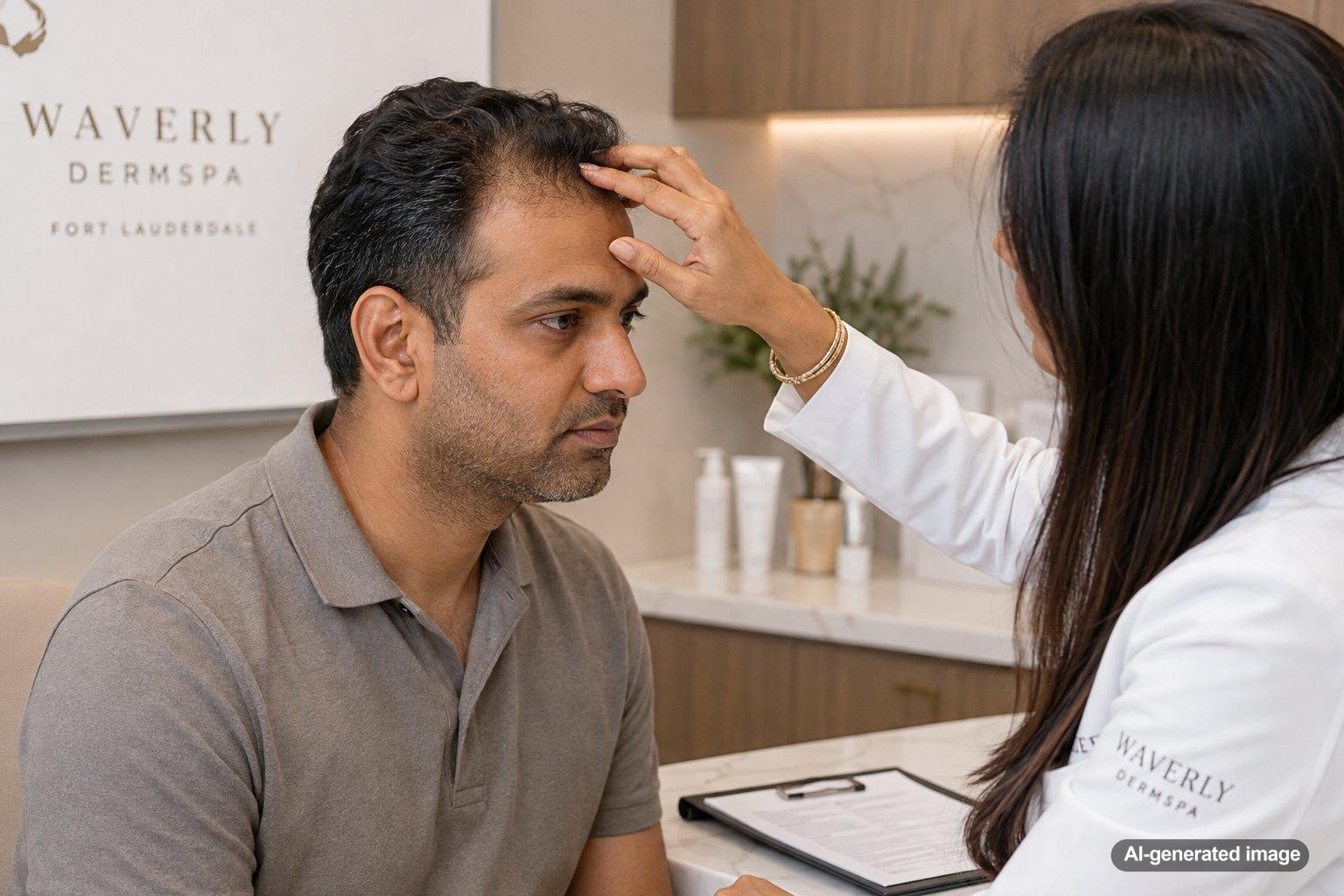
Noticing a new layer of fine, short fuzz along your forehead or hairline can be confusing. In many cases, these delicate hairs are simply vellus hairs, sometimes casually called peach fuzz, or shorter hairs that are growing, breaking, or changing as part of the normal hair cycle. Their appearance alone does not automatically mean something is wrong.
What matters is the pattern. Fine hairs that have always been present are different from a hairline that is becoming visibly thinner, receding, irritated, or increasingly filled with hairs that seem shorter and finer than they used to be. A dermatologist can examine the area closely when the change is new or progressing.
Quick answer
- Fine forehead fuzz may simply be normal vellus hair that has become more noticeable.
- Short hairs near the hairline can also represent new growth or strands that have broken.
- Some hair follicles gradually produce finer, shorter strands through a process called miniaturization.
- Changes in grooming, hormones, age, hair styling, and the hair growth cycle can influence what you see.
- Progressive thinning, a receding hairline, scalp symptoms, or eyebrow changes are good reasons to schedule a dermatology evaluation.
What is that fine fuzz around the forehead?
The body naturally produces different types of hair. Vellus hairs are soft, fine, relatively short hairs that cover much of the skin. They are usually less noticeable than the thicker, longer terminal hairs found on the scalp, eyebrows, and other areas.
Along the forehead, temples, and border of the scalp, the distinction is not always visually obvious. Some people naturally have a soft transition between forehead skin and thicker scalp hair. Lighting, magnifying mirrors, high-resolution phone cameras, changes in hairstyle, and pulling the hair away from the face can suddenly make those fine hairs much easier to see.
Why might the hairs suddenly look shorter or finer?
Several possibilities can change the appearance of hair around the forehead without producing exactly the same pattern in every person.
- Normal vellus hair: Fine facial hairs may simply become more noticeable even though they have been present for a long time.
- New hair growth: Growing strands can initially appear much shorter than neighboring scalp hairs. Their significance depends on the overall hair pattern and what happened before the new hairs appeared.
- Hair breakage: Heat styling, chemical processing, friction, tight hairstyles, repeated tension, or rough handling can leave shorter strands around the hairline.
- Follicle miniaturization: Some forms of patterned hair thinning cause follicles to produce progressively finer and shorter hairs. A dermatologist can help distinguish this from ordinary baby hairs or regrowth.
- Age-related changes: Hair diameter, density, texture, and growth patterns can gradually change over time.
- Hormonal influences: Hormonal shifts can affect hair distribution and the growth cycle, although the appearance of fine forehead hair by itself cannot identify a hormonal problem.
Is it new growth or hair miniaturization?
This is one of the hardest distinctions to make by looking in the mirror. New growth and miniaturized hair can both appear fine and short.
New growth may gradually become longer and blend with surrounding hair. Miniaturization, by contrast, involves follicles producing strands that become progressively smaller in diameter and often shorter over time. The surrounding pattern can provide important clues. A widening part, reduced density, or gradual change along the hairline may deserve closer evaluation.
A dermatologist may examine the scalp and hairline under magnification to compare hair shaft thickness, density, follicle openings, breakage, and other features. That evaluation is more informative than judging a few individual hairs at home.
Could styling be causing the short hairs?
Yes. Hair around the forehead and temples is particularly vulnerable to mechanical stress because these strands may be finer to begin with. Repeatedly pulling the hair tightly backward, frequent heat exposure, aggressive brushing, chemical processing, extensions, or friction can contribute to breakage or stress around the hairline.
If you suspect styling is involved, consider gentler handling. Avoid repeatedly pulling the same area tightly, reduce unnecessary heat, use care when detangling, and watch whether the pattern improves or continues to progress. Persistent loss or a visibly changing hairline should still be evaluated rather than assumed to be simple breakage.
What can you do at home?
A few conservative steps can make it easier to understand what is changing without trying to diagnose yourself.
- Take clear photos of the hairline in similar lighting every few weeks rather than checking it repeatedly throughout the day.
- Notice whether the fine hairs are confined to the forehead or accompanied by thinning elsewhere on the scalp.
- Look for obvious sources of tension, friction, heat, or chemical stress around the hairline.
- Use gentle hair care and avoid repeatedly tugging on short hairs to test whether they are loose.
- Pay attention to accompanying symptoms such as itching, tenderness, redness, scaling, bumps, or eyebrow thinning.
Avoid starting prescription treatments or assuming that a product marketed for hair growth is appropriate based solely on the appearance of forehead fuzz. Different causes of hair changes can require very different approaches.
What can a dermatologist evaluate?
A dermatologist can look at the entire pattern rather than focusing on one cluster of short hairs. The evaluation may include your recent hair history, family history, styling practices, medications, general health changes, scalp symptoms, and the distribution of thinning or breakage.
Depending on what is seen, professional options may range from simply monitoring the area and adjusting hair-care practices to discussing treatments for an identified form of hair loss. Additional testing may sometimes be appropriate when the examination or history suggests another contributing factor. The right approach depends on the cause, so treatment should be individualized rather than chosen based on the appearance of the fuzz alone.
When should you see a dermatologist?
Consider scheduling an evaluation if the change is clearly new, continues to progress, or is accompanied by other changes. In particular, it is worth getting checked if you notice:
- A steadily receding or changing hairline
- A widening part or reduced scalp density
- Increasing numbers of unusually fine hairs where thicker hairs used to grow
- Patchy areas of hair loss
- Loss or thinning of eyebrow hair
- Persistent itching, burning, tenderness, redness, scaling, or bumps near the hairline
- Areas that look unusually smooth or appear to have fewer visible follicle openings
- Sudden or substantial shedding elsewhere on the scalp
These features do not establish a diagnosis, but they can help a dermatologist decide whether the change represents ordinary variation, breakage, patterned thinning, or another process that deserves attention.
FAQ
Are fine hairs on my forehead the same as baby hairs?
Sometimes. The term baby hairs is informal and can describe several different things, including naturally fine hairs along the hairline, new growth, short broken strands, or hairs that have become finer over time. Their pattern and progression are more useful than the nickname.
Does forehead fuzz mean my hair is growing back?
Not necessarily. Short hairs can be new growth, but they can also be normal vellus hairs, broken hairs, or miniaturized strands. Watching how the area changes over time and having it examined when thinning is suspected can provide more useful information.
Can hair around the hairline become finer with age?
Yes. Hair characteristics can change with age, including strand diameter, density, texture, and growth rate. However, a noticeable or progressive change in the hairline should not automatically be attributed to aging.
Should I remove the fine forehead hairs?
If they are simply unwanted facial hairs, cosmetic removal may be an option depending on your skin and the type of hair. If the hairs are occurring along a changing or thinning scalp hairline, it is sensible to clarify what they represent before treating them purely as unwanted hair.
How can a dermatologist tell what the short hairs mean?
The dermatologist can assess the overall distribution of hair, compare strand thickness, examine the scalp and follicle openings, look for breakage or inflammation, and consider your history. In some situations, further evaluation may be recommended to clarify the cause.
Ready to get help?
Schedule an appointment or send a message and our team will get back to you.
Prefer to call? 954-666-3736
This article is for educational purposes and is not medical advice. For diagnosis and personalized treatment, please book an appointment with a board-certified dermatologist.
