

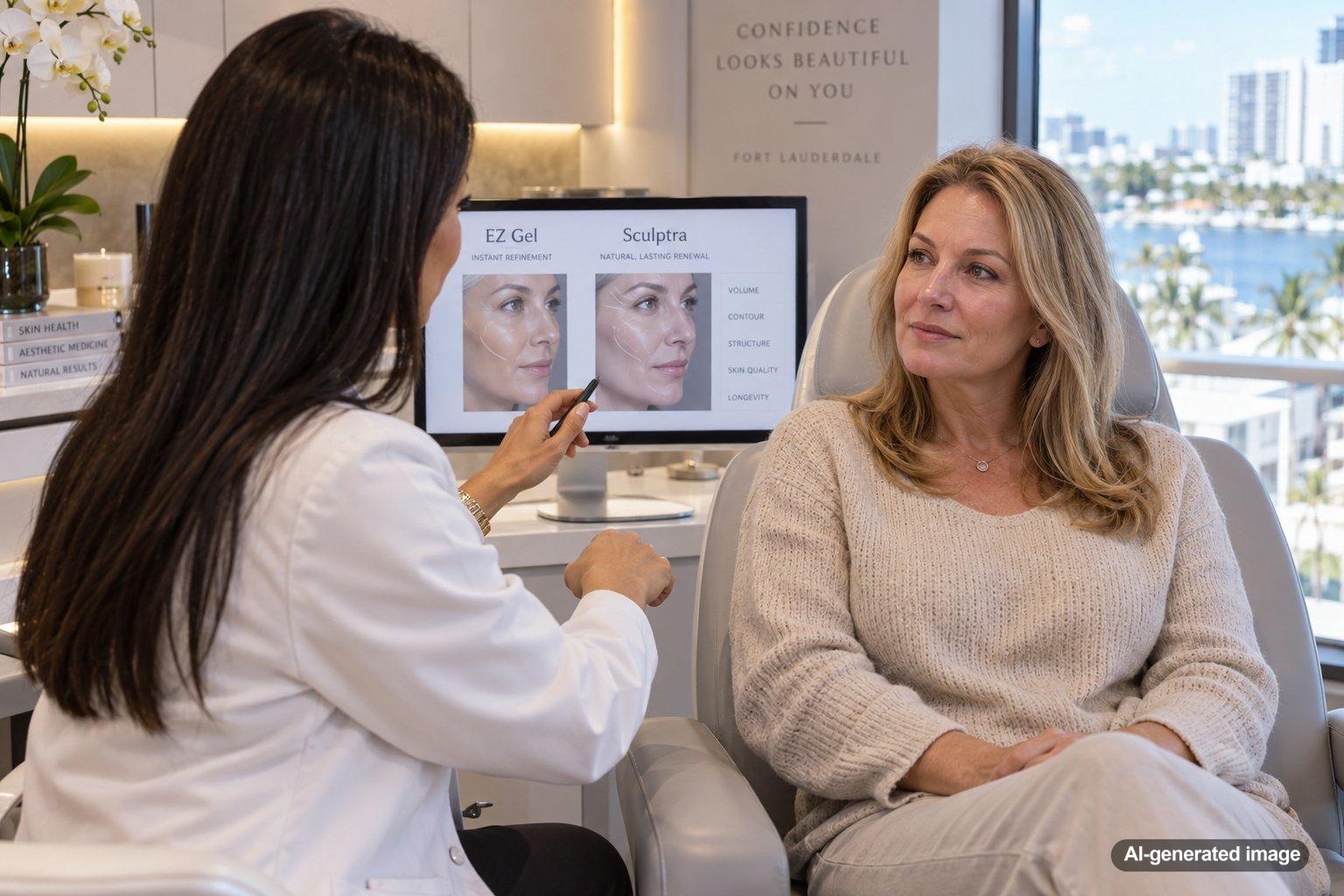
EZ Gel and Sculptra can both support subtle facial rejuvenation, but they take very different paths. EZ Gel is prepared from components of a patient’s own blood and is generally used to provide gentle support in carefully selected areas. Sculptra is an injectable poly-L-lactic acid treatment designed to encourage gradual collagen production.
Neither option is automatically better. The more appropriate choice depends on the treatment area, degree of volume change, desired pace, medical history, and tolerance for a series of treatments. A dermatologist can evaluate facial structure and help set realistic expectations before recommending either approach.
Quick answer
- EZ Gel: Uses a processed concentration prepared from the patient’s own blood and may suit people seeking a conservative, autologous approach.
- Sculptra: Uses poly-L-lactic acid to stimulate gradual collagen production and is often considered for broader facial support.
- Timing: EZ Gel may provide an earlier visible filling effect, while Sculptra changes usually develop more gradually.
- Treatment planning: Either option may involve more than one session, depending on anatomy, goals, and clinical response.
- Best next step: A personalized consultation is important because treatment areas, limitations, and risk profiles are not identical.
| Comparison point | EZ Gel | Sculptra |
|---|---|---|
| Material | Prepared from the patient’s own blood components | Injectable poly-L-lactic acid |
| Primary approach | Gentle, localized support with an autologous material | Gradual collagen stimulation and structural support |
| Pace of change | An initial filling effect may be noticeable, with results varying as swelling settles and the material changes over time | Changes generally emerge progressively rather than immediately |
| Typical planning focus | Small, carefully selected areas and conservative correction | Broader volume patterns and gradual facial support |
| Key limitation | The amount and consistency obtained can vary between patients | It is not intended to create a precise immediate correction in every area |
How EZ Gel works
EZ Gel is an autologous injectable, meaning it is made from material collected from the same patient who receives it. A blood sample is processed to concentrate selected plasma, platelet, and fibrin components. Controlled preparation converts that material into a gel-like consistency that can be injected into an appropriate treatment area.
Because preparation begins with the patient’s own blood, EZ Gel appeals to people interested in a treatment that does not rely on a conventional synthetic filler. However, “natural” does not mean risk-free, universally suitable, or able to reproduce the lifting capacity and predictability of every manufactured injectable. The final consistency and visible effect may vary with the patient’s biology, preparation protocol, treatment site, and injection technique.
How Sculptra works
Sculptra contains poly-L-lactic acid particles suspended for injection. Rather than acting only as a conventional space-filling gel, it is used to stimulate a gradual tissue response that may increase collagen support in the treated region. Early fullness can partly reflect the fluid used during treatment and temporary swelling, so the initial appearance should not be confused with the eventual result.
Sculptra is commonly planned as a progressive treatment. The clinician reassesses the face between sessions and determines whether additional treatment is appropriate. It is generally better suited to gradual structural improvement than to exact, immediate sculpting of a small feature.
Differences in treatment goals
EZ Gel may be considered when the goal is a modest change in a delicate or localized area and the patient values an autologous option. The treatment plan should account for the limited amount of material available and the variability of blood-derived preparations.
Sculptra may be considered when facial volume loss is more diffuse or when the goal is to improve support gradually through collagen stimulation. It is not interchangeable with a precisely placed hyaluronic acid filler, and it may not be suitable for every facial area. Product labeling, anatomy, and clinician judgment all matter.
Which option looks more subtle?
Both can look subtle when the treatment is conservative and appropriately matched to the patient’s anatomy. Subtlety depends less on the product name than on the treatment plan. Placement, amount, facial proportions, tissue quality, and the decision to stop before correction becomes excessive all influence the result.
EZ Gel may appeal to someone who wants a small-scale adjustment using their own blood components. Sculptra may appeal to someone comfortable with a slower evolution and a broader collagen-support strategy. Photographs, facial movement, skin thickness, and previous injectable treatments can help guide the discussion.
Limitations and practical clues
- EZ Gel may not provide the same consistency, projection, or controllability as a manufactured filler.
- Sculptra develops gradually and may not suit someone seeking a precisely visible change for an event in the near future.
- Neither treatment replaces surgery when significant tissue repositioning is the main goal.
- Prior filler, facial surgery, active skin conditions, dental work, medications, and bleeding history may affect treatment planning.
- The safest and most natural-looking plan may involve treating less than the patient initially expects or choosing a different option entirely.
Safety considerations
Both treatments involve injections. Temporary swelling, redness, tenderness, and bruising can occur. Infection, prolonged inflammation, asymmetry, palpable areas, or unsatisfactory cosmetic changes are also possible. Sculptra has product-specific considerations, including the possibility of delayed papules or nodules.
Any facial injection carries a rare but serious risk of material entering or affecting a blood vessel. Seek immediate medical attention for unusual or severe pain, vision changes, stroke-like symptoms, or skin that becomes white, gray, blue, or unusually mottled during or after treatment. Choosing a qualified medical professional with detailed knowledge of facial anatomy is essential.
Tell your clinician about prescription and over-the-counter medications, supplements, allergies, bleeding or clotting concerns, immune conditions, previous injectables, and any active rash or infection. Do not stop a prescribed medication unless the prescribing clinician advises you to do so.
How a dermatologist helps you choose
A consultation should begin with the desired change, not a predetermined product. The dermatologist can examine where volume has changed, distinguish volume loss from skin laxity or surface texture, and identify areas where an injectable may be inappropriate. They can also explain whether EZ Gel, Sculptra, another injectable, an energy-based treatment, or no procedure is the more reasonable choice.
Useful questions include how the treatment is prepared, where it will be placed, why that area is appropriate, how many sessions may be considered, what changes are realistic, and how complications are handled. If a major trip or event is approaching, discuss timing before scheduling because bruising, swelling, and the pace of improvement vary.
Frequently asked questions
Is EZ Gel the same as PRP?
No. Both begin with a patient’s blood, but EZ Gel is processed into a thicker, gel-like injectable. PRP is a liquid platelet-rich preparation. Preparation methods and intended uses can differ, so it is worth asking exactly what will be used.
Does Sculptra work immediately?
Sculptra is intended to produce gradual change. Fullness seen immediately after an appointment can include treatment fluid and swelling. Your clinician should explain what may change as that temporary fullness settles.
Can EZ Gel and Sculptra be combined?
A clinician may consider staged or complementary treatments for different goals, but combining procedures is not appropriate for everyone. The sequence, treatment sites, medical history, and cumulative risks require individual evaluation.
Which treatment lasts longer?
Duration varies, and a direct promise is not appropriate. Sculptra is generally selected for a progressive collagen-stimulating effect, while the visible persistence of EZ Gel can be less predictable because it is a patient-derived preparation. Anatomy, metabolism, technique, and treatment plan all influence longevity.
Which option is better for an upcoming event?
Neither should be scheduled solely around a promised recovery date. EZ Gel may create earlier visible support, while Sculptra usually evolves more gradually. Both can cause bruising or swelling, so allow flexibility and ask your clinician for personalized timing.
Can either treatment replace a facelift?
No injectable duplicates surgical lifting or tissue repositioning. EZ Gel and Sculptra may help selected concerns, but a dermatologist or facial plastic surgeon can explain when laxity or structural change is beyond what an injectable can reasonably address.
At Waverly DermSpa, we offer EZ Gel (Natural Filler) and can help you understand whether it may be appropriate.
Ready to get help?
Schedule an appointment or send a message and our team will get back to you.
Prefer to call? 954-666-3736
This article is for educational purposes and is not medical advice. For diagnosis and personalized treatment, please book an appointment with a board-certified dermatologist.
Sources & further reading
- U.S. Food and Drug Administration (FDA) – Dermal Fillers (Soft Tissue Fillers)
- Cleveland Clinic – Vampire Facelift (PRP Facelift)
