

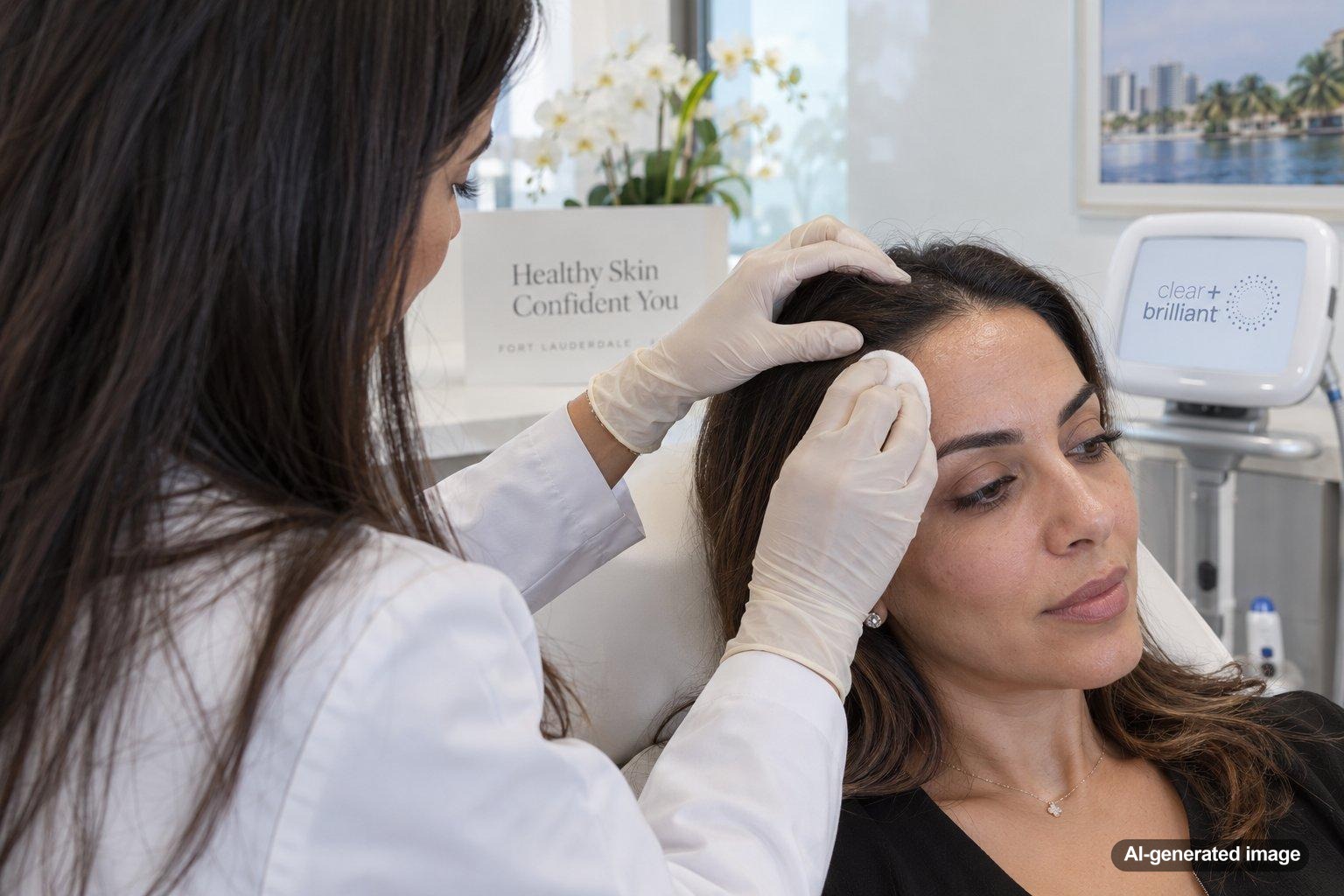
Uneven texture on the forehead can show up as roughness, visible pores, fine surface lines, or an overall lack of smoothness. Skincare can support the skin barrier and improve hydration, but some texture concerns extend beyond what topical products can reasonably address. Clear + Brilliant Touch is a fractional laser treatment that may help refine the appearance of skin texture while fitting into a relatively conservative resurfacing approach.
The right treatment depends on what is actually creating the texture. A dermatologist can evaluate whether the concern is primarily related to sun exposure, fine lines, acne-related changes, dryness, congestion, or another skin issue before recommending a procedure.
Quick answer
- Clear + Brilliant Touch may help improve the appearance of mild uneven texture and fine surface irregularities on the forehead.
- Fractional treatment means only portions of the skin are treated at a time rather than resurfacing the entire surface uniformly.
- The appropriate settings and treatment plan depend on skin tone, sensitivity, existing pigmentation, and the type of texture being addressed.
- Temporary redness, sensitivity, dryness, or a rough feeling can occur as the skin recovers.
- A consultation is important because not every forehead bump, rough patch, or textural change should automatically be treated with a laser.
Why forehead texture can look uneven
The forehead has a naturally visible pattern of pores, oil glands, fine lines, and hair follicles. That means perfectly poreless or completely uniform skin is not a realistic goal. However, certain changes can make normal texture more noticeable.
Common contributors may include:
- Fine lines related to repeated facial movement and normal aging
- Sun-related changes that make the surface appear less even
- Visible pores or oiliness
- Past acne or minor acne-related textural changes
- Dryness or an impaired skin barrier that makes the surface look rough
- Product buildup, irritation, or over-exfoliation
- Differences in pigmentation that make texture appear more pronounced under certain lighting
Because several of these concerns can look similar, identifying the likely cause matters before choosing a procedure.
How Clear + Brilliant Touch approaches texture
Clear + Brilliant Touch uses fractional laser energy, meaning treatment is delivered in a pattern rather than uniformly resurfacing every part of the skin. Fractional laser approaches are designed to create controlled treatment zones while leaving surrounding areas untreated. The skin’s healing response can gradually contribute to a smoother-looking surface.
For forehead texture, the goal is generally refinement rather than dramatic resurfacing. A clinician may consider the degree of roughness, visible pores, pigmentation, fine lines, previous procedures, and how much recovery time a patient is comfortable with when discussing whether a fractional laser is appropriate.
What Clear + Brilliant Touch may help with
Depending on the individual treatment plan, Clear + Brilliant Touch may be considered for concerns such as:
- Mildly rough or uneven-looking skin texture
- Fine surface lines
- Visible pores
- Dull or uneven-looking tone
- Early sun-related changes
- General skin refinement when more aggressive resurfacing is not desired
It is important to separate these cosmetic concerns from persistent bumps, inflamed lesions, changing growths, or unexplained rashes. Those findings deserve evaluation rather than simply being treated as a texture problem.
What treatment may feel like
The experience varies with treatment settings, individual sensitivity, and the area being treated. During fractional laser treatment, patients may notice warmth, prickling, or a sensation of repeated small pulses across the forehead.
Afterward, temporary redness, warmth, sensitivity, dryness, or a slightly rough texture may occur. Laser procedures can also carry risks such as pigment changes, infection, or scarring, although the specific risk profile varies by device, settings, skin characteristics, and treatment technique. Medical lasers should be used by appropriately trained professionals, and individualized evaluation is especially important when there is a history of abnormal scarring, pigment changes, active skin problems, or medications that affect the skin.
Preparing your forehead before treatment
Preparation should be based on instructions from the treating clinician rather than a one-size-fits-all routine. In general, it is helpful to keep the skin calm and avoid creating unnecessary irritation before a laser appointment.
- Tell your clinician about prescription and over-the-counter skincare products you use.
- Discuss recent chemical peels, microneedling, laser treatments, waxing, or other procedures.
- Mention any history of cold sores, unusual scarring, or significant pigment changes after inflammation.
- Avoid intentionally tanning the treatment area.
- Do not aggressively exfoliate the forehead in an attempt to make the treatment work better.
Your clinician can give specific instructions about retinoids, acids, exfoliants, and other active products based on your routine and treatment plan.
How to care for the skin afterward
Post-treatment care usually centers on protecting the skin barrier while the forehead settles. Follow the instructions provided by your treatment team, since care can vary with the settings used.
Common conservative measures may include gentle cleansing, a simple moisturizer, avoiding unnecessary exfoliation, and being consistent with sun protection. Picking, scrubbing, or trying to remove temporary roughness can increase irritation and may interfere with normal recovery.
If you spend significant time outdoors in South Florida, sun protection deserves particular attention. Hats, shade, and broad-spectrum sunscreen can help limit additional ultraviolet exposure while the skin is recovering.
How many treatments are needed?
There is no universal number that applies to everyone. The treatment plan can depend on the severity and cause of the texture, treatment intensity, skin response, cosmetic goals, and whether other concerns such as pigmentation are being addressed at the same time.
Some people pursue a series of lighter treatments, while others may be better served by a different resurfacing approach. Your clinician can explain the expected tradeoffs between treatment intensity, recovery, and the degree of improvement that may reasonably be pursued.
When a different approach may make more sense
Laser treatment is only one option for uneven forehead texture. If the surface looks rough mainly because of dryness or irritation, simplifying skincare and supporting the skin barrier may be more appropriate initially. Acne-related bumps may require an acne-focused plan. Deeper scars or more pronounced resurfacing goals may lead to a discussion of other procedures.
The forehead is also an area where expression lines and surface texture can overlap visually. A treatment that targets texture does not necessarily address every type of line, and combining procedures is not automatically necessary. A consultation can help separate the concerns and prioritize them appropriately.
When to see a dermatologist first
Consider a dermatology evaluation before cosmetic laser treatment if the texture is new, rapidly changing, inflamed, painful, persistently itchy, crusting, bleeding, or associated with a changing growth or lesion. You should also mention active breakouts, recent significant sun exposure, a history of unusual scarring, or previous problems with pigmentation after procedures.
A dermatologist can determine whether the concern is suitable for cosmetic resurfacing or whether something else should be addressed first.
Frequently asked questions
Can Clear + Brilliant Touch make the forehead look completely smooth?
No cosmetic procedure can create perfectly texture-free skin, and normal pores and follicles remain part of healthy skin. The goal is generally to improve the appearance of unevenness rather than eliminate natural skin texture.
Is Clear + Brilliant Touch only for older skin?
No. Treatment decisions are based more on the concern, skin characteristics, medical history, and goals than on age alone. A clinician can determine whether laser resurfacing is appropriate for a particular patient.
Can I use exfoliating acids after treatment?
Do not restart strong acids or other potentially irritating active products simply because the skin looks rough during recovery. Follow your clinician’s instructions about when to resume your usual routine.
Can Clear + Brilliant Touch help forehead pores?
Fractional laser treatment may help make pores appear less noticeable in some patients by improving the surrounding skin texture. It cannot remove pores, which are normal structures in the skin.
Is this the same as aggressive laser resurfacing?
No. Laser and light-based treatments vary considerably in wavelength, depth, intensity, downtime, and purpose. A clinician can explain where a particular treatment fits within the spectrum of resurfacing options.
Can darker skin tones receive fractional laser treatment?
Skin tone is an important part of laser treatment planning because pigment changes are a potential consideration after laser procedures. An experienced clinician can evaluate skin type, history, and treatment goals and discuss appropriate options and settings.
At Waverly DermSpa, we offer Clear + Brilliant Touch and can help you understand whether it may be appropriate.
Ready to get help?
Schedule an appointment or send a message and our team will get back to you.
Prefer to call? 954-666-3736
This article is for educational purposes and is not medical advice. For diagnosis and personalized treatment, please book an appointment with a board-certified dermatologist.
Sources & further reading
- U.S. Food and Drug Administration (FDA) – Medical Lasers
- Cleveland Clinic – Laser Skin Resurfacing: Lasers Types, Skin Conditions, What to Expect
