

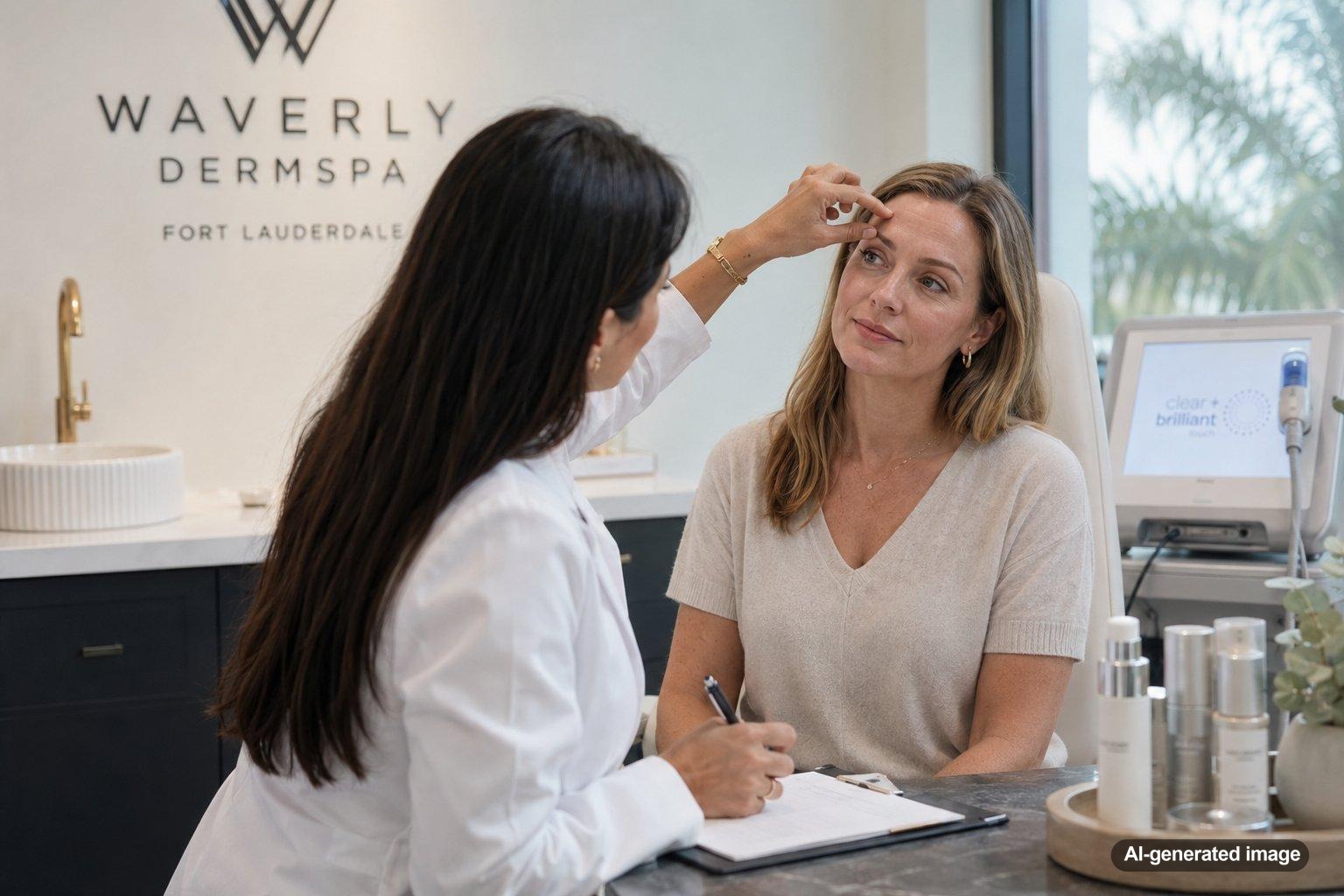
Clear + Brilliant Touch may help improve the overall texture, tone, and sun-related appearance of skin around sebaceous hyperplasia, but it is not usually the most direct treatment for removing distinct raised bumps. Sebaceous hyperplasia develops when oil-producing glands become enlarged, creating small flesh-colored or yellowish bumps that often appear on the forehead and cheeks.
Because several types of facial growths can resemble one another, the first step should be confirming that the bumps are truly sebaceous hyperplasia. Once a dermatologist has evaluated them, your treatment plan can address both the individual growths and broader concerns such as rough texture, discoloration, enlarged-looking pores, or visible sun damage.
Quick answer
- Clear + Brilliant Touch is primarily used to improve general skin tone and texture rather than precisely remove individual oil gland growths.
- It may soften the overall appearance of the surrounding forehead skin, but raised bumps may remain noticeable.
- More targeted procedures are commonly considered when the main goal is flattening or removing individual lesions.
- A dermatologist should examine unfamiliar facial bumps before cosmetic treatment because some skin growths can look similar.
- A combined plan may be appropriate when someone wants to address both sebaceous hyperplasia and broader signs of sun exposure or uneven texture.
What is sebaceous hyperplasia?
Sebaceous hyperplasia is an enlargement of the sebaceous glands, which are the glands that produce the skin’s natural oil. It commonly appears as small, soft bumps on areas with many oil glands, especially the forehead, temples, cheeks, and nose.
The bumps are often skin-colored, pale yellow, or slightly pink. Many have a subtle central indentation. They are generally harmless, but people may choose treatment because they dislike the texture, notice that makeup settles around the bumps, or find that the growths become more visible in certain lighting.
Sebaceous hyperplasia is not the same as acne. Squeezing a bump usually does not empty it like a clogged pore, and picking at it can cause irritation, bleeding, discoloration, or scarring.
How Clear + Brilliant Touch works
Clear + Brilliant Touch is a fractional laser treatment. Instead of treating the entire skin surface as one continuous area, fractional technology creates controlled microscopic treatment zones while leaving surrounding tissue untreated. This approach is generally used to support gradual renewal and improve concerns such as uneven texture, visible pores, dullness, and irregular pigmentation.
Those benefits can make the forehead look smoother and more refined overall. However, improving the skin around a sebaceous hyperplasia bump is different from directly destroying or removing the enlarged gland that creates the bump.
Can it flatten the bumps?
Results depend on the size, depth, number, and appearance of the lesions, as well as the settings and treatment strategy selected by the clinician. Clear + Brilliant Touch may make mild surface irregularities look less obvious as the surrounding texture improves. It should not be assumed to remove established raised lesions, however.
If individual bumps are the primary concern, a dermatologist may recommend a procedure that can be applied more precisely to each lesion. Clear + Brilliant Touch may still have a role in the overall plan when there are additional concerns involving sun damage, uneven pigment, or rough texture.
What treatments are commonly used for sebaceous hyperplasia?
Professional options depend on the diagnosis, the number of bumps, their location, your skin tone, your tendency to develop discoloration or scars, and your tolerance for downtime. Common categories may include:
- Electrosurgery or electrocautery: Controlled electrical energy may be used to treat individual growths.
- Laser treatment: Certain laser approaches may vaporize or reduce targeted lesions.
- Light-based treatment: Selected patients may be evaluated for treatments that target oil glands or associated visible vessels.
- Cryotherapy: Carefully applied cold treatment may be considered in some cases, although pigment changes can be a concern.
- Minor procedural removal: A dermatologist may use a precise office technique for an isolated bump.
- Prescription therapy: Medication may occasionally be discussed when lesions are numerous or recurrent, but this requires medical evaluation and individualized risk assessment.
No single option is appropriate for every person. Treating too aggressively can increase the chance of prolonged redness, pigment changes, textural changes, or scarring, particularly on a highly visible area such as the forehead.
Why diagnosis matters before laser treatment
Sebaceous hyperplasia has recognizable features, but it can sometimes resemble other bumps, including benign growths, enlarged pores, acne-related lesions, and certain forms of skin cancer. A photograph or mirror check cannot reliably confirm every lesion.
A dermatologist can examine the area closely and determine whether any bump needs additional evaluation before cosmetic treatment. This is especially important when a growth is new, changing, unusually firm, crusted, repeatedly bleeding, painful, or different from the surrounding bumps.
Laser treatment should not be used simply to erase an unidentified lesion. Establishing what the growth is helps your clinician select an appropriate approach and avoid delaying necessary care.
Can Clear + Brilliant Touch be combined with targeted treatment?
In some cases, a staged or combined strategy may offer the most balanced result. A dermatologist might first address distinct sebaceous hyperplasia lesions with a targeted technique, then use a fractional treatment during a separate session to improve the broader appearance of the forehead.
The order and spacing of treatments matter. Combining procedures too closely may increase irritation, so your clinician should consider healing time, recent sun exposure, skincare products, previous procedures, and your history of post-inflammatory hyperpigmentation.
At Waverly DermSpa, we offer Clear + Brilliant Touch and can help you understand whether it may be appropriate.
What can you do at home?
Home skincare cannot reliably remove an enlarged sebaceous gland, but a conservative routine can support the surrounding skin and reduce unnecessary irritation:
- Use a gentle cleanser rather than abrasive scrubs.
- Avoid squeezing, scraping, or puncturing the bumps.
- Apply broad-spectrum sunscreen consistently, especially on the forehead.
- Choose lightweight, non-comedogenic moisturizers when heavy products seem to worsen congestion.
- Discuss retinoids or exfoliating products with a dermatologist if your skin is sensitive or you are planning a procedure.
- Pause harsh acids, scrubs, or irritating active ingredients when directed before and after treatment.
Sun protection is particularly important in Fort Lauderdale, where frequent ultraviolet exposure can contribute to uneven pigment and make post-procedure discoloration more noticeable.
When to see a dermatologist
Schedule an evaluation when you are unsure what the bumps are, when they are increasing in number, or when you want to discuss removal without damaging the surrounding skin. Prompt assessment is especially worthwhile for any spot that:
- Changes in size, shape, or color
- Bleeds, crusts, or repeatedly opens
- Becomes painful, itchy, or persistently irritated
- Looks different from the other bumps
- Grows rapidly
- Does not heal
A dermatologist can decide whether the area is suitable for cosmetic treatment or whether closer examination or a biopsy should be considered.
Frequently asked questions
Will Clear + Brilliant Touch make sebaceous hyperplasia disappear?
It should not be expected to make every lesion disappear. The treatment may improve surrounding tone and texture, while individual raised glands may require a more targeted procedure.
How many treatments would I need?
The number of sessions varies based on the goal. A plan intended to improve overall texture may differ from one focused on individual growths. Your clinician can recommend a schedule after examining your skin and discussing the outcome you hope to achieve.
Can sebaceous hyperplasia return after removal?
Previously treated lesions may recur, and new enlarged glands may develop over time. Treatment can address visible bumps, but it does not necessarily prevent future lesions from forming.
Can I squeeze sebaceous hyperplasia at home?
No. These bumps are enlarged glands rather than ordinary whiteheads. Squeezing or puncturing them may cause inflammation, infection, pigment changes, or scarring without resolving the growth.
Is sebaceous hyperplasia dangerous?
Sebaceous hyperplasia is generally benign. The concern is that different types of facial growths can resemble one another, so unfamiliar or changing bumps should be evaluated rather than self-diagnosed.
Can I treat the bumps and sun damage at the same visit?
Possibly, but treatment timing depends on the procedures selected and your skin’s sensitivity. Your dermatologist may recommend separate sessions to limit irritation and allow the treated area to heal appropriately.
Ready to get help?
Schedule an appointment or send a message and our team will get back to you.
Prefer to call? 954-666-3736
This article is for educational purposes and is not medical advice. For diagnosis and personalized treatment, please book an appointment with a board-certified dermatologist.
Sources & further reading
- DermNet – Sebaceous hyperplasia
- American Academy of Dermatology (AAD) – Basal cell carcinoma: From symptoms to treatments
