

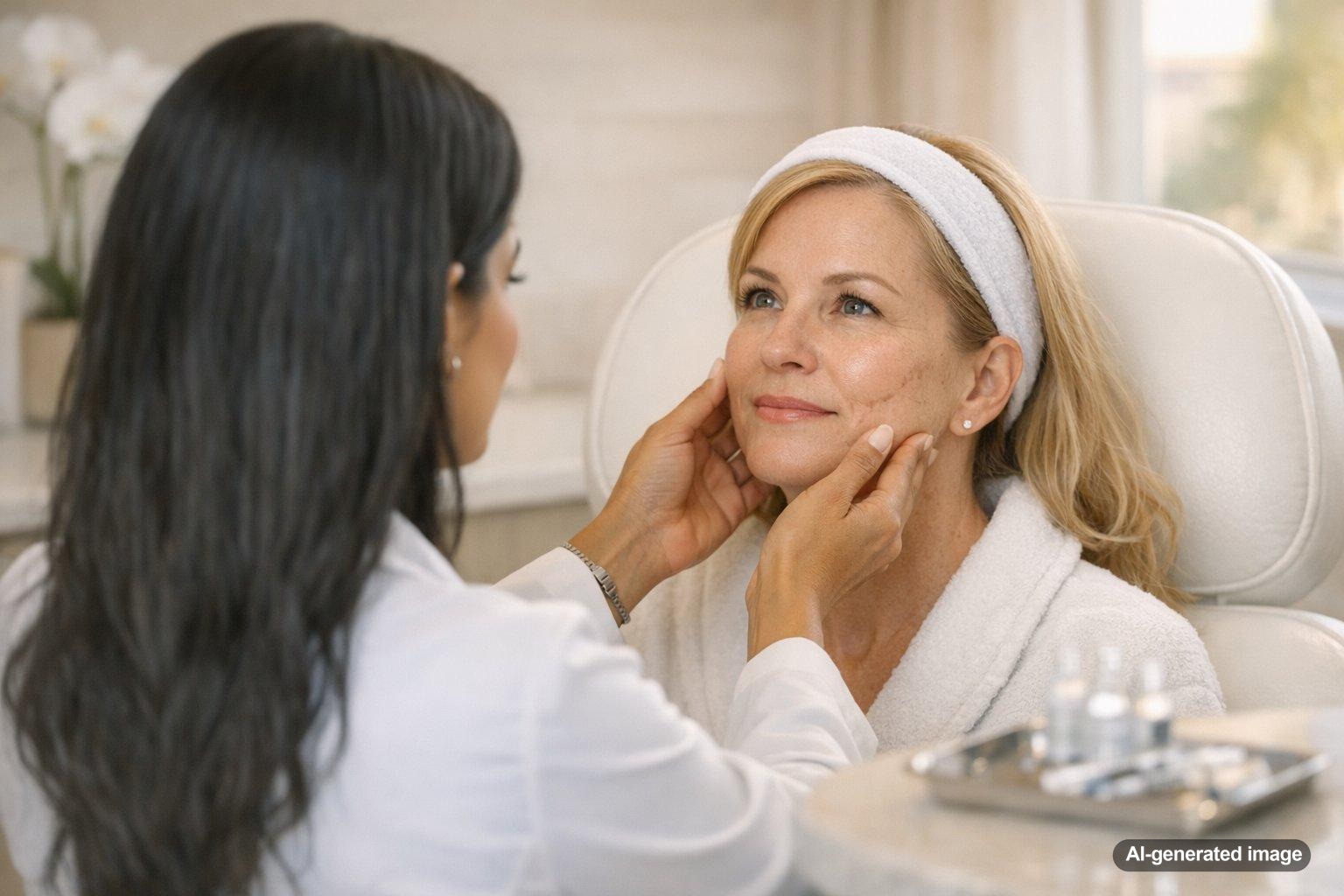
If you are dealing with shallow acne scars or a depressed area after a procedure or surgery, it is understandable to wonder whether a natural filler option like EZ Gel can help. In some cases, it may. The key is understanding what kind of indentation is present, how deep it is, and whether there is volume loss, scar tethering, or both.
EZ Gel is not a one-size-fits-all answer, but it can be part of a thoughtful treatment plan for select patients. A dermatologist can evaluate the shape, depth, and cause of the depression and help you understand whether EZ Gel makes sense on its own or whether another approach may be more appropriate.
Quick answer
- EZ Gel may help certain shallow or moderate depressions when volume support is part of the issue.
- It may be considered for some acne scars and some post-surgical indentations, but not every depression responds the same way.
- Deeply tethered scars often need a more customized approach rather than filler alone.
- A dermatologist evaluation helps determine whether the concern is related to volume loss, scar attachment, texture change, or a mix of factors.
- Results and treatment plans vary, so it is best approached as an individualized option rather than a universal fix.
What is EZ Gel in plain English?
EZ Gel is a natural filler option made from components of your own blood. In simple terms, it is used to add soft support in areas that look hollow or indented. Because it comes from your own material, many patients are interested in it as a more natural-feeling option for subtle correction.
That said, the word filler can be misleading if the issue is not truly volume loss. Some depressions are caused by pulling or binding under the skin, uneven scar tissue, or textural change. In those cases, adding volume alone may not fully address the concern.
Can EZ Gel help acne scars?
Sometimes, yes. EZ Gel may help certain atrophic acne scars, especially when the area has a soft, shallow depression and would benefit from gentle support underneath the skin. Many people notice that some acne scars are not all the same, even on the same face. One area may be broad and shallow, while another may be narrow, tethered, or sharply edged.
This is why acne scar treatment is usually customized. If the scar is bound down or has a more defined fibrotic component, your clinician may discuss combining approaches rather than relying on EZ Gel alone. Common options include microneedling-based treatments, scar release techniques, resurfacing, or other collagen-focused procedures depending on skin type and goals.
Can EZ Gel help surgical depressions?
In some cases, yes. A surgical depression can develop when tissue heals with a slight contour change, a small area of volume loss, or a subtle pull beneath the skin. If the indentation is soft and not heavily tethered, EZ Gel may help improve the transition between the depressed area and the surrounding skin.
However, not every post-surgical indentation behaves the same way. Some areas are more related to scar contraction than missing volume. Others may sit in places where movement, skin thickness, and anatomy matter a great deal. That is why an in-person assessment is important before deciding whether EZ Gel is the right fit.
What kinds of depressions may be less likely to respond well?
- Very deep or sharply defined depressions
- Scars that feel stuck or tethered to deeper tissue
- Areas with significant textural irregularity rather than volume loss
- Concerns that may need resurfacing or scar-release techniques first
- Sites where swelling, motion, or anatomy may affect how a filler-like treatment behaves
These situations do not automatically rule out EZ Gel, but they often mean the conversation needs to be broader than a single treatment option.
What can you do at home while deciding?
At home, the most helpful step is often observation rather than aggressive self-treatment. Good lighting and consistent photos can help you notice whether the issue is mostly a shadow, a true indentation, or a change in texture. Sun protection also matters, because contrast and discoloration around scars can make depressions look more noticeable.
It is usually best to avoid picking, frequent exfoliation, or trying too many strong products at once, especially if the skin barrier is already irritated. Keeping your routine simple can make it easier for your dermatologist to evaluate the area clearly.
What professional options might be considered?
Professional options depend on the reason for the depression. A dermatologist may discuss volume support, collagen-stimulating treatments, texture-focused procedures, scar-release techniques, or a staged plan that combines more than one category. The goal is not to force one tool to do everything, but to match the treatment to the anatomy of the scar or indentation.
If EZ Gel is being considered, your clinician can help you decide whether it may be appropriate as a standalone option or as part of a broader plan. At Waverly DermSpa, we offer EZ Gel (Natural Filler) and can help you understand whether it may be appropriate.
When should you see a dermatologist?
- If the depression is new, changing, or bothersome after healing
- If you are not sure whether the issue is a scar, volume loss, or something else
- If the area feels firm, tethered, tender, or uneven in a way that concerns you
- If home skincare is not helping the appearance
- If you want a realistic plan that balances subtle improvement with downtime, budget, and skin type
FAQ
Is EZ Gel the same as a traditional dermal filler?
No. It is a different type of treatment made from your own blood components. It may be appealing to patients looking for a natural option, but it is not interchangeable with every filler and it is not ideal for every kind of indentation.
Will EZ Gel remove acne scars completely?
No treatment can be framed that way. EZ Gel may help improve certain depressed scars, but outcomes vary based on scar type, depth, skin quality, and whether combination treatment is needed.
Can one treatment address both acne scars and a surgical indentation?
Sometimes, but not always. Even though both concerns look like depressions, the underlying cause may be different. Your clinician can help determine whether the same approach makes sense for both areas.
How do I know if my scar is tethered?
You may notice that the area looks stuck down or does not soften when the skin is gently stretched, but that is not something to self-diagnose. A dermatologist can evaluate whether tethering is part of the picture.
Ready to get help?
Schedule an appointment or send a message and our team will get back to you.
Prefer to call? 954-666-3736
Disclaimer: This article is for educational purposes and is not medical advice. For diagnosis and personalized treatment, please book an appointment with a board-certified dermatologist.
