

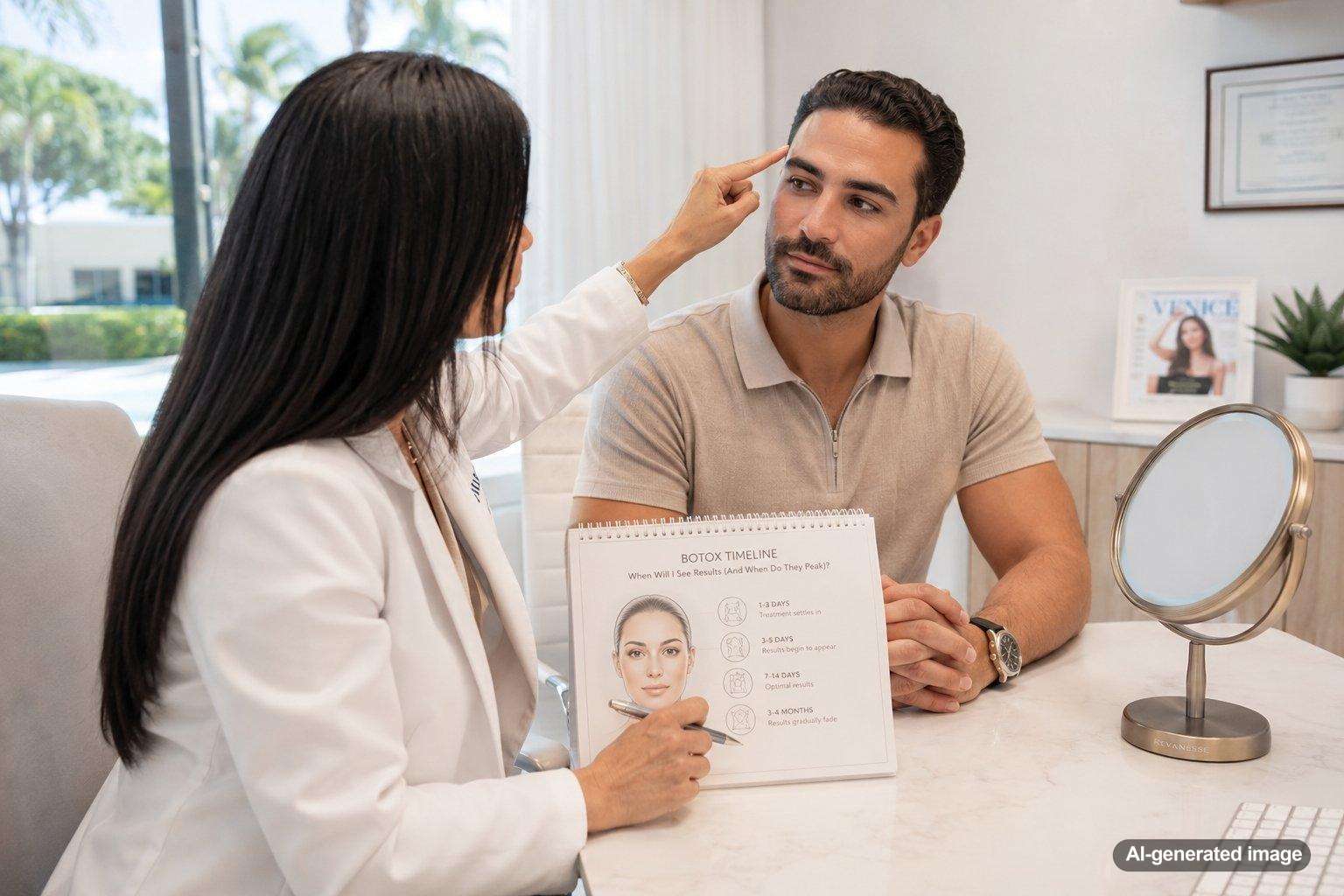
Botox does not usually look final the moment you leave your appointment. For many people, the change is gradual: movement begins to soften first, then lines may look smoother as the treated muscles relax over the following days. The exact timing can vary based on your anatomy, the area treated, the dose, your prior treatment history, and how your body responds.
In general, many people begin noticing early Botox results within several days, with a more settled look often developing around the 1 to 2 week mark. Results are temporary, so a thoughtful plan with a qualified clinician can help you understand what is realistic for your goals.
Quick answer
- Some people notice early softening in about 3 to 7 days, though timing varies.
- Botox results often look more developed around 10 to 14 days.
- The peak effect is commonly assessed at about 2 weeks, when your clinician can evaluate symmetry, movement, and whether refinement may be appropriate.
- Results are temporary and commonly last about 3 to 4 months, though duration can differ from person to person.
- Botox is a prescription treatment, so it should be performed by an appropriately trained medical professional in a clinical setting.
Why Botox results are not instant
Botox Cosmetic is a purified botulinum toxin medication that is injected into specific facial muscles to temporarily reduce the muscle activity associated with certain expression lines. It does not fill the skin like a dermal filler. Instead, it works by affecting the signal between nerves and targeted muscles, which is why the visual effect develops gradually rather than immediately.
Right after treatment, you may see small injection marks or mild redness, but that is not the final cosmetic result. The true result depends on how the targeted muscles respond over the following days.
A typical Botox timeline
Day 0: Your treatment day
On the day of treatment, the appointment is usually brief. Your clinician will evaluate facial movement, discuss your goals, and place small injections in carefully selected areas. You may be advised to keep aftercare simple that day, such as avoiding rubbing the treated area and following the specific instructions provided by your clinician.
Days 1 to 3: Subtle changes may begin
Some people feel that movement begins to soften within the first few days, while others do not notice much yet. Both patterns can be normal. It is usually too early to judge the final outcome during this window.
Days 3 to 7: Early results often become more noticeable
This is when many people begin to see a visible change in treated expression lines. The treated area may start to look calmer, and certain movements may feel less strong. Results can still be uneven or incomplete at this stage, so patience is important.
Days 10 to 14: Results are closer to settled
By about 10 to 14 days, Botox results often look more refined. This is a common time for clinicians to assess the result because the medication has had enough time to take effect in most people. If a follow-up is recommended, this is often the window when your provider can evaluate balance, movement, and whether any conservative adjustment may be appropriate.
After 2 weeks: Maintenance planning
Once results are settled, your clinician can help you understand a maintenance plan. Many people find that results last about 3 to 4 months, though duration can vary. Factors such as the treatment area, muscle strength, metabolism, dose, and treatment history may influence how long the effect remains visible.
What can affect how quickly Botox works?
Botox timing is not identical for every person. Several factors can influence when results appear and how they settle.
- Treatment area: Some areas may appear to respond faster than others.
- Muscle strength: Stronger facial muscles may take more time to soften or may need a different treatment plan.
- Dose and placement: Precise placement and appropriate dosing matter for both timing and appearance.
- Prior treatment history: People who receive regular treatment may notice a different pattern than first-time patients.
- Individual response: Everyone metabolizes and responds to neuromodulators somewhat differently.
What not to do while you are waiting for results
It can be tempting to judge your result too early, especially if one side seems to soften before the other. In most cases, it is better to wait until the expected settling window before deciding whether anything needs adjustment.
- Do not massage or press firmly on treated areas unless your clinician specifically tells you to.
- Do not schedule a refinement too early, because the result may still be developing.
- Do not compare your timeline too closely with a friend’s result, since anatomy and dosing differ.
- Do not receive injections from informal or non-medical settings.
- Contact your clinician if you have symptoms or concerns that feel unusual for you.
When do Botox results peak?
For many people, Botox results are considered near their peak around 2 weeks after treatment. That does not mean every person will follow the same timeline, but it is a practical checkpoint because the result has usually had time to develop. At that point, your provider can better evaluate whether your expression still looks natural, whether treated muscles have softened as intended, and whether the plan aligns with your goals.
A calm, natural-looking result is often the goal. The best Botox plan is not necessarily the one that removes all movement, but the one that helps soften targeted expression lines while preserving an appearance that still feels like you.
How long do results last?
Botox results are temporary. Many people see the effect last about 3 to 4 months, though some notice movement returning sooner or later. As movement gradually comes back, lines may begin to look more visible again. Your clinician can help you decide when maintenance makes sense based on your goals, your facial movement, and your treatment history.
When to contact your dermatologist
It is worth contacting your dermatologist or injector if you are unsure whether your healing or response is typical. You should also reach out promptly if you develop symptoms that concern you, such as significant weakness, difficulty swallowing, breathing concerns, vision changes, or other unexpected symptoms. These are not common cosmetic goals or expected outcomes, but prescription treatments should always be taken seriously.
At Waverly DermSpa, we offer Botox and can help you understand whether it may be appropriate.
FAQ
Can Botox work in 24 hours?
Some people may feel subtle changes early, but 24 hours is generally too soon to judge the final cosmetic result. Most people need several days to begin seeing visible softening.
Why does one side look different at first?
Early results can develop unevenly because facial muscles do not always respond at the exact same pace. Your clinician will usually want the treatment to fully settle before evaluating whether refinement is needed.
When should I schedule Botox before an event?
Because results take time to develop and mild bruising or redness can occur, it is often wise to plan ahead rather than booking immediately before an important event. Your clinician can help you choose a practical treatment window.
Will Botox make my face look frozen?
Not necessarily. A conservative, well-planned treatment can soften targeted movement while preserving natural expression. The outcome depends on your anatomy, goals, dose, placement, and provider technique.
Is Botox the same as filler?
No. Botox temporarily relaxes targeted muscle activity. Dermal fillers are used differently and can add or restore volume in selected areas. Your clinician can explain which approach fits your goals.
Ready to get help?
Schedule an appointment or send a message and our team will get back to you.
Prefer to call? 954-666-3736
Disclaimer
This article is for educational purposes and is not medical advice. For diagnosis and personalized treatment, please book an appointment with a board-certified dermatologist.
Sources & further reading
- American Academy of Dermatology (AAD) – Botulinum toxin therapy: Overview
- American Academy of Dermatology (AAD) – Botulinum toxin therapy: FAQs
- U.S. Food and Drug Administration (FDA) – BOTOX Cosmetic Medication Guide
- Cleveland Clinic – Botox Injections
