

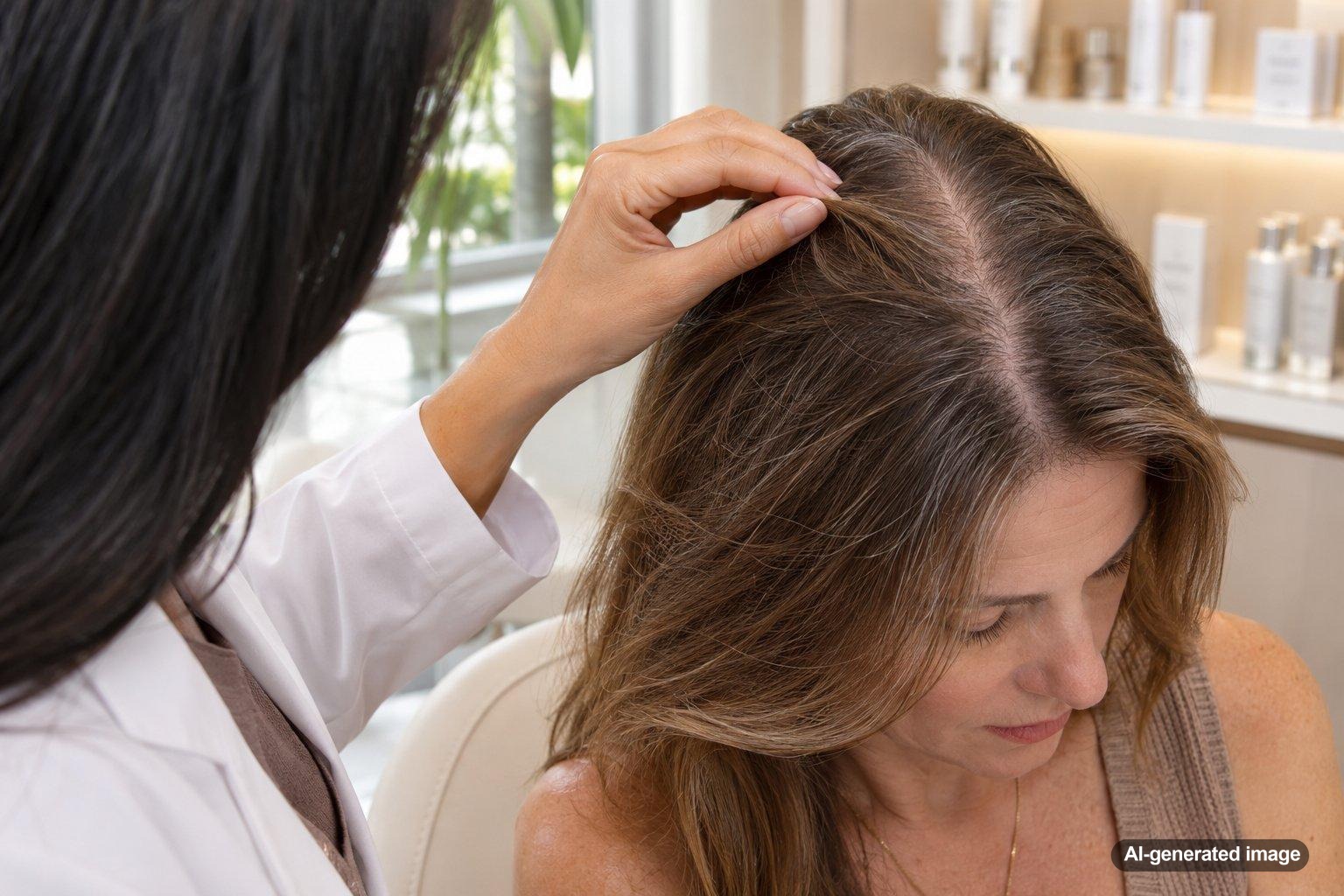
Menopause hair thinning at the part can be especially noticeable when you’re styling your hair, standing beneath bright lighting, or looking at recent photographs. While hormonal changes during menopause can contribute to reduced hair density, they aren’t necessarily the only explanation. Genetics, nutritional deficiencies, thyroid changes, physical stress, and everyday styling habits may also influence how much scalp becomes visible along your part.
Understanding these possibilities matters because different causes of hair thinning require different approaches. Several contributing factors can also occur at the same time, making it difficult to identify the underlying issue based on appearance alone. A closer look at your hair growth pattern, overall health, and scalp condition can help guide a more personalized approach.
Quick answer
- Hormonal changes during menopause can contribute to gradual thinning, particularly along the central part.
- Female pattern hair loss may become more noticeable during menopause, especially when there is a genetic predisposition.
- Thyroid disorders, iron deficiency, nutritional changes, and recent illness may contribute to additional hair shedding.
- Hair breakage and repeated tension from styling can make an already widening part appear more pronounced.
- A dermatologist can evaluate whether thinning reflects reduced follicle activity, increased shedding, hair breakage, or a combination of factors.
Why hair thinning often appears along the part
The central part provides a relatively unobstructed view of the scalp. Even modest changes in hair density or individual strand thickness can become visible in this area before they are obvious elsewhere.
During menopause, changes in estrogen levels and the relative influence of other hormones may affect the hair growth cycle. Some follicles may gradually produce finer, shorter hairs, reducing the amount of coverage across the top of the scalp.
However, a widening part doesn’t automatically establish that menopause is responsible. Female pattern hair loss, temporary shedding, and other changes in scalp or hair health may create a similar appearance.
What else could be causing your widening part?
When hair thinning develops during menopause, it can be helpful to consider changes in your health and daily routine alongside hormonal fluctuations.
- Genetic predisposition: Female pattern hair loss can develop gradually with age. A family history of thinning hair may provide a useful clue, although its absence doesn’t rule out the condition.
- Thyroid changes: An underactive or overactive thyroid can disrupt normal hair growth. Changes in energy, temperature sensitivity, or weight may provide additional context for a medical evaluation.
- Low iron levels: Iron deficiency may contribute to increased hair shedding. It can occur even after menstrual periods have stopped, making appropriate evaluation important.
- Inadequate nutritional intake: Restrictive eating patterns, rapid weight loss, or insufficient protein intake may affect the body’s ability to support normal hair growth.
- Physical or emotional stress: Surgery, significant illness, major life changes, and other stressors can trigger temporary increases in shedding. The shedding may not become apparent until several months after the triggering event.
- Changes in medication: Certain medications may contribute to hair shedding. A clinician can review whether the timing of a medication change corresponds with changes in hair density.
- Repeated styling tension: Tight ponytails, extensions, and hairstyles that consistently pull on the same areas may place unnecessary stress on hair follicles.
- Hair shaft damage: Frequent bleaching, chemical processing, and excessive heat can contribute to breakage, making hair appear less dense even when follicles are still producing hair.
More than one of these factors may be present. For example, someone experiencing gradual genetic thinning may also develop temporary shedding following an illness, making the widening part suddenly more noticeable.
Gradual thinning versus increased shedding
The way your hair changes over time can offer helpful information. Gradual widening of the central part, particularly when accompanied by finer strands across the crown, may suggest a different process from a sudden increase in hair collecting in the shower or on a hairbrush.
Temporary shedding, sometimes called telogen effluvium, occurs when an increased number of hair follicles enter the resting phase of the growth cycle. Although shedding may occur throughout the scalp, the central part can become more visible because it already exposes a narrow area of skin.
Breakage presents another possibility. Short, uneven strands may reflect damage to the hair shaft rather than a change in follicle activity, although newly growing hairs can also be short. A professional scalp examination can help distinguish these possibilities.
What you can do at home
A few conservative adjustments may help protect existing hair and provide useful information for a future dermatology appointment.
- Take occasional photographs of your part using consistent lighting, camera angles, and dry hair.
- Choose comfortable hairstyles that don’t create persistent tension around the scalp.
- Use gentle detangling techniques and reduce unnecessary exposure to high-temperature styling tools.
- Maintain a varied diet that includes adequate protein and essential nutrients.
- Keep a record of recent illnesses, significant weight changes, medication changes, and periods of increased stress.
- Protect exposed areas of the scalp from excessive sun exposure with a comfortable hat or suitable sun protection.
Avoid assuming that a specialized shampoo or hair growth supplement will address the underlying cause. Nutritional supplementation is generally most useful when there is an identified need. A healthcare professional can help determine whether testing or dietary changes are appropriate.
How a dermatologist evaluates menopause-related hair thinning
A dermatology evaluation typically begins with a discussion of when thinning started, how quickly it has progressed, and whether you have noticed increased shedding or changes in scalp comfort.
A dermatologist may examine hair strand thickness, follicle openings, scalp condition, and the distribution of thinning. Magnification can provide additional information about changes that are difficult to see without specialized equipment.
Depending on your medical history and examination findings, laboratory testing may be considered to evaluate possible nutritional deficiencies, thyroid function, or other contributing factors. Not everyone requires the same tests.
Identifying the type of hair loss helps guide treatment decisions and establishes a more meaningful baseline for monitoring future changes.
Professional options for improving hair health
Professional recommendations depend on the underlying cause, the extent of thinning, your medical history, and your personal preferences. Common approaches may include addressing identified nutritional or medical contributors, topical therapies, prescription options, and selected in-office procedures.
Platelet-rich fibrin matrix, commonly called PRFM, is an in-office option that may be considered for certain types of hair thinning. Its suitability depends on the diagnosis and individual follicle condition.
At Waverly DermSpa, we offer PRFM for Hair Loss and can help you understand whether it may be appropriate.
Hair growth responses vary between individuals. Establishing realistic expectations and identifying contributing factors remain important parts of developing a personalized care plan.
When to see a dermatologist
Although menopause-related hair changes can develop gradually, certain patterns deserve timely professional attention. Consider scheduling an evaluation if you notice:
- A central part that continues to widen noticeably.
- A sudden or substantial increase in hair shedding.
- Distinct patches of missing hair or rapidly changing hair density.
- Persistent scalp tenderness, burning, itching, redness, or scaling.
- Thinning accompanied by changes in eyebrow density or a receding hairline.
- Hair changes occurring alongside unexplained fatigue or other changes in your general health.
Some forms of hair loss benefit from early identification. Even when thinning appears mild, an evaluation can help establish what is happening rather than relying on assumptions about menopause or aging.
Frequently asked questions
Does a widening part always mean female pattern hair loss?
No. Female pattern hair loss is one possible explanation, but temporary shedding, nutritional deficiencies, thyroid changes, and hair breakage can also make the part appear wider. A scalp examination can help clarify the distinction.
Can hair thinning begin years after menopause?
Yes. Hair density can continue changing after menopause because of age-related follicle changes, genetic influences, and other health factors. New thinning after menopause should not automatically be attributed to hormonal changes.
Can I have normal blood test results and still experience hair thinning?
Yes. Female pattern hair loss and other changes in follicle activity may occur without abnormalities on routine blood tests. Laboratory results are only one component of a comprehensive hair loss evaluation.
Will changing my part help my hair grow back?
Changing your part may temporarily improve the appearance of coverage and reduce repeated styling tension in certain areas. However, it does not necessarily address the underlying cause of follicle-related thinning.
Can temporary shedding make existing menopause hair thinning worse?
Yes. Increased shedding following an illness, significant stress, or nutritional changes can make previously subtle thinning more noticeable. Identifying overlapping contributing factors can help guide an appropriate care plan.
Ready to get help?
Schedule an appointment or send a message and our team will get back to you.
Prefer to call? 954-666-3736
This article is for educational purposes and is not medical advice. For diagnosis and personalized treatment, please book an appointment with a board-certified dermatologist.
