

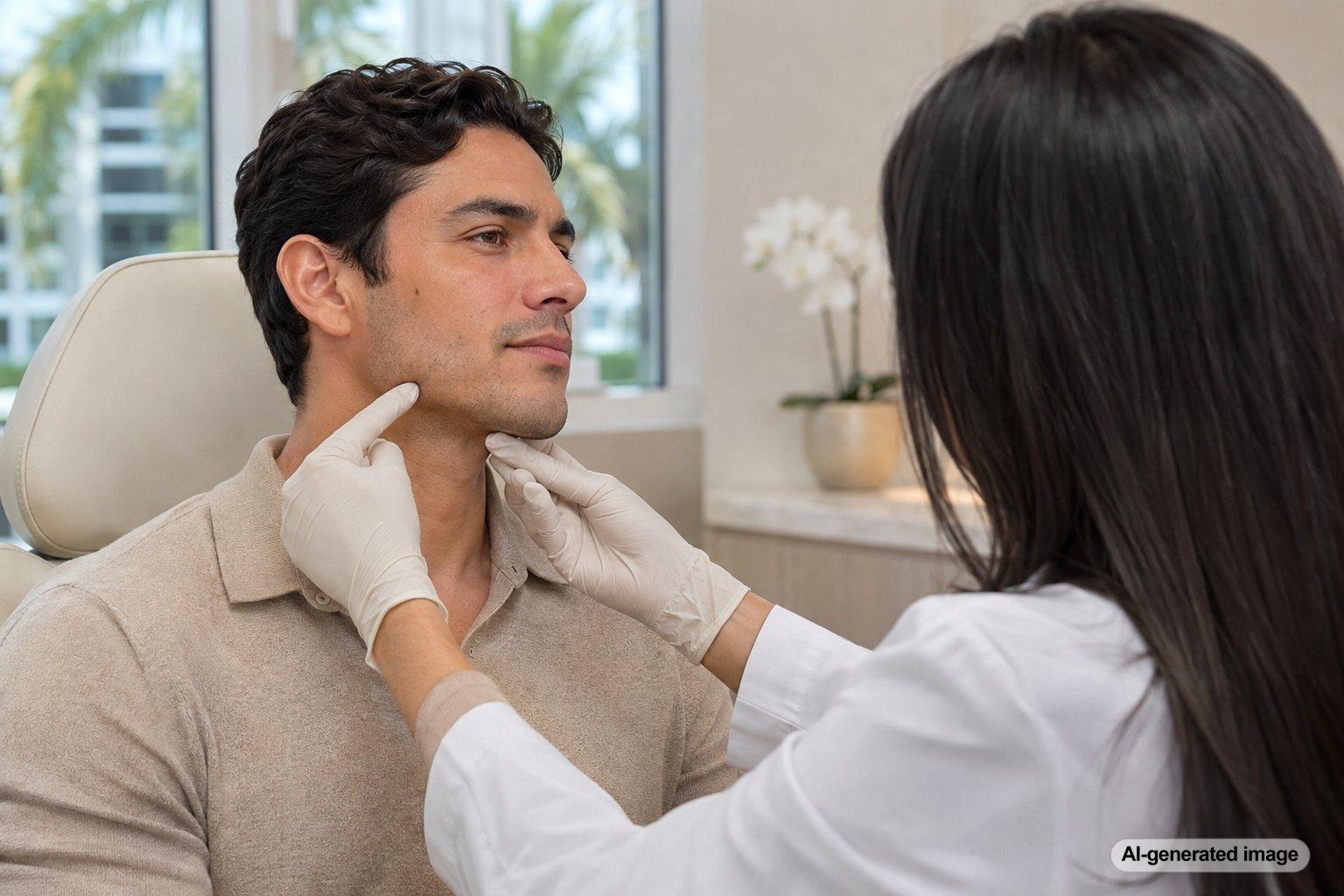
Botox may help improve the appearance of mild jowls and soften certain changes along the lower face, but it cannot directly lift loose skin or replace lost facial volume. Its potential benefit comes from relaxing specific muscles that pull downward on the jawline. For carefully selected patients, this may create a subtle improvement in facial contour without changing the underlying structure of the face.
Jowls develop for several reasons, including changes in skin elasticity, facial fat distribution, and support from deeper tissues. Because these changes do not all respond to the same treatment, Botox is not always the most appropriate approach. Understanding what Botox can and cannot accomplish is an important first step toward choosing a lower-face treatment that looks natural and aligns with your goals.
Quick Answer: Can Botox Help Sagging Jowls?
- Botox may subtly improve jawline definition when downward muscle activity contributes to the appearance of sagging.
- It does not tighten significant excess skin or restore facial volume that has diminished over time.
- Platysma treatment may help soften prominent neck bands and reduce certain downward-pulling effects around the jawline.
- Results are temporary and variable, depending on anatomy, muscle activity, and treatment technique.
- A dermatologist can evaluate whether Botox, another treatment, or a combination of approaches better addresses the source of lower-face changes.
How Can Botox Affect the Lower Face and Jawline?
Botox is a neuromodulator containing botulinum toxin type A. It temporarily reduces activity in targeted muscles by interfering with the nerve signals that normally cause those muscles to contract.
Although Botox is widely associated with forehead lines and crow’s feet, certain muscles in the lower face and neck can also influence facial appearance. These muscles contribute to expressions, mouth movement, and the balance of forces around the jawline.
One particularly important muscle is the platysma, a broad, thin muscle extending from the upper chest and neck toward the lower face. When it contracts, it can create vertical neck bands and contribute to downward tension along the lower facial border.
In selected patients, relaxing portions of this muscle may reduce that downward influence and make the jawline appear slightly more defined. However, the improvement is generally subtle and depends on the relationship between muscle activity and the surrounding tissues.
Botox Cosmetic has FDA approval for the temporary improvement of moderate to severe platysma bands in adults. That indication is distinct from a general treatment claim for lifting jowls or correcting facial sagging. A dermatologist can explain which proposed uses are FDA-approved and which may be considered off-label.
Why Do Jowls and Lower-Face Sagging Develop?
Jowls are areas of soft tissue that become more noticeable along or below the lower jaw. Their appearance reflects several overlapping changes rather than one isolated muscle problem.
Common contributing factors include:
- Reduced skin elasticity: Natural changes in collagen and elastin can make the skin less resilient over time.
- Changes in facial volume: Shifts or reductions in facial fat can alter the support and contours of the cheeks and lower face.
- Changes in deeper structural support: Age-related changes in bone and connective tissue can influence how facial tissues are positioned.
- Platysma muscle activity: Downward muscle tension may accentuate the appearance of certain jawline irregularities.
- Sun exposure: Cumulative ultraviolet exposure contributes to changes in skin quality and elasticity.
- Genetics and weight changes: Inherited facial structure and changes in body weight can influence when and how jowling becomes noticeable.
Botox addresses muscle activity, not all of these factors. When loose skin or changes in tissue support are the main contributors, relaxing a muscle may offer little visible improvement.
What Is a Nefertiti Lift With Botox?
The term Nefertiti lift describes a cosmetic injection approach intended to soften the downward pull of the platysma and potentially enhance the appearance of the jawline and upper neck.
The name refers to the elegantly defined neck and jawline commonly associated with ancient Egyptian depictions of Queen Nefertiti. Despite the word ‘lift,’ this procedure does not physically reposition sagging tissue in the way a surgical facelift or neck lift can.
The approach focuses on selected muscle activity around the lower face and neck. Depending on individual anatomy, a clinician may consider whether relaxing certain portions of the platysma could improve the visual balance of the jawline.
Potential benefits may include a softer appearance of vertical neck bands and a modest improvement in lower-face contour. These changes tend to be most relevant when muscle activity is a meaningful contributor to the concern.
The Nefertiti lift is not a standardized substitute for surgical lifting, and treatment techniques should not be assumed to be interchangeable with FDA-approved platysma band protocols. Individual evaluation is essential.
What Botox Cannot Do for Jowls
One of the most important considerations is understanding the limitations of Botox for lower-face rejuvenation.
Botox cannot remove excess skin. When significant tissue laxity causes the lower face to hang below the jawline, relaxing muscles does not eliminate that tissue.
Botox cannot replace missing volume. If changes in cheek or facial support contribute to jowling, other approaches may be more relevant.
Botox cannot directly tighten collagen. It works through muscle relaxation rather than the skin-remodeling mechanisms used by certain energy-based treatments.
Botox cannot reproduce the structural changes of surgery. Patients with more pronounced sagging may need a discussion of surgical options if substantial lifting is their primary goal.
For some people, Botox may provide a worthwhile refinement. For others, the expected change may be too limited to justify treatment. A realistic consultation helps clarify that distinction.
Who Might Be a Candidate for Lower-Face Botox?
People with relatively mild jawline changes and noticeable platysma activity may be more likely to benefit from a muscle-focused approach than those whose concerns arise predominantly from skin laxity or tissue descent.
During an evaluation, a dermatologist may assess the jawline at rest and during facial movement, the visibility of neck bands, the amount of skin laxity, and the relationship between muscle activity and the surrounding facial contours.
Medical history also matters. Certain neuromuscular conditions, previous treatments, medications, and other health considerations may affect whether botulinum toxin injections are appropriate.
Not everyone with jowls is a suitable candidate. In particular, the muscles that help support normal mouth movement and facial expression are closely interconnected in the lower face. Treatment must account for both cosmetic goals and normal function.
Can Botox Make Jowls or Lower-Face Sagging Look Worse?
Unwanted cosmetic changes are possible when muscle relaxation alters the balance of movement and support in the lower face. For example, weakening an unintended muscle can affect smile symmetry, lip movement, or the way the mouth rests.
Lower-face injections require careful anatomical assessment because muscles involved in expression, chewing, and speaking are located close together.
Other possible adverse effects include temporary bruising, swelling, discomfort, and unwanted muscle weakness. Botulinum toxin products also carry important safety warnings about the possibility of toxin effects spreading beyond the injection area, which can cause serious symptoms such as difficulty swallowing, speaking, or breathing.
These risks make provider qualifications and individualized treatment planning especially important. Lower-face Botox should be performed only by an appropriately qualified medical professional in a suitable medical setting.
What Can You Do at Home for Lower-Face Skin Health?
Home skincare cannot reproduce the effects of Botox or reverse substantial tissue descent. However, a consistent routine may help support skin quality and reduce avoidable contributors to premature skin aging.
- Use broad-spectrum sunscreen: Daily SPF 30 or higher helps protect against ultraviolet damage that contributes to visible skin aging.
- Maintain a gentle skincare routine: Cleansing and moisturizing can support the skin barrier and improve the appearance of dryness.
- Discuss appropriate anti-aging ingredients: A dermatologist can help determine whether ingredients such as retinoids fit your skin type and personal circumstances.
- Avoid aggressive facial manipulation: Forceful massage or unverified lifting techniques should not be expected to reposition jowls.
- Support overall skin health: Avoiding smoking and maintaining balanced daily habits can contribute to healthier-looking skin over time.
Facial exercises and topical lifting products are sometimes promoted for jowls, but their ability to produce meaningful, lasting correction of lower-face sagging is not well established.
What Other Professional Treatments May Help Sagging Jowls?
When Botox does not adequately address the underlying cause, a dermatologist may discuss other treatment categories. The appropriate choice depends on whether the primary concern involves skin laxity, facial volume, muscle activity, or more substantial tissue descent.
Dermal Fillers
Dermal fillers may help restore selected areas of volume or improve contour when a loss of structural support contributes to the appearance of jowls. They do not remove excess skin, and inappropriate placement can create unwanted fullness. Injectable fillers also carry important risks, including rare but serious vascular complications.
Energy-Based Skin Tightening
Some radiofrequency and other energy-based treatments aim to improve skin firmness through controlled tissue heating and remodeling. The degree of improvement varies, and these treatments are not equivalent to a surgical lift.
Collagen-Stimulating Injectables
Selected biostimulatory treatments may be considered when changes in facial volume or tissue quality contribute to the overall appearance. Their role, limitations, and risks differ from those of neuromodulators.
Surgical Consultation
More substantial skin laxity and tissue descent may be better addressed through surgical evaluation. A facelift or neck lift can reposition tissues in ways that Botox and other nonsurgical options cannot.
These approaches are not automatically interchangeable, and combining procedures is not necessarily appropriate for every patient.
When Should You See a Dermatologist About Jowls?
A dermatology consultation is appropriate when changes in the lower face concern you, when you are considering cosmetic injections, or when previous treatments have not produced the outcome you expected.
A dermatologist can distinguish between muscle-related contour changes and concerns primarily associated with skin laxity or volume loss. This helps establish realistic treatment goals and reduces the likelihood of choosing a procedure that does not address the underlying issue.
Changes that appear suddenly, especially one-sided facial drooping or facial weakness, should not be treated as routine cosmetic aging. Sudden facial drooping accompanied by symptoms such as arm weakness or speech difficulty warrants emergency medical attention.
After botulinum toxin injections, difficulty breathing, swallowing, or speaking requires immediate medical evaluation.
Frequently Asked Questions
Can Botox lift jowls without surgery?
Botox may create a subtle improvement in jawline appearance when downward muscle activity contributes to the concern. However, it does not physically lift loose tissue or remove excess skin, so the effect differs substantially from surgery.
How long does Botox for the lower face last?
The effects of cosmetic botulinum toxin treatment often last several months, although individual responses vary. The duration of any visible jawline refinement depends on the treatment area, anatomy, and other factors. A dermatologist can discuss reasonable expectations during consultation.
Is Botox better than filler for jowls?
Neither treatment is universally better. Botox targets muscle activity, while fillers are used to address certain volume and contour concerns. If significant skin laxity is present, neither approach may provide the degree of lifting desired.
Can Botox tighten loose skin under the chin?
Botox does not directly tighten loose skin. It may soften prominent platysma bands in appropriately selected adults, but excess skin beneath the chin generally requires a different type of treatment discussion.
Will lower-face Botox change my smile?
Changes in smile symmetry or mouth movement are possible if treatment affects muscles involved in facial expression. Careful patient selection, anatomical knowledge, and precise treatment planning help manage this risk but cannot eliminate it.
Can Botox be combined with other lower-face treatments?
In some circumstances, a dermatologist may consider combining treatments that address different contributors to facial aging. Whether this is appropriate depends on individual anatomy, medical history, treatment goals, and the risks associated with each procedure.
Making an Informed Decision About Lower-Face Botox
Botox can sometimes improve the appearance of mild jowls by reducing downward muscle tension, but its limitations are important. A less defined jawline does not necessarily mean that Botox is the right solution, particularly when skin laxity or changes in facial volume are the primary concerns.
At Waverly DermSpa, we offer Botox and can help you understand whether it may be appropriate.
Dr. Maryann Mikhail, MD, can evaluate your lower-face concerns and discuss options based on your anatomy and goals. Whether you live in Fort Lauderdale year-round or spend part of the year in South Florida, an individualized consultation can help you understand what a treatment may realistically accomplish.
Ready to get help?
Schedule an appointment or send a message and our team will get back to you.
Prefer to call? 954-666-3736
Disclaimer
This article is for educational purposes and is not medical advice. For diagnosis and personalized treatment, please book an appointment with a board-certified dermatologist.
Sources & Further Reading
- U.S. Food and Drug Administration (FDA) – BOTOX Cosmetic Prescribing Information
- American Academy of Dermatology (AAD) – Botulinum toxin therapy: FAQs
- Cleveland Clinic – Neck Lift (Platysmaplasty): Surgery, Recovery & What to Expect
