

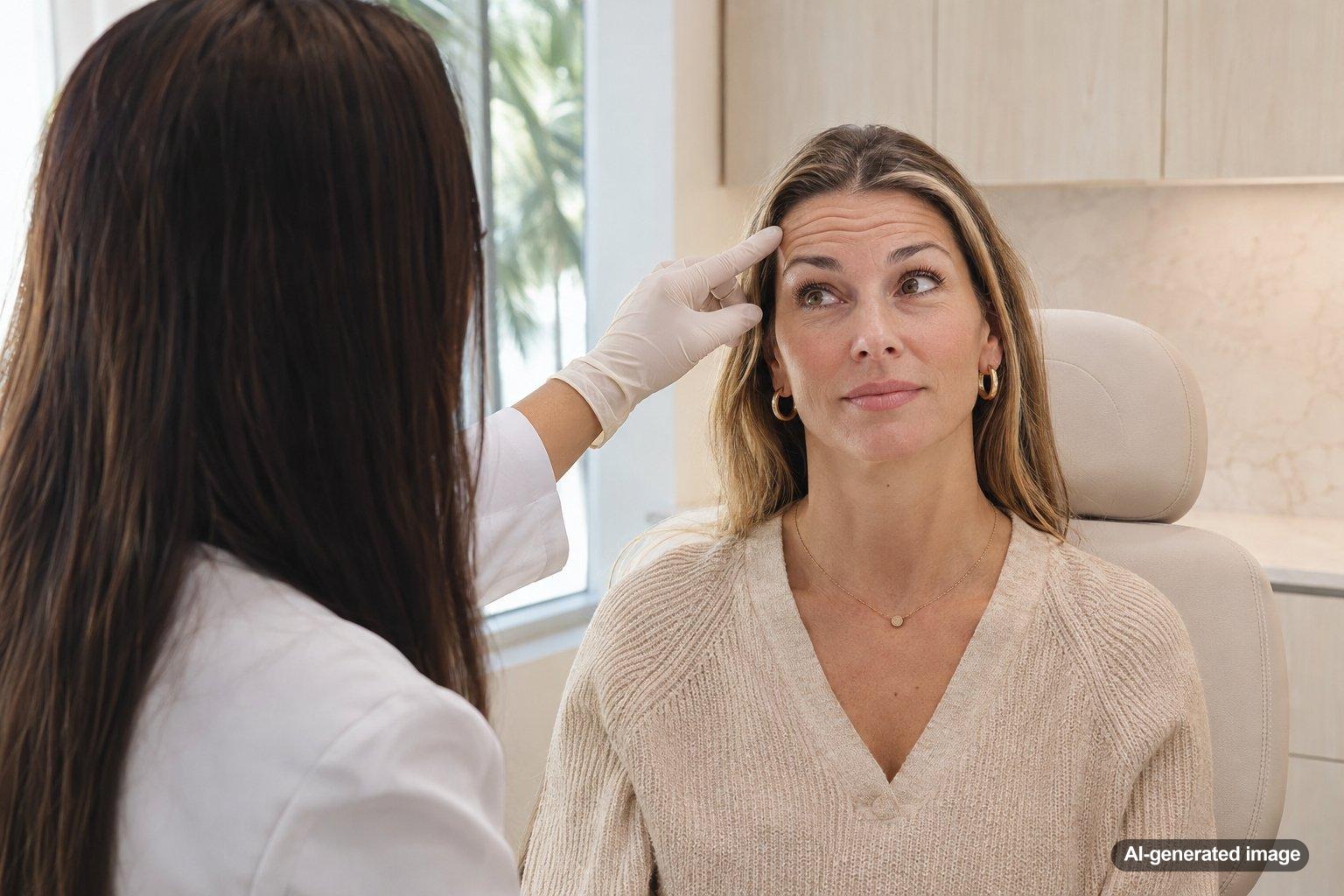
Some people notice that their neuromodulator injections produce a beautifully balanced result after one appointment, while others benefit from a small adjustment. A touch-up may be considered when certain facial muscles remain more active than expected, one side responds differently from the other, or the initial treatment was intentionally conservative. This does not automatically mean the treatment was performed incorrectly.
Neuromodulator treatments such as Botox and Dysport involve a careful balance between reducing unwanted expression lines and preserving natural facial movement. Because everyone’s anatomy, muscle activity, and treatment goals are different, the final result can vary. Understanding why a touch-up might be recommended can help patients approach their follow-up appointments with realistic expectations.
Quick Answer: Why Might a Neuromodulator Touch-Up Be Needed?
- Individual muscle strength: Some facial muscles may require a different treatment approach to achieve the intended degree of relaxation.
- Natural facial asymmetry: The two sides of the face may respond differently because muscle anatomy and movement are not perfectly identical.
- Conservative initial treatment: A dermatologist may intentionally begin with a measured approach to preserve expression and assess the response.
- Incomplete treatment development: Results continue evolving after injections, so an early impression may not represent the final outcome.
- Different aesthetic goals: A patient may prefer slightly less movement or a different balance after seeing how the initial treatment settles.
How Neuromodulator Injections Work
Neuromodulators are prescription injectable treatments that temporarily reduce activity in selected muscles. They work by interfering with the nerve signals that normally trigger muscle contraction. When a targeted facial muscle relaxes, the expression lines associated with its repeated movement may become less noticeable.
Common cosmetic treatment areas include the lines between the eyebrows, horizontal forehead lines, and crow’s feet around the eyes. The goal is not necessarily to eliminate all movement. Many patients prefer a softer, more rested appearance while maintaining recognizable expressions.
Results are not immediate. Some people begin noticing changes within several days, but the response can continue developing for approximately 10 to 14 days, depending on the product, treatment area, and individual response. This is one reason clinicians generally assess the settled treatment effect rather than making decisions based on the first few days.
Common Reasons Someone May Need a Touch-Up
1. Facial Muscles Have Different Strengths
Facial muscles do not contract with identical force in every person. Someone who frequently raises their eyebrows, squints, or furrows their brow may have particularly active muscles in certain areas.
If some movement remains after treatment, a dermatologist can evaluate whether it represents normal expression, an intentionally conservative result, or a potential reason for adjustment. The presence of movement alone does not establish that additional medication is needed.
2. Natural Facial Asymmetry Becomes More Noticeable
Most faces have subtle differences between the left and right sides. One eyebrow may naturally sit slightly higher, or one side of the forehead may move more strongly during expression.
When neuromodulators change the activity of selected muscles, these differences can sometimes become more apparent. A patient might notice that one eyebrow lifts more easily or that expression lines appear softer on one side.
A dermatologist can assess the relationship between the muscles involved before deciding whether any adjustment is appropriate. Perfect symmetry is not a realistic or necessary goal for every face.
3. The Initial Treatment Was Intentionally Conservative
For someone receiving neuromodulators for the first time, a dermatologist may choose a conservative initial approach. This allows the clinician to observe the person’s response while reducing the possibility of excessive muscle relaxation.
The same approach may be appropriate for patients who specifically want subtle improvement or who depend on expressive facial movement for personal or professional reasons.
After the initial effect has developed, a follow-up evaluation may help determine whether the original treatment achieved the intended balance. In some cases, no adjustment is necessary. In others, a carefully considered touch-up may be discussed.
4. The Treatment Has Not Fully Settled
One of the most common sources of uncertainty is evaluating results too early. Neuromodulators do not produce their complete effect immediately after injection.
During the first several days, some treated muscles may appear to relax sooner than others. This can create temporary differences in movement that become less noticeable as the treatment continues developing.
Because the response varies, clinicians often schedule a follow-up assessment around two weeks after treatment, although the appropriate timing depends on the product and individual circumstances. Adding medication prematurely could produce more relaxation than intended.
5. The Original Treatment Goal Needs Clarification
Not everyone defines a successful result in the same way. One patient may want visible softening of forehead lines while retaining the ability to raise their eyebrows. Another may prefer greater reduction in movement, provided the result remains balanced and appropriate for their anatomy.
Sometimes the initial treatment is working as expected, but the patient realizes that their preferred outcome differs from what they originally described.
A follow-up appointment provides an opportunity to discuss those preferences and assess whether further treatment would be safe, beneficial, or unnecessary.
What Can You Do at Home Before Your Follow-Up?
The most useful approach is to allow the treatment to develop and follow the aftercare instructions provided by your clinician. Trying to correct the result yourself is neither necessary nor appropriate.
- Allow time for the response: Avoid judging the outcome solely by changes observed during the first few days.
- Observe normal facial expressions: Notice how your forehead, eyebrows, and eye area move naturally without repeatedly forcing exaggerated expressions.
- Use consistent photographs: If helpful, compare your appearance under similar lighting, camera angles, and facial expressions rather than relying on photographs taken under very different conditions.
- Follow individualized aftercare: Avoid rubbing or massaging treated areas immediately afterward, as directed by your clinician.
- Keep your treatment information: Record the date, product, and treating practice so your dermatologist has useful context during a follow-up discussion.
Do not attempt to obtain additional injections from another provider simply because the first result seems subtle. Your original treatment details matter when assessing the safety and appropriateness of further injections.
How a Dermatologist Decides Whether a Touch-Up Is Appropriate
A neuromodulator touch-up should be a clinical decision rather than an automatic response to any remaining facial movement. During a follow-up assessment, a dermatologist may examine the face both at rest and during normal expression.
The evaluation may consider muscle activity, eyebrow position, facial symmetry, the original treatment plan, the product administered, and the patient’s goals. The clinician also considers whether the treatment has had sufficient time to develop and whether additional injections could create unwanted weakness.
Potential recommendations include:
- No additional treatment: The existing result may already provide an appropriate balance between relaxation and expression.
- Further observation: More time may be appropriate if the initial response is still developing.
- A limited adjustment: A clinician may consider additional treatment in a selected area after evaluating the existing effect and product-specific safety considerations.
- A revised plan for a future session: Sometimes the most appropriate solution is to document the response and make adjustments during a later treatment cycle rather than immediately adding medication.
Botox and Dysport are different prescription products, and their dosing units are not directly interchangeable. Decisions about additional treatment should account for the specific product used and its prescribing information.
When Should You Contact a Dermatologist?
Contact your treating clinician if you notice a persistent difference in eyebrow movement, an unexpectedly uneven result, or an appearance that concerns you after the anticipated treatment-development period. A follow-up assessment can help distinguish residual muscle activity from an unwanted effect that should not be treated with additional injections.
New eyelid drooping, significant visual changes, or unusual weakness also warrant prompt medical evaluation. These symptoms should not be treated as ordinary cosmetic concerns.
Seek immediate medical care if you develop difficulty breathing, swallowing, or speaking, or generalized muscle weakness after botulinum toxin injections. Although serious reactions are uncommon, prescription botulinum toxin products carry important warnings about effects that can extend beyond the injection site.
A touch-up is not the appropriate response to a suspected treatment complication. Your dermatologist can help determine the safest next step.
Frequently Asked Questions
Is it normal to have some movement after Botox or Dysport?
Yes. Some residual movement may be intentional, especially when the treatment goal is to soften expression lines without creating an overly restricted appearance. Your dermatologist can assess whether the remaining activity is consistent with your treatment plan.
How soon can I tell whether I need a touch-up?
Results develop gradually, and many clinicians prefer to assess the response around two weeks after treatment. The appropriate follow-up schedule may vary with the product, treatment area, and your individual circumstances. Follow the timing recommended by your treating clinician.
Does needing a touch-up mean my Botox did not work?
Not necessarily. A partial response, natural asymmetry, or intentionally conservative treatment can all contribute to a recommendation for reassessment. Your dermatologist can determine whether the treatment is functioning as intended or whether any adjustment makes sense.
Can too much neuromodulator make the result look unnatural?
Excessive relaxation of certain facial muscles can affect expression or eyebrow and eyelid positioning. This is why additional medication should be considered carefully rather than used automatically whenever movement remains.
Will I need a touch-up after every treatment?
Not necessarily. Responses can differ between treatment sessions, and many people do not require an additional adjustment. Keeping a record of prior results can help your dermatologist refine future treatment planning.
Is a touch-up the same as a maintenance appointment?
No. A touch-up generally refers to reassessing and potentially adjusting a recent treatment. Maintenance treatment refers to a later session considered as the temporary neuromodulator effect gradually wears off. The appropriate interval depends on the product, treatment history, and clinical assessment.
A Personalized Approach to Natural-Looking Results
Needing a touch-up does not automatically indicate a problem. The important question is whether additional treatment would improve the intended outcome without compromising natural expression or safety. Facial anatomy, treatment response, and personal preferences all deserve consideration.
At Waverly DermSpa, we offer Botox and can help you understand whether it may be appropriate.
Dr. Maryann Mikhail, MD, and the Waverly DermSpa team in Fort Lauderdale can help patients discuss their treatment goals, understand their response, and determine whether a follow-up evaluation is appropriate.
Ready to get help?
Schedule an appointment or send a message and our team will get back to you.
Prefer to call? 954-666-3736
Disclaimer
This article is for educational purposes and is not medical advice. For diagnosis and personalized treatment, please book an appointment with a board-certified dermatologist.
Sources & Further Reading
- American Academy of Dermatology (AAD) – Botulinum toxin therapy: FAQs
- Cleveland Clinic – Botox (Botulinum Toxin): What It Is, Results & Side Effects
- U.S. Food and Drug Administration (FDA) – FDA Warns Companies Over Illegal Marketing of Botox and Related Products
