

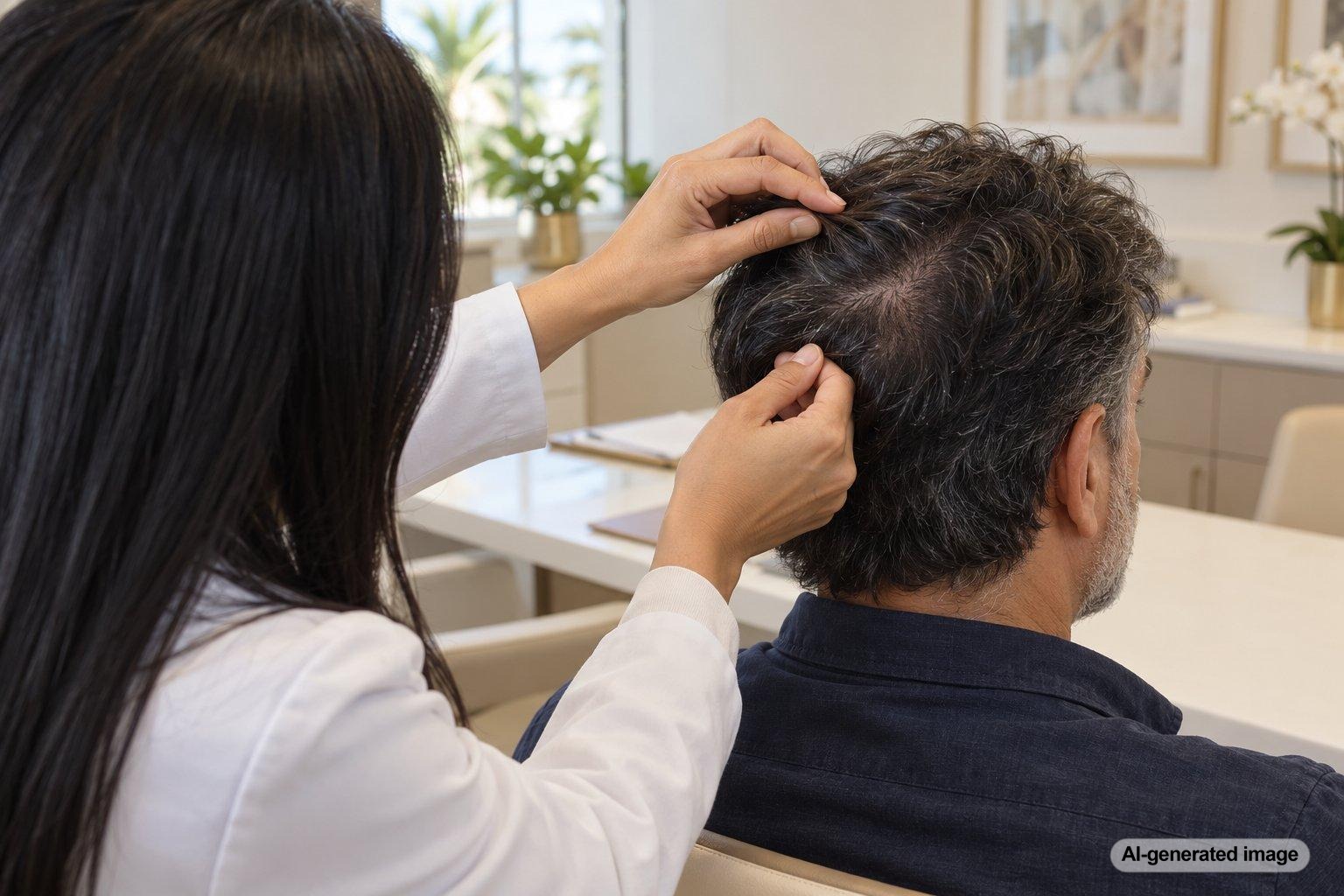
When one section of your hair seems to stop growing beyond a certain length, the problem may not be slow growth at all. Hair can continue growing normally from the scalp while the exposed strands repeatedly break at a similar point. This creates a patch that looks shorter than the surrounding hair, sometimes with a noticeable line where the longer strands begin.
Repeated breakage in one area often reflects something specific happening to that section, such as friction, tension, heat exposure, or an older area of weakened hair. However, not every patch of short hair represents breakage. Understanding the difference between damaged strands, new growth, and changes involving the scalp can help you decide whether gentle adjustments are enough or a dermatologist should take a closer look.
Quick Answer: Why Does Hair Keep Breaking at the Same Length?
Hair that repeatedly breaks at a similar length in one area may be experiencing ongoing stress or weakness at a particular point along the hair shaft. Several explanations are possible:
- Repeated friction: A pillowcase, collar, headwear, or habitual styling movement may repeatedly rub the same section.
- Localized tension: Tight hairstyles, clips, extensions, or frequent pulling may place more stress on certain strands.
- Heat or chemical damage: A section that receives more heat, coloring, lightening, or processing may become unusually fragile.
- Older damage: Previously weakened hair can continue snapping as it reaches a vulnerable point, even after the original damaging practice has stopped.
- Scalp or hair-shaft concerns: Some patterns that resemble ordinary breakage may warrant dermatologic evaluation, especially when accompanied by thinning, irritation, or visible scalp changes.
The location of the short section, the appearance of the hair ends, and whether the problem continues over time can provide useful clues.
What Does It Mean When Hair Breaks in One Particular Area?
Every hair strand grows from a follicle beneath the scalp. The portion you see above the skin is the hair shaft, which consists primarily of keratinized cells. Although the follicle produces new hair, the exposed shaft cannot biologically repair itself after structural damage.
As hair grows longer, its older sections experience additional washing, brushing, styling, environmental exposure, and everyday wear. The protective outer cuticle can become disrupted, leaving the inner structure more vulnerable to splitting and snapping.
When this happens repeatedly in a concentrated area, you may notice a section of hair that never seems to reach the same length as neighboring strands.
For example, hair near one temple might repeatedly break around the height where a styling clip sits. Hair at the back of the head may become shorter where it regularly contacts a collar. Another section may break where a flat iron repeatedly clamps down.
However, the visible length of a broken strand does not necessarily identify the exact location where the damage began. Damage can accumulate over time, and strands may break at different points along weakened areas.
Common Reasons Hair Breaks at the Same Length in One Area
1. Repeated Friction Against the Same Section
Friction is an easily overlooked contributor to localized hair breakage. When the same group of strands repeatedly rubs against fabric, accessories, or other surfaces, the outer cuticle may gradually become worn.
Possible sources of localized friction include:
- Pillowcases and bedding, particularly when hair repeatedly contacts the same surface during sleep.
- Shirt collars, jackets, scarves, or uniform necklines.
- Helmet straps, hats, headbands, and other frequently worn accessories.
- Repeatedly tucking hair behind the same ear.
- Rubbing hair with a towel after washing.
Friction-related breakage does not always appear immediately. It may develop gradually, making the underlying habit difficult to recognize.
2. Hairstyles That Pull on One Particular Area
Hair tension is not always distributed evenly. A ponytail, bun, braid, or extension attachment may place more force on some strands than others.
Repeated pulling can damage the hair shaft and may also affect the follicles when traction is persistent. The hairline, temples, and areas beneath attachment points are particularly useful places to inspect for uneven tension.
Hair that feels uncomfortable, pulls against the scalp, or requires repeated tightening may be experiencing unnecessary stress.
If the area shows progressive thinning rather than simply shorter strands, a dermatologist can evaluate whether the follicles may also be affected.
3. Heat Styling Concentrated in One Spot
Many people unintentionally spend more time styling one section of their hair. A difficult curl, an uneven layer, or a small area that does not lie flat may receive extra passes from a heated tool.
Excessive heat can weaken hair fibers, especially when strands are already affected by coloring, lightening, or other chemical processing.
Breakage may become more apparent where the tool repeatedly contacts the same section or where an already fragile portion of hair is exposed to additional heat.
Using a lower appropriate temperature, reducing repeated passes, and allowing hair to dry appropriately before using tools designed for dry hair may help limit additional damage.
4. Chemical Processing That Creates a Weakened Section
Bleaching, coloring, relaxing, and permanent waving can alter the structure of the hair shaft. The degree of damage depends on multiple factors, including the product, application, processing conditions, and previous treatments.
When a particular length of hair has been processed repeatedly, it may become more vulnerable than the newer growth above it.
As that weakened section moves farther from the scalp during growth, it can eventually snap. This may create the impression that hair repeatedly stops at one predictable length.
Overlapping chemical treatments on previously processed hair can contribute to this pattern.
5. Brushing, Detangling, or Handling the Same Section More Aggressively
Mechanical handling can be uneven across the scalp. Some areas tangle more easily, while others are repeatedly brushed, teased, twisted, or pulled into place.
Hair is especially vulnerable when excessive force is used to remove knots or when brushing repeatedly catches on weakened strands.
For textured or tightly curled hair, detangling methods should account for the hair’s structure and condition. A technique that works well for one hair type may create unnecessary tension in another.
Starting near the ends, working upward gradually, and avoiding forceful pulling may help reduce further breakage.
6. Previous Damage That Has Not Yet Grown Out
Sometimes the original source of damage is no longer present, but the affected hair remains.
For instance, a section weakened by a previous coloring appointment may continue to break months later. Hair growing from the scalp can be healthy while the older portion remains fragile.
Conditioners and cosmetic treatments may temporarily improve softness, manageability, and the appearance of damaged hair. However, they cannot permanently reconstruct a severely damaged hair shaft.
Reducing additional stress while weakened lengths are gradually trimmed or shed through the normal hair cycle may help the section appear more even over time.
7. Hair-Shaft Differences or Scalp-Related Changes
Not all localized breakage is caused by styling. Certain hair-shaft abnormalities can make strands unusually fragile. Some are inherited, while others develop in association with acquired damage or other health concerns.
Changes involving the scalp may also contribute to fragile hair or create a pattern that resembles breakage.
When short hairs appear alongside scaling, tenderness, redness, itching, or visible thinning, it is important not to assume that the cause is purely cosmetic.
A dermatologist can examine the hair shafts and scalp to determine whether further investigation is appropriate.
How to Tell Hair Breakage From New Growth or Hair Loss
A patch of short hair can have several different explanations. Looking closely at the strands and surrounding scalp may help distinguish them, although appearance alone cannot establish a diagnosis.
Clues That May Suggest Hair Breakage
- Short hairs have blunt, irregular, frayed, or split-looking ends.
- The affected section contains strands of several different lengths.
- Hair feels unusually rough, brittle, or tangled in that area.
- Small fragments appear during brushing or styling.
- The pattern corresponds with a repeated hairstyle, accessory, or styling practice.
Clues That May Suggest New Growth
- Short hairs appear gradually after a period of shedding or a change in styling habits.
- The shorter strands have relatively smooth, tapered-looking tips.
- Hair density in the surrounding area appears stable or is improving.
These observations are not definitive. Broken hair can sometimes appear tapered, and new growth does not always look uniform.
Clues That May Suggest Hair Loss
- The scalp becomes more visible in the affected area.
- There is a widening part or a progressively receding hairline.
- The number of hairs in the area appears to decrease over time.
- There is noticeable shedding from the root rather than primarily short fragments.
Breakage and hair loss can occur together. If the distinction is unclear, a dermatologic examination may provide a more reliable answer than visual inspection at home.
Why Does the Breakage Seem to Stop at Exactly the Same Length?
This pattern can be particularly frustrating because the hair may appear to reach a certain point and then refuse to grow any longer.
In many situations, the apparent length limit reflects a balance between ongoing growth and repeated breakage. Hair continues to grow from its follicle, but the strand loses length when a vulnerable area snaps.
Consider a small section near the shoulder that repeatedly experiences friction from clothing. As the strands grow long enough to encounter that contact, some may develop enough wear to break. The section can then appear to remain close to the same length.
Another possibility is a band of older chemical damage. Strands can break when that weakened portion reaches a particular point during handling or styling.
The important distinction is that hair follicles do not generally measure the exposed strand and deliberately stop producing hair at an exact cosmetic length. A recurring short section should prompt consideration of breakage, growth patterns, and follicle-related changes rather than an assumption that growth has stopped.
Does the Location of the Broken Hair Offer Any Clues?
The location of the shorter section may help identify repeated sources of stress.
- Temples and hairline: Consider tension from pulled-back hairstyles, frequent edge styling, or accessories that contact the hairline.
- Back of the neck: Repeated contact with clothing, headrests, and bedding may be relevant.
- Crown: Review heat styling, brushing habits, chemical processing, and repeated manipulation of that section.
- One side of the head: Sleeping position, habitual hair handling, accessory placement, and uneven styling practices may contribute.
- Ends of one layer: Previous chemical processing, frequent heat exposure, or differences in how the layer is cut and styled may be involved.
These patterns are clues, not diagnostic rules. A particular location does not reliably establish a specific cause without examining the hair and scalp.
What Can You Do at Home to Reduce Repeated Hair Breakage?
When breakage appears related to routine handling, a few conservative changes may help protect the remaining strands.
Reduce Repeated Mechanical Stress
Pay attention to the objects and habits that regularly contact the shorter section. Consider whether a clip, collar, hair accessory, or frequently repeated movement is rubbing or pulling the same spot.
Changing how hair is secured, choosing less restrictive styles, and avoiding unnecessary tension may reduce continued stress.
Be Gentler During Detangling
Work through tangles gradually rather than pulling forcefully. Use a detangling method appropriate for your hair type and avoid repeatedly brushing fragile sections simply to make them look smoother.
A conditioner or suitable detangling product may improve slip and reduce the force needed to separate strands.
Reconsider Heat Styling Habits
If one area receives more heat than others, try reducing the frequency and intensity of styling in that section.
Use heated tools according to their instructions, avoid excessive temperatures, and limit repeated passes. Heat-protective styling products may help reduce some damage, but they do not eliminate the risks of excessive heat.
Space Out Potentially Damaging Chemical Services
If the breakage developed after bleaching, relaxing, or another chemical service, consider discussing a gentler maintenance approach with an experienced hair professional.
Repeated processing of already weakened lengths can worsen fragility. Avoid attempting corrective chemical treatments on a section that is visibly breaking.
Use Conditioning Products for Manageability
Conditioners and leave-in products can help reduce friction, improve combability, and make hair feel smoother. The appropriate formulation depends on hair texture, scalp tolerance, and styling needs.
Remember that improved softness does not necessarily mean the underlying shaft damage has been reversed.
Track the Area Without Constantly Testing It
Occasional photographs taken under similar lighting can help document whether the area is becoming shorter, thinner, or more even.
Avoid repeatedly stretching or tugging on the strands to test their strength. Frequent manipulation can create additional stress and make subtle changes harder to interpret.
Can a Haircut Stop the Same Section From Breaking?
Trimming damaged ends may improve the appearance of a fragile section and remove portions that are already split or frayed.
However, a haircut does not change the underlying follicle or automatically eliminate the cause of repeated breakage.
If the same hairstyle, chemical process, or friction pattern continues, newly grown lengths may eventually experience similar damage.
For that reason, trimming is often most useful when paired with changes that reduce ongoing stress. The amount of trimming needed depends on how much of the shaft is affected and the person’s preferred hairstyle.
What Can a Dermatologist Do for Localized Hair Breakage?
When hair repeatedly breaks in one area despite reasonable changes in care, a dermatologist can help distinguish structural hair damage from conditions involving the scalp or follicles.
An evaluation may include a discussion of how long the problem has been present, whether the affected area is changing, and which hair products or styling practices are used.
The clinician may examine the scalp and individual hair shafts, sometimes with magnification, to look for signs of fragility, inflammation, or changes in hair density.
Depending on the findings, professional options may include:
- Hair-care guidance: Identifying practices that may be contributing to repeated shaft damage.
- Hair-shaft assessment: Looking for characteristic abnormalities in the structure of fragile strands.
- Scalp evaluation: Checking for changes that may explain thinning, irritation, or unusual hair growth patterns.
- Additional testing: Considering selected laboratory tests or other evaluations when the history and examination suggest a broader concern.
- Individualized management: Discussing treatment options if an underlying medical condition is identified.
Not everyone with localized breakage needs medical testing or treatment. The goal is to understand the pattern and identify which next steps are appropriate.
When Should You See a Dermatologist?
Occasional broken strands are not necessarily a sign of disease. However, certain changes deserve professional evaluation, particularly when the cause is unclear.
Consider scheduling an appointment if:
- The same area continues breaking despite reducing heat, friction, and tension.
- The section is becoming progressively thinner or the scalp is increasingly visible.
- You notice redness, tenderness, scaling, persistent itching, or other scalp symptoms.
- The area develops a distinct patch of missing hair.
- Hair seems unusually fragile across several areas, not just one section.
- Breakage begins abruptly without an obvious change in styling or routine.
- The scalp develops pain, swelling, drainage, or other concerning changes.
Prompt assessment is especially important when hair loss progresses quickly or is accompanied by significant inflammation or discomfort.
If you’re unsure whether you are seeing breakage, regrowth, or actual hair loss, a dermatologist can evaluate the pattern rather than relying on the appearance of a few individual strands.
Frequently Asked Questions
Why does my hair grow normally everywhere except one spot?
One area may receive more friction, heat, pulling, or chemical exposure than the surrounding hair. This can make the visible strands shorter even when the follicles continue producing hair. Differences in growth cycles or localized scalp changes are other possibilities. An examination may be helpful if the area is thinning or the pattern persists.
Can sleeping on one side cause hair to break in that area?
Repeated contact with bedding may contribute to friction-related wear, particularly in hair that is already fragile. However, sleeping position alone cannot explain every one-sided pattern of short hair. Styling habits, prior damage, and scalp health may also be relevant.
Why does my hair keep breaking at the same point after I trim it?
Trimming removes damaged lengths but does not necessarily address ongoing friction, tension, or heat exposure. If those factors remain, the section may become fragile again as it grows. Persistent breakage despite gentler care may deserve dermatologic assessment.
Are short hairs around my crown always broken hairs?
No. Short crown hairs may represent new growth, naturally shorter strands, or breakage. The appearance of the ends, differences in length, hair density, and scalp condition can provide clues, but they are not always sufficient to distinguish the possibilities.
Can a conditioner repair hair that keeps breaking?
Conditioning products may improve lubrication, softness, and manageability, which can reduce additional stress during grooming. Some products temporarily improve the appearance and behavior of damaged fibers. However, they cannot permanently restore a severely damaged strand to its original structure.
How long does it take for a broken section of hair to grow back evenly?
The time varies with the amount of length difference, the individual’s hair growth pattern, and whether ongoing breakage has been reduced. Because scalp hair grows gradually, a visibly shorter section may take considerable time to blend with surrounding lengths. There is no single predictable timeline for every person.
The Bottom Line
Hair that repeatedly breaks at the same length in one area is often responding to a recurring source of damage, such as friction, tension, heat, chemical processing, or repeated handling. In other cases, an older weakened portion of the hair shaft continues snapping as it grows outward.
The most useful first step is to look for patterns: where the breakage occurs, what regularly contacts that area, and whether the surrounding scalp and hair density appear normal. Gentle changes may help reduce further damage, but persistent or unexplained breakage should not automatically be dismissed as a styling issue.
At Waverly DermSpa in Fort Lauderdale, Dr. Maryann Mikhail, MD, can evaluate hair and scalp concerns and discuss appropriate next steps based on your individual findings.
Ready to get help?
Schedule an appointment or send a message and our team will get back to you.
Prefer to call? 954-666-3736
Disclaimer
This article is for educational purposes and is not medical advice. For diagnosis and personalized treatment, please book an appointment with a board-certified dermatologist.
