

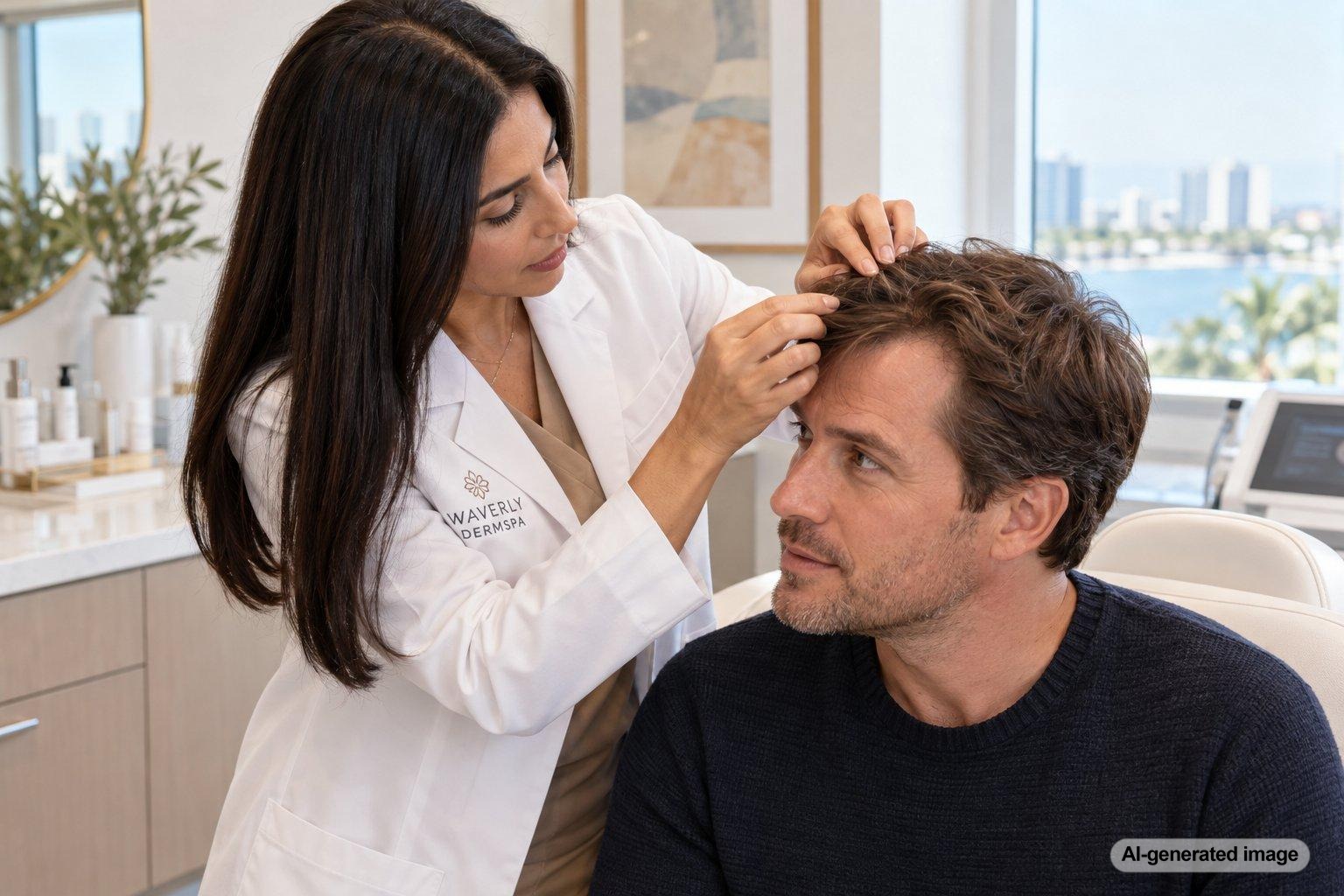
Finding a few wiry, unusually coarse hairs among otherwise soft hair can be surprising, especially when those strands seem to appear in the same spots. You might notice one hair that feels almost like a wire, stands away from the surrounding hair, or has a rough texture that makes it easy to identify by touch. In many cases, this difference reflects normal variation between individual hair follicles rather than a problem with the scalp.
Each hair follicle has its own growth characteristics, and neighboring follicles do not necessarily produce identical strands. Genetics, aging, hormonal influences, follicle shape, and everyday hair damage can all contribute to differences in texture. The important distinction is whether a few hairs have always been different or whether the change is new, spreading, or accompanied by other symptoms.
Quick Answer: Why Are a Few Hairs Wiry While the Others Are Soft?
- Individual follicles behave differently. A few follicles may naturally produce thicker, more curved, or less flexible hairs than nearby follicles.
- Hair shape affects how a strand feels. Differences in diameter, curvature, and cross-sectional shape can make one hair feel coarse while another feels smooth.
- Hormones and aging can influence hair growth. Some follicles change their output over time, although not every isolated coarse hair represents a hormonal concern.
- Damage can imitate naturally wiry texture. Heat, chemical processing, friction, and weathering can make portions of a hair shaft feel rough.
- New symptoms deserve attention. A sudden widespread texture change, unusual shedding, scalp inflammation, or rapidly increasing coarse facial or body hair may warrant evaluation.
Can Different Hairs on the Same Head Naturally Have Different Textures?
Yes. Hair texture is not necessarily uniform across the scalp. Even when someone’s hair appears consistently straight, wavy, curly, fine, or thick, individual strands may vary substantially when examined closely.
Hair follicles are small structures within the skin that produce hair shafts. Although follicles share the same general biological processes, they can differ in size, orientation, shape, and sensitivity to biological signals. Those differences influence the strands that emerge.
A thicker strand often feels stiffer because it resists bending more than a thinner one. A hair with pronounced bends or irregular curvature may also feel rougher when someone runs it between their fingers.
This means a single wiry hair does not automatically indicate that the strand is unhealthy. It may simply be the type of hair that particular follicle produces.
What Causes a Few Individual Hairs to Feel Wiry?
1. Natural Differences Between Hair Follicles
Every follicle contributes to the overall appearance of the hair, but follicles are not identical. Some produce relatively fine shafts, while others generate thicker or more curved strands.
These differences can exist within a small area of the scalp. One follicle might repeatedly produce a coarse hair surrounded by dozens of softer strands.
If the same unusual hair returns from the same location after shedding or trimming, that consistency may reflect the follicle’s established growth characteristics.
2. Genetics and Hair Shaft Shape
Inherited characteristics help determine hair diameter, curvature, and texture. Hair shafts vary in shape and structure, and these variations influence how light reflects from the hair and how it feels to the touch.
Some strands naturally have more curvature or a less uniform surface. They may seem kinked, springy, or wiry compared with nearby hairs.
It is possible to have several noticeably different strand textures without having separate scalp conditions.
3. Changes Associated With Aging
Hair can change gradually throughout adulthood. People often focus on graying or thinning, but changes in strand texture and manageability are also possible.
Some follicles may begin producing strands that are different in diameter or curvature from those produced earlier in life. Gray hairs can sometimes feel coarser or more resistant to styling, although gray hair is not inherently thicker or wirier in every person.
These changes do not always happen uniformly. A few strands may look or feel different while most of the hair remains familiar.
4. Hormonal Influences on Hair Growth
Hormones help regulate hair growth in different areas of the body. Certain follicles are particularly responsive to androgens, a group of hormones present in people of all sexes.
Hormonal influences can contribute to differences in hair diameter and growth patterns, particularly on the face and body. For example, a previously fine hair may become more noticeable and coarse in an androgen-sensitive area.
However, finding one or two coarse strands on the scalp is not, by itself, a reliable sign of a hormonal imbalance.
A broader pattern of new coarse facial or body hair, especially when accompanied by acne, changes in menstrual cycles, or scalp thinning, provides more useful context for a medical evaluation.
5. Heat Styling, Coloring, and Chemical Processing
Not every wiry strand begins that way inside the follicle. Hair can become rougher after it emerges from the scalp.
Frequent high-heat styling, bleaching, coloring, chemical straightening, and other processing techniques may damage the hair cuticle, the outer protective layer of the shaft.
When the cuticle is disrupted, strands may feel less smooth, tangle more readily, or become prone to breakage.
Damage may affect individual hairs unevenly. Some strands encounter more heat, friction, or chemical exposure than others, leaving only a few with an unusually rough texture.
6. Friction and Mechanical Stress
Repeated rubbing, tight hairstyles, aggressive brushing, and habitual twisting can stress individual hairs.
Mechanical damage may cause fraying, splitting, or irregularities along the shaft. These changes sometimes make a strand feel stiff or rough, particularly near areas of breakage.
Short broken hairs may also stand upright and appear wiry because they no longer have the length or weight needed to lie smoothly with the surrounding hair.
Why Does One Hair Feel Like a Wire or Fishing Line?
A particularly thick hair can feel surprisingly rigid compared with neighboring fine strands. Hair stiffness depends partly on the dimensions and physical properties of the shaft. Even a modest difference in diameter can make a strand substantially more resistant to bending.
Curvature adds another factor. If a hair bends sharply or twists along its length, it may resist lying flat and feel unusual when pulled gently between the fingers.
Sometimes the coarse sensation comes from the surface rather than the thickness. A damaged shaft may have irregularities that create a rough feeling despite having an otherwise ordinary diameter.
These explanations cannot always be distinguished by touch alone. A dermatologist may examine the hair and scalp more closely if the difference is new, pronounced, or associated with other changes.
Why Do the Same Wiry Hairs Keep Growing Back?
If a wiry hair repeatedly appears in the same location, the explanation may be relatively straightforward: the same follicle continues producing a similar type of strand.
Cutting a hair changes its length, not the underlying characteristics of the follicle. Similarly, trimming a coarse strand does not instruct the follicle to produce a finer one.
Plucking removes the visible hair from the follicle, but it does not reliably change the characteristics of future hair growth. Repeated plucking can also irritate the skin and contribute to ingrown hairs or follicular inflammation.
For an isolated coarse scalp hair that causes no discomfort, leaving it alone or trimming it gently is generally more conservative than repeatedly pulling it out.
Is a Wiry Hair Different From a Damaged Hair?
It can be. A naturally coarse strand and a damaged strand may feel similar, but their underlying characteristics differ.
Clues That a Strand May Be Naturally Coarse
- The strand feels relatively thick or stiff along most of its length.
- It has a consistent curl, kink, or wave pattern.
- Similar hairs have appeared in the same area for a long time.
- The surrounding scalp looks normal without redness, scaling, or irritation.
- The strand does not show obvious splitting or frequent breakage.
Clues That Hair Damage May Be Contributing
- The roughness is more noticeable near the ends or along previously processed lengths.
- The strand has split ends, white breakage points, or uneven thickness.
- Multiple short hairs have appeared after frequent heat styling or tight hairstyles.
- Hair tangles easily or breaks during grooming.
- The texture changed after bleaching, coloring, or chemical treatment.
These are observations rather than diagnostic tests. Some naturally coarse hairs are also damaged, and certain hair shaft abnormalities require closer examination to identify accurately.
What If the Wiry Hairs Are on My Chin, Neck, or Another Part of My Body?
A few coarse hairs on the face or body can have a different explanation from coarse hairs on the scalp.
Hair follicles in areas such as the chin, upper lip, chest, and abdomen may respond to androgen activity. As hormone exposure and follicle sensitivity change over time, some previously fine hairs may become thicker, darker, and more noticeable.
Isolated coarse chin hairs can occur without an underlying medical disorder. However, rapidly increasing facial or body hair, especially when accompanied by scalp hair thinning, acne, irregular menstrual periods, or other new symptoms, deserves professional assessment.
Location, growth pattern, timing, and accompanying symptoms are often more informative than the texture of one individual hair.
What Can You Do at Home About a Few Wiry Hairs?
If the coarse hairs are isolated, the scalp is comfortable, and there are no other changes, aggressive treatment is generally unnecessary.
- Use gentle conditioning. Conditioner can improve lubrication and manageability, making some rough strands feel smoother without changing their underlying follicle characteristics.
- Limit excessive heat. Reduce unnecessary exposure to very hot styling tools and use appropriate heat protection when styling.
- Avoid repeatedly plucking scalp hairs. Trimming a bothersome strand may be less irritating than repeatedly removing it from the follicle.
- Handle wet hair carefully. Minimize forceful brushing and pulling, particularly if the hair is already fragile.
- Pay attention to patterns. Notice whether the coarse hairs have always been present or appeared alongside changes in shedding, scalp comfort, or hair density.
- Keep products simple. A gentle shampoo and conditioner suited to your hair type are often more useful than adding multiple products promising to transform texture.
Conditioning products may improve the feel and appearance of a coarse strand, but they generally do not permanently change the shape or genetic characteristics of the follicle producing it.
Can You Make Naturally Wiry Hair Grow Back Soft?
There is no universally reliable home method for making a naturally coarse follicle begin producing fine hair.
Hair texture reflects a combination of follicle characteristics, genetics, biological influences, and the physical condition of the hair shaft. Surface treatments can improve smoothness and manageability, but they do not necessarily alter how future strands grow.
If the rough texture comes mainly from chemical or mechanical damage, reducing further damage and allowing healthier new growth may improve the overall appearance over time. Existing damaged lengths cannot always be fully restored by conditioning products.
When a texture change is associated with an underlying scalp or medical condition, management depends on the cause rather than on the texture alone.
When Might a Dermatologist Recommend a Closer Look?
A dermatologist can evaluate whether unusual hair texture represents ordinary follicle variation, hair shaft damage, a scalp disorder, or another change in hair growth.
Depending on the concern, evaluation may include reviewing the timing of the change, examining the scalp, assessing patterns of hair density, and looking at individual strands with magnification. Additional testing is considered only when the history and examination suggest a reason for it.
For isolated coarse hairs without other symptoms, medical treatment may not be necessary. When the texture change occurs alongside thinning, breakage, inflammation, or unusual facial or body hair growth, the discussion may focus on the broader pattern rather than individual wiry strands.
If an isolated coarse facial or body hair is primarily a cosmetic concern, a clinician can discuss appropriate hair removal approaches and their limitations. The suitable approach depends on the location, skin characteristics, and nature of the hair.
When Should You See a Dermatologist About Changing Hair Texture?
Consider scheduling an evaluation when a new texture change is accompanied by symptoms or changes that extend beyond a few isolated strands.
- Sudden or noticeable hair thinning: Especially when accompanied by increased shedding or patchy areas of hair loss.
- Scalp discomfort: Persistent itching, burning, pain, redness, scaling, or tenderness deserves attention.
- Unusual breakage: Hair that becomes increasingly fragile, develops irregular-looking shafts, or breaks without an obvious explanation may need assessment.
- Rapidly changing facial or body hair: A new pattern of coarse hair growth, particularly with other hormonal symptoms, can warrant evaluation.
- Changes affecting a larger area: A widespread or progressive alteration in hair texture is different from a few strands that have always felt coarse.
- Inflamed bumps around follicles: Recurrent tenderness, pustules, or significant irritation should not be attributed to normal texture variation without an examination.
If hair loss is accompanied by a painful, inflamed scalp or develops rapidly, seek timely medical assessment rather than waiting for additional cosmetic changes.
Frequently Asked Questions
Is it normal to have one or two wiry hairs on my head?
Yes. Individual follicles can produce strands with different diameters, shapes, and degrees of curvature. A few consistently coarse hairs, without scalp symptoms or other changes, can reflect normal variation.
Why is one strand of my hair much thicker than the others?
That follicle may naturally produce a wider hair shaft. Differences in hair diameter can make one strand feel much stiffer or more resistant to bending than surrounding hairs. Texture alone cannot determine whether the strand is abnormal.
Does a wiry hair mean I have a hormone imbalance?
Not necessarily. An isolated coarse scalp hair is not a reliable indicator of hormonal imbalance. A significant new pattern of coarse facial or body hair, especially with other symptoms, may be more relevant to discuss with a clinician.
Why do I sometimes find a coarse, crinkly hair among straight hairs?
Individual strands can differ in curvature and shaft structure. A naturally kinked strand may grow among straighter hairs. Uneven damage can also create an irregular appearance, so the history and condition of the strand matter.
Will plucking a wiry hair make it grow back softer?
Plucking does not reliably change the characteristics of the follicle that produces the hair. The next strand may have a similar texture, and repeated plucking can irritate the skin. Gentle trimming is an alternative when the hair is merely bothersome.
Can stress make individual hairs turn wiry?
Stress can influence aspects of hair growth and shedding, but a few isolated wiry hairs are not a specific or reliable indicator of stress. Genetics, natural follicle variation, aging, and hair damage are other possibilities. New texture changes accompanied by significant shedding or scalp symptoms are worth discussing with a dermatologist.
The Bottom Line on a Few Wiry Hairs
A few wiry hairs surrounded by softer strands often reflect the natural individuality of hair follicles. Differences in shaft thickness, curvature, and growth characteristics can make certain hairs feel noticeably coarse, even when the surrounding hair appears uniform.
The most useful questions are whether the hairs have always been that way, whether the scalp looks and feels healthy, and whether other changes are occurring. Stable, isolated coarse hairs are generally less concerning than a sudden or progressive change accompanied by hair loss, irritation, or unusual hair growth elsewhere.
If the pattern is new or you are uncertain about what you are noticing, a dermatologist can examine the hair and scalp and help determine whether any further evaluation is appropriate.
Ready to get help?
Schedule an appointment or send a message and our team will get back to you.
Prefer to call? 954-666-3736
This article is for educational purposes and is not medical advice. For diagnosis and personalized treatment, please book an appointment with a board-certified dermatologist.
