

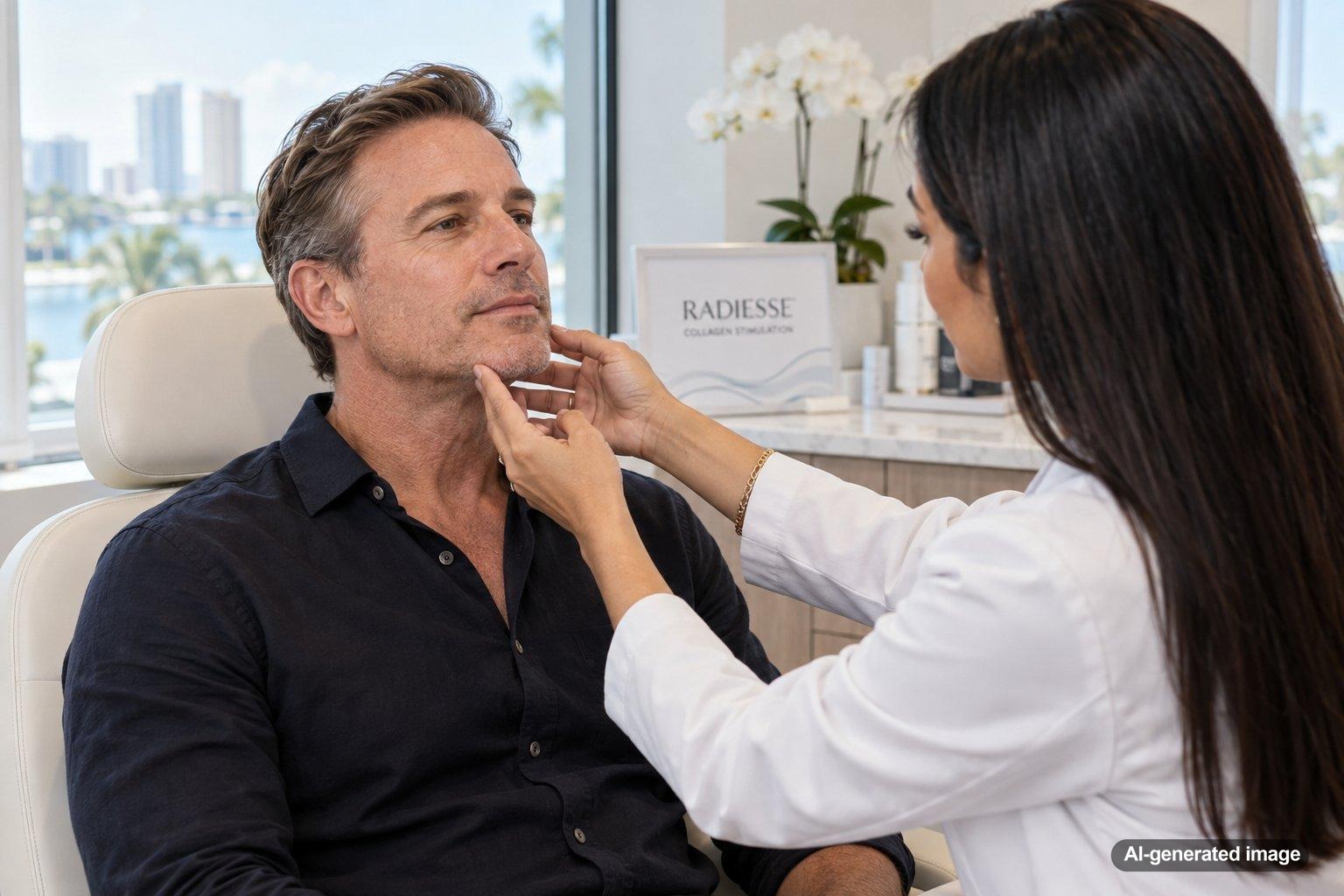
Changes in the lower face often develop gradually. The jawline may appear less defined, the area around the mouth may lose some of its former fullness, and the transition between the cheeks and chin may become softer. For people interested in addressing these changes without surgery, Radiesse is one injectable option that may offer both structural support and stimulation of the skin’s natural collagen production.
Radiesse is different from some familiar gel-based fillers because it contains calcium hydroxylapatite microspheres. These particles contribute to the product’s immediate filling effect and can encourage collagen formation over time. Understanding how those two effects work, and where the treatment may be appropriate, is an important part of making an informed decision.
Quick Answer: How Does Radiesse Support the Lower Face?
- Structural support: Radiesse can provide immediate volume and contour support in appropriately selected facial treatment areas.
- Collagen stimulation: Its calcium hydroxylapatite particles can encourage the production of new collagen around the treated tissue.
- Lower-face applications: Depending on the product, anatomy, and treatment plan, clinicians may consider Radiesse for certain lower-face folds and contour concerns.
- Gradual changes: Collagen-related improvements develop over time and vary between individuals.
- Professional assessment: An experienced medical injector should determine whether the product and intended treatment location are appropriate.
What Is Radiesse?
Radiesse is an injectable dermal filler made with calcium hydroxylapatite, often abbreviated as CaHA. The material consists of tiny calcium-based particles suspended in a water-based gel carrier. Calcium hydroxylapatite is related to a mineral naturally present in human bones and teeth, although the injectable product is specifically manufactured for medical use.
When placed in an appropriate tissue plane, the gel and suspended particles provide volume and support. As the carrier gel is gradually absorbed, the particles can serve as a framework around which the body produces collagen. This is why Radiesse is frequently described as a biostimulatory filler.
Radiesse is not simply a topical collagen treatment. It is an injectable medical product, and the choice of formulation, treatment site, amount, and placement technique affects both safety and the appearance of the result.
How Collagen Stimulation May Affect the Lower Face
Collagen is a structural protein that helps skin maintain its firmness and resilience. With age, changes in collagen, elastin, facial fat, bone structure, and supporting tissues can contribute to a less defined lower-face appearance.
Radiesse addresses some of these concerns through two related but distinct mechanisms. Its initial filling effect may provide support in selected areas, while the tissue response to calcium hydroxylapatite may encourage additional collagen formation over time.
That distinction matters because increasing collagen activity does not automatically produce a visible lifting effect. The appearance of the jawline and lower face also depends on deeper facial anatomy, fat distribution, skin elasticity, and the degree of tissue descent. A dermatologist can assess which factors are most relevant before suggesting an injectable treatment.
Which Lower-Face Concerns Might Be Considered?
Radiesse may be discussed during a consultation involving several common cosmetic concerns. However, not every area of the lower face is an approved or suitable injection site for every Radiesse formulation.
- Nasolabial folds: Radiesse has established indications for correcting moderate to severe facial wrinkles and folds, including nasolabial folds.
- Jawline definition: Certain Radiesse formulations have specific indications involving jawline contour improvement in appropriately selected adults. Product selection and injection technique require medical assessment.
- Lower-face volume changes: A clinician may evaluate whether restoring support in an appropriate area could improve overall facial balance.
- Skin quality concerns: Collagen stimulation may be relevant to discussions about skin firmness, although specific skin-tightening applications may be outside a product’s approved indications.
- Early jowl appearance: The cause and severity of jowling determine whether filler could provide a meaningful cosmetic improvement or whether another approach would be more appropriate.
Some techniques discussed online, including diluted or hyperdiluted calcium hydroxylapatite injections for skin quality, may involve off-label applications. Off-label use does not establish that a technique is suitable for a particular patient. Its evidence, limitations, and risks should be reviewed with a qualified medical professional.
What Causes the Lower Face to Lose Definition?
Lower-face aging is rarely explained by one change alone. Several processes can influence how the area looks:
- Collagen and elastin changes: Gradual changes in the skin’s supporting proteins can reduce firmness and elasticity.
- Facial fat redistribution: Changes in the position and volume of facial fat compartments can affect the appearance of folds and contours.
- Bone remodeling: Age-related skeletal changes can alter the underlying support of the chin and jaw.
- Skin laxity: Reduced elasticity and tissue support can contribute to a softer jawline.
- Sun exposure: Cumulative ultraviolet exposure can contribute to visible changes in skin texture, pigmentation, and elasticity.
- Individual anatomy: Genetics, facial proportions, and natural asymmetry influence how these changes develop.
Because these processes interact, adding filler is not always the most appropriate response. In some cases, additional volume could make the lower face appear heavier rather than more defined.
What Can You Do at Home to Support Lower-Face Skin Health?
Daily skin care cannot reproduce the structural effects of an injectable filler, but it can support the skin’s overall condition. Conservative habits are particularly useful for people concerned about texture, dryness, and photoaging.
- Apply broad-spectrum sunscreen with SPF 30 or higher regularly and use additional sun protection when spending time outdoors.
- Choose a gentle cleanser that does not leave the skin feeling excessively tight or irritated.
- Use a moisturizer appropriate for your skin type to support the skin barrier.
- Discuss ingredients such as retinoids with a dermatologist if you want to address visible signs of photoaging, especially if your skin is sensitive or you have other medical considerations.
- Avoid aggressive facial massage, abrasive devices, or unverified products that claim to rebuild the jawline.
- Maintain realistic expectations about the difference between improving skin texture and changing deeper facial contours.
These habits may complement professional skin care, but they should not be considered substitutes for a medical assessment when the primary concern is significant laxity or volume loss.
What Happens During a Radiesse Consultation?
A thoughtful consultation begins with facial assessment rather than a predetermined injection plan. Your dermatologist may examine skin quality, facial proportions, movement, existing volume, and the location of the changes you would like to address.
It is important to discuss previous fillers, cosmetic procedures, allergies, medications, bleeding concerns, relevant medical conditions, and any history of complications from injectable treatments. Active inflammation or infection near a proposed treatment area may be a reason to postpone an injection.
Your clinician should also explain whether the proposed use is within the product’s approved indications, what alternatives exist, and what complications are possible. The consultation is an opportunity to decide whether an injectable approach is appropriate at all.
How Is Radiesse Different From Other Fillers?
Radiesse is often considered alongside hyaluronic acid fillers and other collagen-stimulating products. These treatments have different properties and are not interchangeable.
Radiesse Versus Hyaluronic Acid Fillers
Hyaluronic acid fillers are gel-based products commonly used to add volume and refine contours. Different formulations are designed for different treatment areas and tissue characteristics. Some hyaluronic acid fillers may be treated with hyaluronidase when reduction or removal is medically appropriate.
Radiesse uses calcium hydroxylapatite rather than hyaluronic acid. It provides a filling effect while also encouraging collagen formation. Unlike hyaluronic acid fillers, Radiesse cannot be predictably dissolved with hyaluronidase. Managing an unwanted result or complication may therefore be more challenging.
Radiesse Versus Sculptra
Sculptra contains poly-L-lactic acid and works primarily through gradual collagen stimulation. Radiesse typically provides an earlier filling effect because of its gel carrier, alongside its biostimulatory properties.
The choice between them depends on the treatment objective, approved indications, anatomy, desired degree of volume correction, and clinician judgment. Neither product is automatically preferable for every lower-face concern.
When Might Results Become Noticeable?
Some visible change may be apparent shortly after appropriately placed Radiesse injections because the product provides volume and support. Initial swelling, however, can influence the early appearance and should not be confused with the final outcome.
Collagen-related changes are generally more gradual. The body’s response varies with factors such as treatment location, technique, individual biology, and the amount of product used.
Radiesse is not a permanent filler, and the duration of visible improvement differs between people. Aging continues after treatment, and some individuals may choose additional procedures or maintenance following professional assessment.
A dermatologist can discuss what changes are reasonable to anticipate in your particular situation without assigning a fixed outcome or timeline.
What Are the Risks and Limitations?
Radiesse injections carry risks similar to those of other injectable dermal fillers, along with considerations related to the properties of calcium hydroxylapatite.
Common injection-related reactions can include temporary swelling, redness, bruising, tenderness, discomfort, or itching. Other possible complications include nodules, persistent inflammation, infection, allergic reactions, contour irregularities, and delayed reactions.
Rare but serious complications can occur if filler enters a blood vessel. Vascular obstruction can interfere with blood supply and may lead to tissue injury, vision changes, blindness, or stroke. These complications require urgent medical attention.
Seek emergency medical care for sudden vision changes, severe or unusual pain, white or dusky skin discoloration near the treated area, or symptoms suggestive of a stroke during or after an injection. Do not wait for a routine follow-up appointment.
Radiesse also has product-specific contraindications and restrictions. An experienced licensed medical professional should review the current product labeling, including which lower-face uses are approved for the particular formulation.
When Should You See a Dermatologist?
A dermatologist can help determine whether an injectable treatment is suitable for concerns such as volume loss, facial folds, or declining jawline definition. This is especially useful when the visible change seems to involve both skin laxity and deeper facial structure.
Schedule a consultation before treatment if you have had previous filler complications, have an underlying medical condition that could affect injection safety, or are uncertain whether your goals are realistic for a nonsurgical procedure.
If you have already received filler and develop a persistent lump, increasing redness, warmth, drainage, or worsening swelling, contact your treating clinician promptly. Sudden severe pain, skin color changes, vision disturbances, or neurological symptoms warrant emergency evaluation.
At Waverly DermSpa, we offer Radiesse and can help you understand whether it may be appropriate.
Frequently Asked Questions
Does Radiesse actually stimulate collagen?
Calcium hydroxylapatite can encourage collagen formation in tissue surrounding the injected particles. However, the amount of collagen response and the resulting visible improvement vary. Collagen stimulation should not be interpreted as an assurance of skin lifting or facial rejuvenation.
Can Radiesse help define the jawline?
Certain Radiesse formulations may be used for jawline contour improvement in appropriately selected adults. The potential benefit depends on facial anatomy, existing tissue support, and the specific product’s approved indications. Filler may be less useful when substantial skin laxity is the main concern.
Will Radiesse make my lower face look fuller?
Radiesse has a filling effect, so increased volume is possible depending on placement and amount. Careful planning is important because some patients want contour support without visible fullness. A conservative, anatomy-based approach may help balance those objectives.
Is Radiesse the same as a skin-tightening treatment?
No. Radiesse is an injectable filler with biostimulatory properties. Collagen formation may contribute to changes in tissue quality, but this is not equivalent to surgically lifting descended tissues or tightening skin with an energy-based procedure.
Can Radiesse be dissolved if I dislike the result?
Radiesse cannot be predictably dissolved with the enzyme used for many hyaluronic acid fillers. Correcting an unwanted result may require individualized medical management, and complete removal may not be possible. This difference is important to understand before treatment.
How do I know whether Radiesse is right for me?
A dermatologist can evaluate your facial anatomy, medical history, skin condition, and treatment goals. That evaluation can clarify whether Radiesse, another injectable approach, a different procedure, or no treatment would be the most reasonable option.
Ready to get help?
Schedule an appointment or send a message and our team will get back to you.
Prefer to call? 954-666-3736
Medical Disclaimer
This article is for educational purposes and is not medical advice. For diagnosis and personalized treatment, please book an appointment with a board-certified dermatologist.
Sources & Further Reading
- U.S. Food and Drug Administration (FDA) – Dermal Fillers (Soft Tissue Fillers)
- American Academy of Dermatology (AAD) – Fillers: FAQs
- U.S. Food and Drug Administration (FDA) – FDA-Approved Dermal Fillers
