

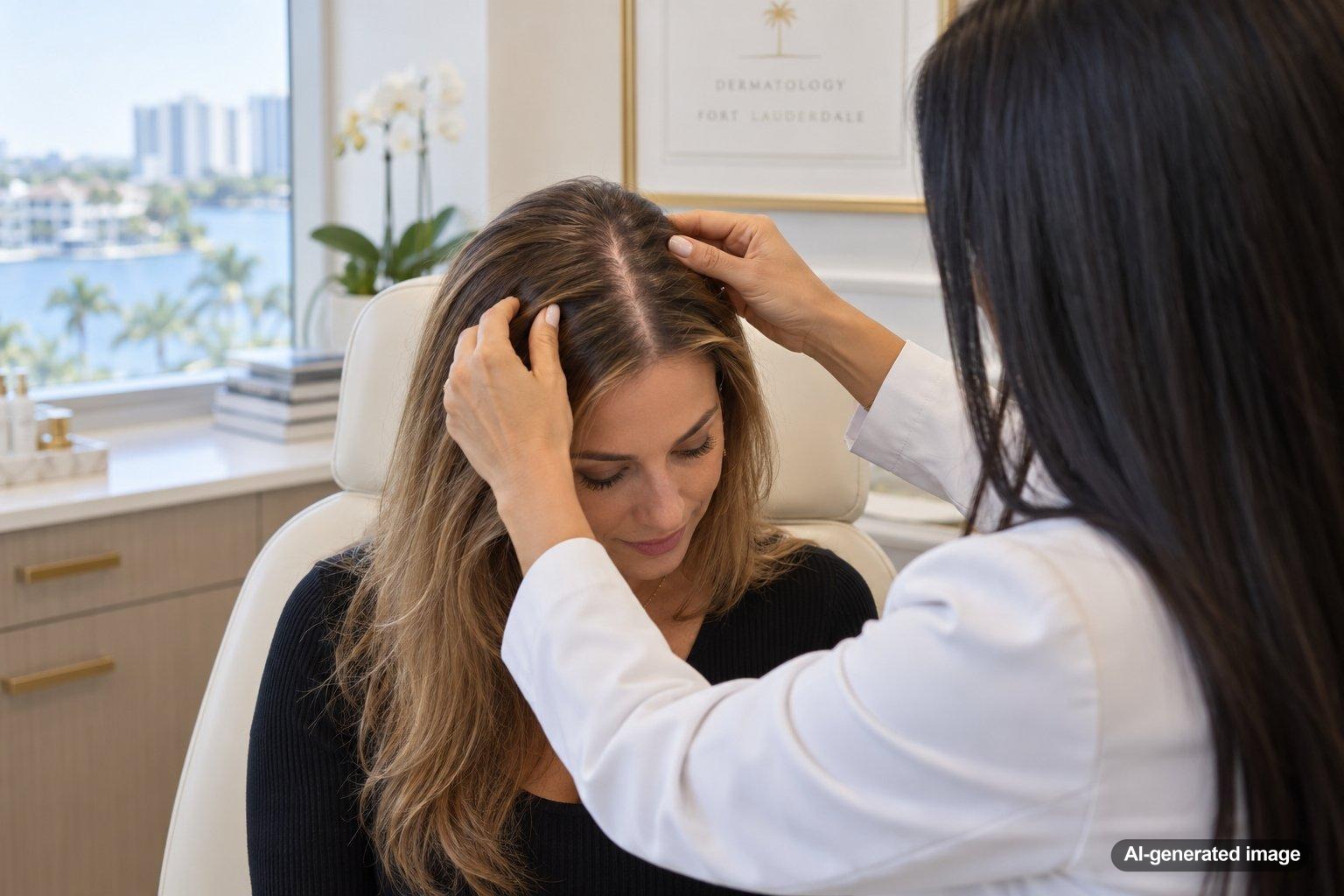
When the part line begins to look wider, more scalp becomes visible in photos, or the hair at the top of the head seems less dense than it used to, the change can be subtle but frustrating. Hair thinning in this pattern can have several possible causes, so determining what is happening is an important first step before choosing a treatment.
PRFM, or platelet-rich fibrin matrix, is one office-based option that may be considered for certain types of hair thinning. It uses a preparation made from a patient’s own blood and is placed into targeted areas of the scalp. Whether it is appropriate depends on the cause of the thinning, scalp health, medical history, and other individual factors that a dermatologist can evaluate.
Quick answer
- PRFM is an injectable treatment prepared from a small sample of the patient’s own blood.
- It may be considered for some people with gradual thinning around the part line or crown.
- A widening part can have multiple causes, so evaluation is important before assuming the thinning is related to one specific condition.
- PRFM does not create new hair follicles and outcomes vary from person to person.
- A dermatologist can determine whether PRFM, another treatment, or additional evaluation makes the most sense.
What is PRFM for hair thinning?
PRFM stands for platelet-rich fibrin matrix. The treatment begins with a blood draw. The sample is processed to concentrate components of the blood, including platelets and fibrin, which are then prepared for use in the scalp.
The resulting material is injected into selected areas where thinning is present. In hair-loss care, the goal is generally to support the environment surrounding existing follicles rather than replace follicles that are no longer present. Because hair loss has many possible causes, PRFM is typically considered as part of a broader treatment discussion rather than as a universal solution.
Why does thinning often become noticeable along the part line?
The center or side part is one of the easiest places to notice gradual changes in hair density. When individual hairs become finer or fewer hairs are growing in an area at the same time, more scalp may become visible between strands. A part that previously looked narrow can gradually appear broader.
Possible contributors to thinning around the part or crown can include hereditary patterns, hormonal changes, temporary shedding after physical or emotional stress, nutritional issues, certain medications, scalp conditions, and repeated tension from hairstyles. These possibilities can look similar without a careful examination.
For that reason, a dermatologist may review when the thinning began, whether shedding increased suddenly or gradually, family history, hair-care practices, medications, recent illnesses or major life changes, and the condition of the scalp. Additional evaluation may be appropriate when the history or examination suggests another underlying factor.
Who might consider PRFM?
PRFM may be discussed when a person has existing follicles in an area of reduced density and is looking for an office-based option that may complement an individualized hair-loss plan. It is not automatically appropriate for every type of thinning.
The distinction matters because gradual thinning along the part line is different from sudden patchy loss, scarring hair loss, active scalp inflammation, or abrupt widespread shedding. Treating the appearance of thinning without identifying the pattern can delay more appropriate care.
What happens during a PRFM appointment?
A typical appointment involves collecting a small blood sample and processing it in the office. The prepared PRFM is then administered to selected areas of the scalp using a series of small injections.
Your clinician can explain what preparation is needed, what the procedure may feel like, what temporary scalp effects can occur afterward, and whether any medications or health conditions require special consideration. Treatment planning varies because the extent and cause of hair thinning are different for each person.
What can you do at home for a widening part?
Gentle hair and scalp habits can help minimize avoidable stress while you determine why thinning is occurring. Practical steps may include:
- Avoid repeatedly wearing very tight ponytails, braids, buns, or extensions that pull on the same areas.
- Use heat styling thoughtfully and avoid repeatedly exposing fragile hair to very high temperatures.
- Handle wet hair gently, especially if strands are breaking easily.
- Maintain a balanced diet rather than beginning multiple hair supplements without knowing whether a deficiency is present.
- Take occasional photos of the same part line under similar lighting if you want a more consistent way to observe changes over time.
If shedding is persistent or density is clearly changing, home care alone may not address the reason. A professional evaluation can help separate hair-shaft breakage from changes occurring at the follicle or scalp level.
What other professional options may be considered?
Hair-loss treatment is usually guided by the suspected cause rather than by appearance alone. Depending on the evaluation, a dermatologist may discuss topical treatments, prescription options, changes in hair-care practices, correction of an identified contributing factor, injectable approaches such as PRFM, or other strategies.
Some people may use more than one approach because different treatments can address different parts of the problem. Your clinician can help you understand the potential benefits, limitations, and practical considerations of each option without assuming that one plan is appropriate for everyone.
When should you see a dermatologist?
It is worth scheduling an evaluation if you notice continuing loss of density, a progressively widening part, unusually heavy shedding, or a change that concerns you. More prompt evaluation is especially useful when hair loss is sudden, occurs in distinct patches, is accompanied by scalp pain or significant inflammation, or appears to involve areas of scarring.
Seeing a dermatologist does not mean that an invasive treatment will be recommended. The purpose of the visit is to identify the pattern, consider possible contributors, and discuss appropriate next steps.
Frequently asked questions
Does PRFM work for every type of female hair loss?
No single hair-loss treatment is suitable for every pattern or cause. PRFM may be considered for selected patients, but a dermatologist can first evaluate whether the follicles, scalp, and overall pattern make this approach reasonable.
Can PRFM restore hair in an area with no functioning follicles?
PRFM is generally used with the goal of supporting existing follicles. It should not be viewed as a way to create entirely new follicles in areas where they are absent.
Is a widening part always female pattern hair loss?
No. A widening part can be associated with several forms of hair thinning or shedding. The timing, distribution, scalp findings, medical history, and other details help a dermatologist determine what may be contributing.
Can PRFM be combined with other hair-loss treatments?
In some treatment plans, an injectable approach may be discussed alongside other options. The combination, if any, should be selected according to the suspected cause of thinning and the individual’s medical history.
How soon should I expect a change?
Hair grows in cycles, and responses to treatment vary. Your clinician can explain what changes may reasonably be monitored and how follow-up can be used to assess whether a treatment plan should continue or be adjusted.
Should I wait until my part is significantly wider before getting evaluated?
You do not need to wait for thinning to become severe before discussing it with a dermatologist. Earlier evaluation can help document the pattern and identify potential contributors while there is still useful baseline information to compare over time.
At Waverly DermSpa, we offer PRFM for Hair Loss and can help you understand whether it may be appropriate.
Ready to get help?
Schedule an appointment or send a message and our team will get back to you.
Prefer to call? 954-666-3736
This article is for educational purposes and is not medical advice. For diagnosis and personalized treatment, please book an appointment with a board-certified dermatologist.
