

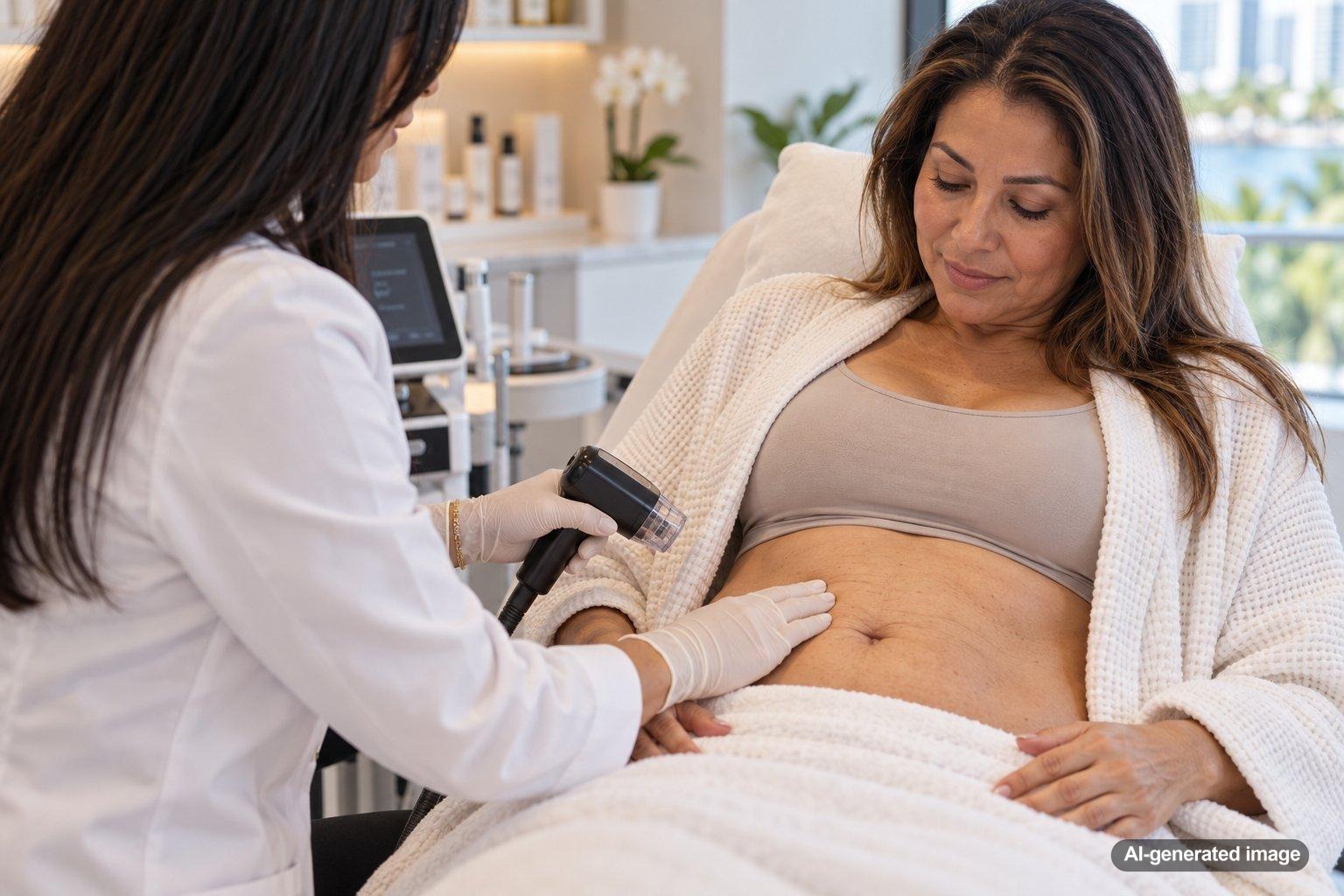
Pregnancy can leave the skin around the belly button looking looser, more crepey, or differently textured than it did before. These changes are common after the abdominal skin has stretched, and they may remain even after weight and abdominal size have stabilized. Morpheus8 is a radiofrequency microneedling treatment that may be considered when the main concern is skin texture and mild to moderate laxity rather than a deeper structural change.
The important distinction is that not every postpartum abdominal change comes from the skin itself. A personalized evaluation can help determine whether the concern is primarily loose skin, stretch marks, residual fat, abdominal muscle separation, scar tissue, or a combination of factors.
Quick answer
- Morpheus8 combines microneedles with radiofrequency energy delivered into the skin and underlying tissue.
- It may be considered for postpartum abdominal skin that appears mildly loose, crepey, or uneven in texture.
- It does not correct every cause of a protruding or changed abdomen, including abdominal muscle separation.
- Results vary, and the appropriate treatment depth, settings, and number of sessions depend on the individual.
- RF microneedling is a medical procedure with potential risks, so treatment should be performed by an appropriately trained, licensed health care provider.
What Morpheus8 is
Morpheus8 is a form of radiofrequency microneedling. During treatment, small needles enter the skin while radiofrequency energy produces controlled heating within the treated tissue. The goal of this type of procedure is to create a controlled response that may improve the appearance and texture of the skin over time.
The skin around the belly button can be a particularly noticeable area after pregnancy because it may have stretched considerably as the abdomen expanded. After delivery, some skin gradually contracts, while some may remain lax or develop a finely wrinkled appearance. How much change persists varies from person to person.
Why the skin around the belly button can look different after pregnancy
Pregnancy places significant mechanical stress on the abdominal skin. Several changes can contribute to the appearance of the area afterward:
- Skin stretching: Abdominal expansion can leave skin with less visible firmness after pregnancy.
- Changes in texture: Some people notice crepey or finely wrinkled skin, especially close to the belly button.
- Stretch marks: These can alter the color and texture of the surrounding skin and may coexist with laxity.
- Changes in body composition: Residual fat beneath the skin can affect abdominal contours independently of skin looseness.
- Abdominal wall changes: Pregnancy can affect the underlying abdominal muscles, so what appears to be loose skin may not be entirely a skin issue.
- Surgical scarring: A prior abdominal delivery or other procedure may influence skin tension, sensation, and treatment planning.
What Morpheus8 may and may not address
Morpheus8 may be considered when the concern is primarily the quality of the skin. Someone with mild laxity or crepey texture around the belly button may be a more logical candidate for a skin-focused treatment than someone whose main concern is substantial excess skin or a change involving the abdominal wall.
It is also important to keep expectations realistic. A nonsurgical procedure cannot duplicate the amount of tissue removal or repositioning possible with surgery. Likewise, a skin treatment does not repair separated abdominal muscles. If there is a persistent abdominal bulge, core weakness, discomfort, or a substantial amount of excess skin, a clinician may recommend evaluation beyond an aesthetic skin procedure.
What treatment is generally like
Before treatment, the clinician evaluates the skin, discusses medical history, and determines whether radiofrequency microneedling is appropriate. Treatment settings can differ according to the body area, skin thickness, treatment goals, and individual risk factors.
The handpiece is passed over the planned treatment area while microneedles deliver radiofrequency energy at selected depths. Temporary redness, swelling, tenderness, pinpoint crusting, or sensitivity may occur afterward. Your clinician should provide specific aftercare instructions based on the treatment performed.
Changes from a procedure of this type are generally evaluated over time rather than immediately after the appointment. The degree of improvement and the number of treatments that may be appropriate vary substantially, so an individualized plan is more useful than assuming a fixed treatment schedule.
Pregnancy, breastfeeding, and postpartum timing
If you are currently pregnant, breastfeeding, recently postpartum, or planning another pregnancy, tell your dermatologist before scheduling an elective procedure. Pregnancy and the postpartum period can involve ongoing hormonal, skin, and body changes, and treatment decisions should be individualized.
The American Academy of Dermatology recommends discussing skin treatments with a dermatologist during pregnancy because some products and procedures may need to be changed or postponed. The same practical approach is useful after delivery, particularly when breastfeeding or when the abdomen is still changing.
There is no single postpartum date that automatically makes every person ready for Morpheus8. Your clinician can consider factors such as healing after delivery, breastfeeding status, medications, skin sensitivity, scars, future pregnancy plans, and whether the abdominal contour has stabilized enough to make treatment worthwhile.
Safety considerations for RF microneedling
Radiofrequency microneedling should be approached as a medical procedure rather than a casual spa treatment. In an October 2025 safety communication, the U.S. Food and Drug Administration reported serious complications associated with certain uses of RF microneedling devices, including burns, scarring, fat loss, disfigurement, and nerve damage. The FDA recommends discussing benefits and risks with a licensed health care provider who has training and experience using RF microneedling devices.
Risk can depend on the device, treatment area, energy level, needle depth, technique, individual anatomy, skin characteristics, and medical history. A thoughtful consultation should include a discussion of realistic goals as well as possible complications and alternatives.
What you can do at home
Home care cannot remove significant excess skin, but simple measures can support the skin while your body continues to recover after pregnancy:
- Use a gentle moisturizer if the abdominal skin feels dry or sensitive.
- Avoid aggressive scrubbing or irritating products on recently stretched or sensitive skin.
- Protect exposed abdominal skin from excessive sun exposure, particularly when stretch marks or pigmentation changes are present.
- Allow normal postpartum body changes time to settle before judging the final appearance of the area.
- If you are pregnant or breastfeeding, discuss active skin care ingredients and elective procedures with your clinician.
Professional options
The most appropriate option depends on what is creating the concern. Radiofrequency microneedling may be discussed for skin quality and laxity. Other nonsurgical approaches may be considered for different skin or contour concerns. Substantial excess skin, significant abdominal wall changes, or concerns related to muscle separation may call for evaluation outside the scope of a skin resurfacing procedure.
A dermatologist can examine the area directly and help distinguish which features are likely to respond to a dermatologic procedure and which are not. This is particularly important around the abdomen, where skin, fat, scar tissue, and the abdominal wall all contribute to appearance.
When to see a dermatologist
Consider an evaluation if you are interested in treating persistent loose or crepey abdominal skin and want to understand whether an energy-based procedure fits your goals. You should also tell your clinician about unusual sensitivity, persistent pain, poor wound healing, a history of problematic scarring, active skin irritation, or any recent procedure in the area before treatment.
If the main issue is a pronounced abdominal bulge, significant weakness, pain, or a suspected abdominal wall problem rather than skin texture alone, your dermatologist may recommend evaluation by another appropriate medical professional.
Frequently asked questions
Can Morpheus8 tighten loose skin around the belly button?
Morpheus8 may help improve the appearance of mild to moderate skin laxity or crepey texture in appropriately selected patients. The amount of visible change varies, and significant excess skin may require a different approach.
Can Morpheus8 fix diastasis recti?
Morpheus8 is a skin and soft-tissue treatment and is not a repair for separated abdominal muscles. If abdominal muscle separation may be contributing to the appearance of the abdomen, a clinician can recommend an appropriate evaluation.
Can Morpheus8 be used on stretch marks after pregnancy?
Microneedling-based procedures may sometimes be discussed when texture changes and stretch marks are part of the concern, but suitability depends on the individual skin and the specific treatment goal. A dermatologist can explain what degree of improvement may be realistic.
How many Morpheus8 treatments are needed for the abdomen?
There is no universal number. Treatment plans vary according to skin laxity, treatment area, settings, response, medical history, and the individual’s goals. Your clinician can recommend a plan after examining the area.
Should I wait until I am finished having children?
Future pregnancy can stretch the abdominal skin again, so pregnancy plans can be relevant when deciding when an elective treatment makes sense. This does not create one correct timeline for everyone. Discuss your plans with your dermatologist so timing can be considered as part of the overall treatment decision.
Is Morpheus8 the same as regular microneedling?
No. Both use microneedles, but radiofrequency microneedling also delivers RF energy into the treated tissue. That additional energy changes how the procedure works and introduces considerations that are different from microneedling without radiofrequency.
At Waverly DermSpa, we offer Morpheus8 and can help you understand whether it may be appropriate.
Ready to get help?
Schedule an appointment or send a message and our team will get back to you.
Prefer to call? 954-666-3736
This article is for educational purposes and is not medical advice. For diagnosis and personalized treatment, please book an appointment with a board-certified dermatologist.
Sources & further reading
- U.S. Food and Drug Administration (FDA) – Potential Risks with Certain Uses of Radiofrequency (RF) Microneedling – FDA Safety Communication
- American Academy of Dermatology (AAD) – Dermatologist-approved pregnancy skin care
