

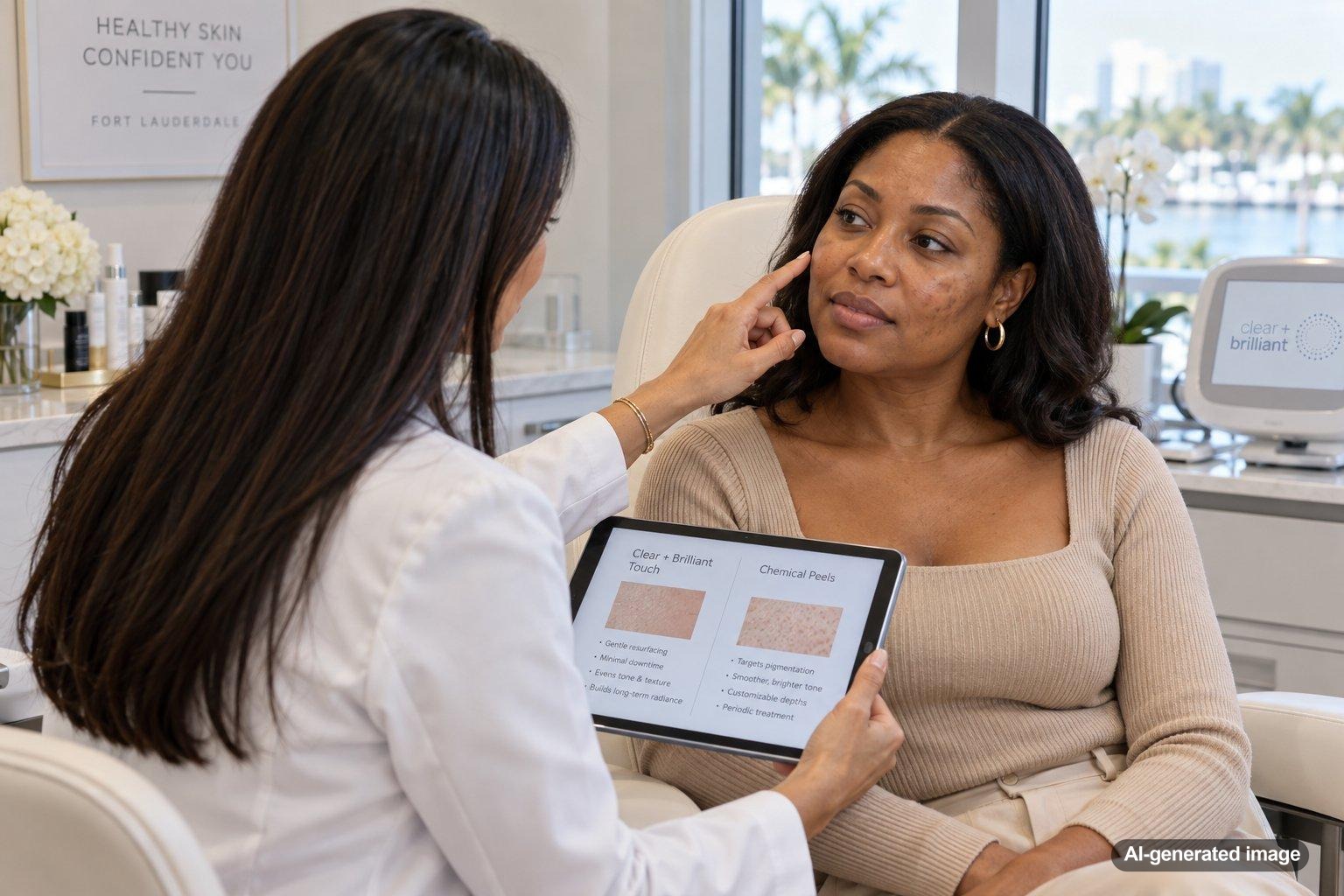
Post-acne pigmentation can linger long after a breakout has settled, leaving flat brown, gray, or reddish marks that make the skin look uneven. Clear + Brilliant Touch and chemical peels are two office-based options that may help improve this type of discoloration, but they work in different ways and are not interchangeable for every person.
Clear + Brilliant Touch uses controlled laser energy to create microscopic treatment zones in the skin, while a chemical peel uses a carefully selected solution to exfoliate targeted layers of the skin. The better fit depends on factors such as your skin tone, the type and depth of discoloration, sensitivity, current acne activity, downtime preferences, and the rest of your skincare routine.
Quick answer
- Clear + Brilliant Touch: May be useful when pigmentation is accompanied by uneven tone or texture and a controlled fractional laser approach makes sense.
- Chemical peels: May be useful when superficial discoloration and skin turnover are the primary concerns.
- Neither is automatically better: Treatment choice depends on pigment pattern, skin type, sensitivity, and treatment goals.
- Sun protection matters with either option: UV exposure can make post-acne discoloration more persistent and can complicate recovery after procedures.
| Comparison | Clear + Brilliant Touch | Chemical Peels |
|---|---|---|
| How it works | Fractional laser energy creates microscopic treatment zones. | A chemical solution produces controlled exfoliation. |
| Potential focus | Uneven pigmentation, tone, and texture. | Superficial pigmentation, dullness, and uneven surface tone. |
| Customization | Settings can be selected according to the treatment plan. | Peel type and strength can be selected according to the treatment plan. |
| Recovery | Temporary redness, warmth, dryness, or a rough texture may occur. | Temporary redness, dryness, tightness, flaking, or peeling may occur depending on the peel. |
How Clear + Brilliant Touch approaches post-acne pigmentation
Clear + Brilliant Touch is a fractional laser treatment. Instead of treating the entire surface uniformly, it creates many microscopic treatment zones while leaving surrounding areas untreated. This controlled process is intended to support gradual renewal of the treated skin.
For someone with post-acne discoloration, a clinician may consider Clear + Brilliant Touch when pigment irregularity occurs alongside concerns such as uneven texture or an overall mottled appearance. The treatment plan still needs to account for skin tone and the tendency to develop pigment changes after irritation.
Laser treatment also requires thoughtful timing. Active inflammation, recent tanning, significant irritation, and certain skincare products or procedures may affect how a dermatologist approaches treatment. A consultation is useful because not every dark acne mark represents the same process.
How chemical peels approach post-acne pigmentation
Chemical peels use acids or other exfoliating ingredients in controlled concentrations to remove or loosen portions of the outer skin layers. The depth and intensity vary considerably. A superficial peel is very different from a stronger peel, so the phrase “chemical peel” covers a broad range of treatments.
For post-acne pigmentation, a clinician may select a peel when encouraging surface exfoliation and more even-looking tone fits the treatment goal. The choice of peeling agent, concentration, contact time, and treatment interval can be adjusted according to the person’s skin and response.
Peels may also fit well into a broader acne-care plan, but stronger is not necessarily more appropriate. Excessive irritation can be counterproductive for skin that readily develops discoloration after inflammation.
Which option may make more sense for your skin?
The most useful comparison is not simply laser versus peel. It is whether a particular treatment matches the type of discoloration present and how your skin tends to react.
- If texture is also a major concern: A fractional laser approach may be considered because it can address more than surface discoloration alone.
- If the discoloration appears relatively superficial: A carefully chosen chemical peel may be a reasonable option to discuss.
- If your skin is very sensitive or reactive: Treatment intensity and preparation may matter as much as the treatment category.
- If you have a history of developing dark marks after irritation: A dermatologist can plan more conservatively and discuss ways to reduce unnecessary inflammation.
- If acne is still active: Controlling ongoing breakouts may be an important part of the plan so new marks are not continually forming.
Downtime and aftercare differences
Both treatments can cause temporary visible changes, although the experience varies with treatment intensity and individual skin response. After Clear + Brilliant Touch, the skin may look red or feel warm, dry, or slightly rough. After a chemical peel, the skin may feel tight or dry and may develop visible flaking or peeling depending on the formula and depth.
Gentle cleansing, moisturizer, and consistent broad-spectrum sunscreen are commonly emphasized after either treatment. Scrubs, picking, aggressive exfoliation, and adding multiple new active ingredients during recovery can create unnecessary irritation. Your clinician can give specific instructions based on the procedure performed.
Why skin tone and pigment history matter
Post-acne pigmentation is often related to inflammation, which means creating additional irritation without an appropriate plan can sometimes make discoloration more noticeable. This is one reason procedure selection should be individualized rather than based only on which treatment sounds stronger.
A dermatologist can evaluate whether the marks are primarily pigment, persistent redness, active acne, textural scarring, or a combination. That distinction can change which treatment, or combination of treatments, is worth considering.
Can Clear + Brilliant Touch and chemical peels be used in the same treatment plan?
They may sometimes be incorporated into a broader treatment strategy, but that does not necessarily mean performing them together or close together. The sequence and spacing depend on skin response, treatment intensity, other procedures, and topical products being used.
Combining too many exfoliating or energy-based treatments without enough recovery time can increase irritation. A clinician can decide whether alternating treatments, choosing only one approach, or starting with skincare first is more appropriate.
What to do before choosing
Before scheduling either treatment, it helps to review your current skincare routine, recent procedures, sun exposure, history of pigmentation after irritation, and whether acne is still active. Bring a list of prescription and nonprescription products you use, especially exfoliating acids, retinoids, or other potentially irritating ingredients.
A professional evaluation can also clarify expectations. Flat post-acne pigmentation responds differently from indented or raised acne scars, so a treatment aimed primarily at discoloration may not address every concern left behind by acne.
At Waverly DermSpa, we offer Clear + Brilliant Touch and can help you understand whether it may be appropriate.
FAQ
Is Clear + Brilliant Touch better than a chemical peel for acne marks?
Not universally. Clear + Brilliant Touch and chemical peels work differently, and the more appropriate option depends on the type of mark, skin tone, texture concerns, sensitivity, and treatment history.
Can a chemical peel remove post-acne pigmentation?
Chemical peels may help improve the appearance of some superficial post-acne discoloration by promoting controlled exfoliation. Results vary, and the peel type and strength should be selected carefully.
Does Clear + Brilliant Touch help acne scars?
It may be considered for certain texture concerns, but acne scars vary considerably in type and depth. A dermatologist can distinguish textural scarring from flat pigmentation and discuss appropriate options.
Can pigmentation get darker after a procedure?
Inflammation can be associated with pigment changes in some skin types. Careful treatment selection, conservative settings or peel strength when appropriate, aftercare, and sun protection are important parts of treatment planning.
Should active acne be treated before pigmentation?
Often, controlling ongoing breakouts is an important part of the overall strategy because continued inflammation can produce new discoloration. The sequence depends on the acne pattern and the treatments being considered.
Ready to get help?
Schedule an appointment or send a message and our team will get back to you.
Prefer to call? 954-666-3736
This article is for educational purposes and is not medical advice. For diagnosis and personalized treatment, please book an appointment with a board-certified dermatologist.
