

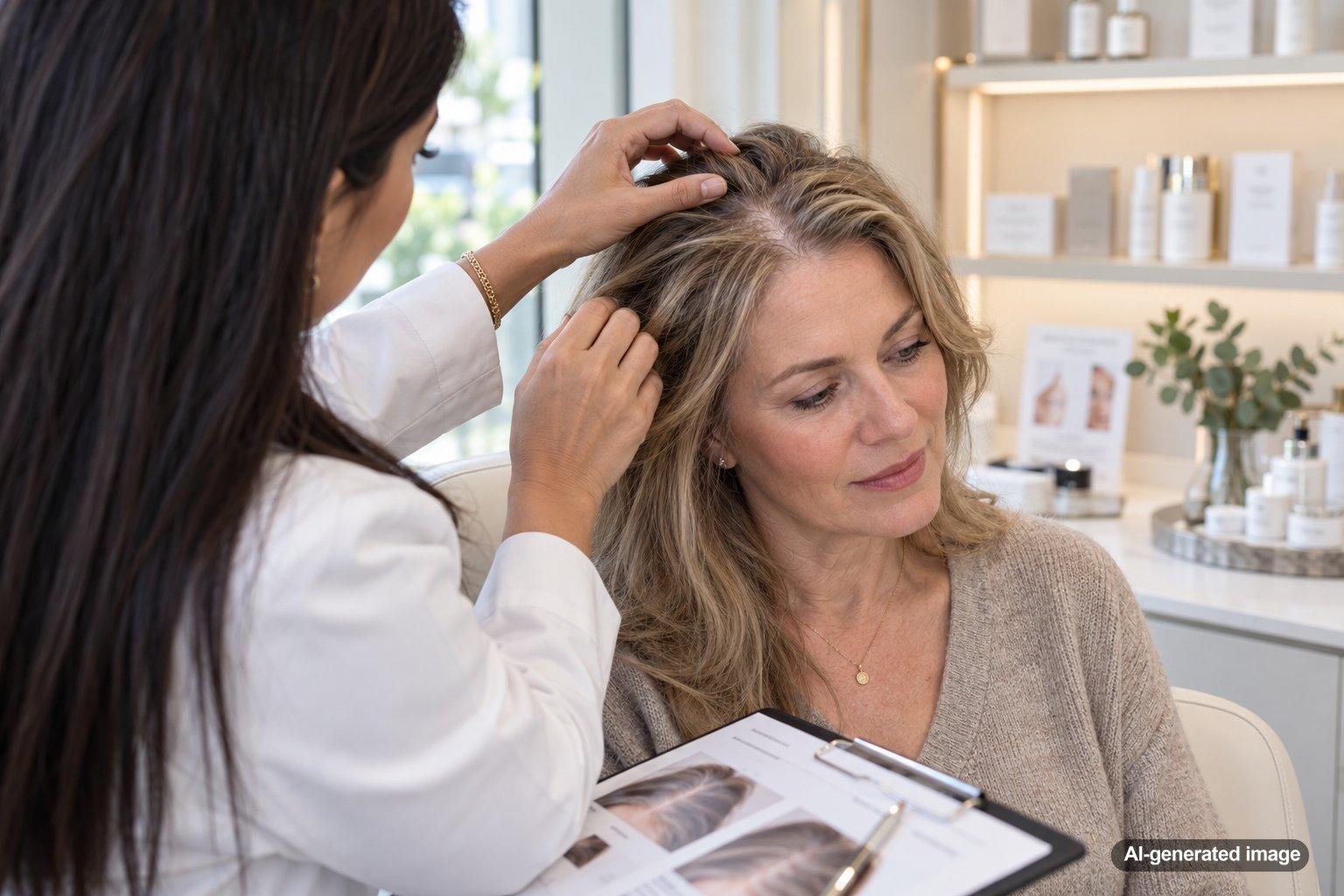
PRFM and minoxidil take very different approaches to early pattern hair loss. Minoxidil is a topical medication used regularly at home, while PRFM is an in-office treatment made from a patient’s own blood components and delivered into areas of thinning. Neither approach is automatically right for everyone, and the first step is confirming that the hair loss pattern is actually androgenetic, or pattern, hair loss rather than another cause.
For people who are noticing gradual thinning, a widening part, reduced density, or a slowly receding hairline, the practical differences often come down to routine, treatment setting, tolerance, cost, and how comfortable you are with an ongoing home medication versus office-based procedures.
Quick answer
- Minoxidil is an established topical option for pattern hair loss and is available without a prescription in commonly used formulations.
- PRFM is an office-based treatment derived from your own blood and is related to platelet-based regenerative approaches used for hair thinning.
- Minoxidil generally requires consistent ongoing application to maintain its benefit.
- PRFM involves injections and usually follows a clinician-directed treatment and maintenance schedule.
- A dermatologist can help determine whether either approach fits your diagnosis, medical history, scalp condition, and goals.
| Comparison | PRFM | Minoxidil |
|---|---|---|
| How it is used | Injected into the scalp during an office visit | Applied to the scalp at home according to product or clinician directions |
| Main commitment | Appointments and maintenance treatments as recommended | Consistent ongoing use |
| Medication | Uses material prepared from the patient’s own blood rather than a topical hair-loss medication | Topical medication used for pattern hair loss |
| Evidence base | Platelet-based hair treatments are promising, but techniques and protocols vary | Long-established option with FDA-approved topical products for pattern hair loss |
How minoxidil works in a hair-loss plan
Topical minoxidil is one of the most familiar treatments for androgenetic alopecia. It is applied directly to the scalp, and FDA-approved topical products are available for pattern hair loss. The exact formulation and frequency can differ by product and by patient, so following the label and your dermatologist’s instructions matters.
One of the biggest practical advantages is accessibility. Treatment happens at home and does not require an office procedure. The tradeoff is consistency. Minoxidil generally needs to be used continuously to maintain the benefit. Stopping it can allow the underlying pattern of thinning to become noticeable again over time.
Scalp irritation, dryness, itching, or unwanted hair growth outside the intended area can occur in some people. A temporary increase in shedding can also occur after starting treatment. If irritation is significant, the cause of the hair loss is uncertain, or the response is not what you expected, it is worth discussing the situation with a dermatologist rather than simply changing products on your own.
How PRFM differs
PRFM, or platelet-rich fibrin matrix, is prepared from a patient’s own blood and is used as an injectable treatment in selected hair-loss plans. It belongs to the broader family of platelet-based approaches used in regenerative dermatology, although PRFM preparation is not identical to conventional platelet-rich plasma, or PRP.
For patients, the most obvious difference is that PRFM is an office procedure. Blood is drawn, processed, and the resulting material is placed into targeted areas of the scalp. That removes the need for a daily topical routine, but it introduces a different commitment: injections, scheduled visits, and the possibility of temporary tenderness, swelling, bruising, or sensitivity around treated areas.
Platelet-based treatments for pattern hair loss have encouraging research behind them, but protocols are less standardized than topical minoxidil. Preparation methods, treatment intervals, patient selection, and maintenance plans can vary. That makes a dermatologist’s evaluation especially important when deciding whether this type of procedure belongs in a treatment plan.
Which option is more practical for early thinning?
For someone with confirmed early pattern hair loss, minoxidil may make sense when the priority is a non-procedural treatment that can be used at home. It can also be attractive for people who are comfortable building a regular scalp application into their routine.
PRFM may appeal to someone who prefers an office-based option, has difficulty staying consistent with topical treatment, or wants to discuss a platelet-based approach as part of a broader plan. Cost, comfort with injections, travel schedule, scalp sensitivity, and previous treatment experience can all influence the decision.
The two approaches are not necessarily mutually exclusive. Dermatologists sometimes build hair-loss plans around more than one strategy when appropriate. Whether combining treatments makes sense depends on the diagnosis, health history, medications, pregnancy considerations, scalp findings, and individual goals.
Why the diagnosis matters before choosing either one
Gradual pattern thinning is only one cause of hair loss. Sudden shedding, patchy bald spots, scalp inflammation, breakage, nutritional problems, hormonal changes, medication effects, scarring conditions, and autoimmune disease can produce very different patterns and may call for different treatment.
A dermatologist can examine the scalp and hair distribution and decide whether additional evaluation is appropriate. This is particularly important if the hair loss is sudden, patchy, painful, associated with redness or scaling, or occurring along with other symptoms.
What about oral minoxidil?
Oral minoxidil is different from the over-the-counter topical products people commonly associate with hair loss. It is a prescription medication, and its use for hair loss requires medical judgment because it can affect more than the scalp. If oral minoxidil is being considered, a dermatologist can review medications, blood pressure history, cardiovascular considerations, and other factors before deciding whether it may be appropriate.
Do not assume that oral and topical minoxidil have the same safety profile or that one can simply be substituted for the other without medical guidance.
When to see a dermatologist
Consider a dermatology evaluation if you are noticing progressive thinning and want to start treatment early, or if you are unsure what type of hair loss you have. An evaluation is especially useful when:
- Hair loss begins suddenly or progresses rapidly.
- You have smooth patches of complete hair loss.
- The scalp is painful, inflamed, very itchy, or heavily scaling.
- You notice scarring, shiny areas, or loss of follicle openings.
- You are pregnant, planning pregnancy, or breastfeeding and are considering hair-loss medication.
- You take prescription medications or have medical conditions that could affect treatment choices.
- You have tried an over-the-counter approach without understanding why the thinning is occurring.
At Waverly DermSpa, we offer PRFM for Hair Loss and can help you understand whether it may be appropriate.
FAQ
Is PRFM the same as PRP?
No. They are related platelet-based treatments prepared from a patient’s blood, but their processing and final composition are different. Because protocols can vary between practices, it is reasonable to ask exactly what preparation is being used and why.
Does minoxidil work better when hair loss is caught early?
Pattern hair loss is progressive, and dermatology guidance generally favors evaluating and treating it before extensive thinning has occurred. Response still varies from person to person, and no treatment restores every lost hair.
Do I have to use minoxidil indefinitely?
If minoxidil is helping maintain density, continued use is generally needed to maintain that benefit. When it is stopped, the underlying pattern hair loss can become apparent again.
Can PRFM replace minoxidil?
Not automatically. They are different treatment approaches, and whether one, the other, or a combined plan is reasonable depends on the diagnosis and individual circumstances.
How do I know whether my thinning is pattern hair loss?
The distribution can provide clues, but other conditions can look similar. A dermatologist can examine the scalp, review the timeline, and decide whether additional testing is appropriate.
Ready to get help?
Schedule an appointment or send a message and our team will get back to you.
Prefer to call? 954-666-3736
This article is for educational purposes and is not medical advice. For diagnosis and personalized treatment, please book an appointment with a board-certified dermatologist.
Sources & further reading
- American Academy of Dermatology (AAD) – What is male pattern hair loss, and can it be treated?
- American Academy of Dermatology (AAD) – Thinning hair and hair loss: Could it be female pattern hair loss?
- Cleveland Clinic – Hair Loss Treatments: Topical, Medications & Surgery Options
