

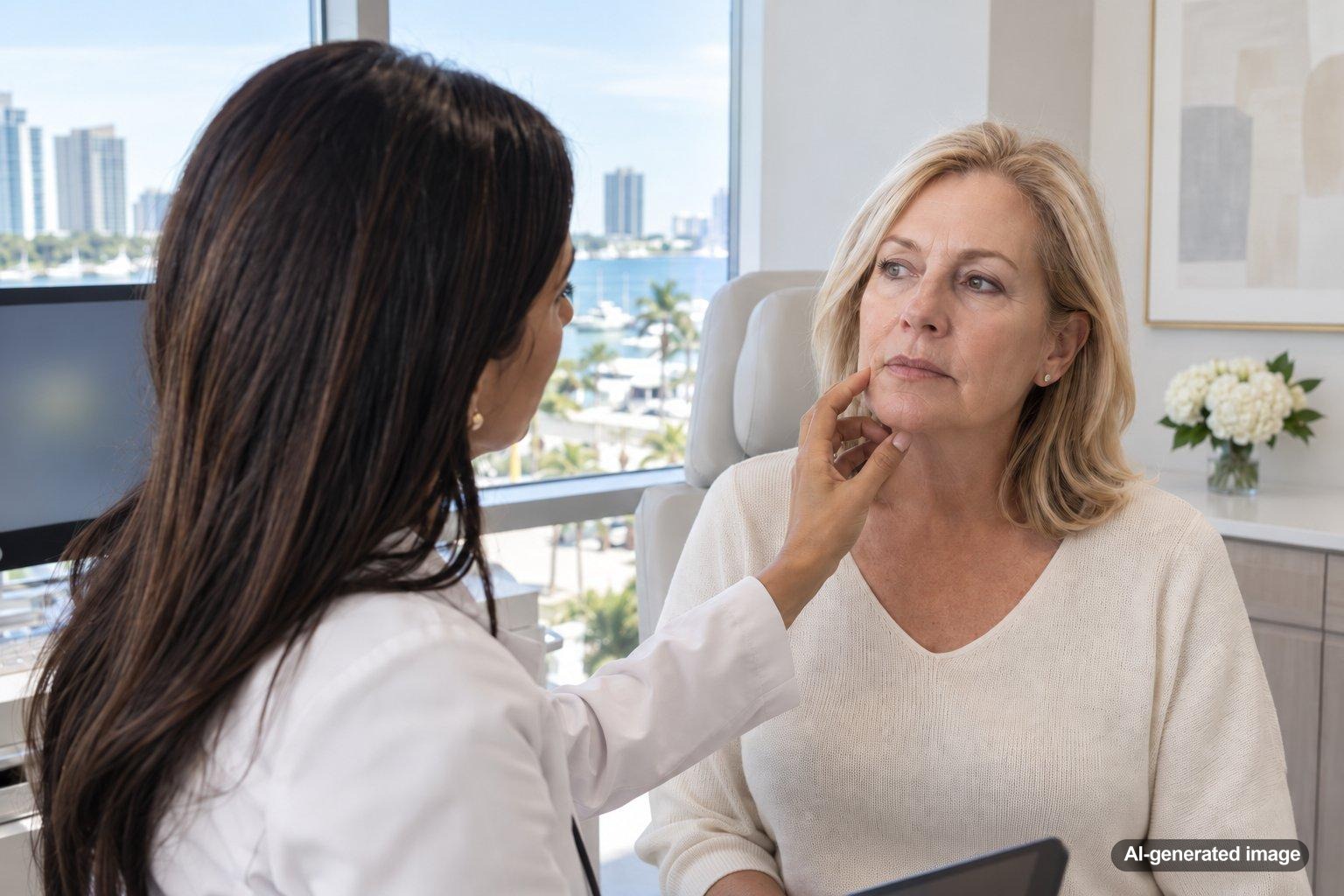
Downturned corners of the mouth can create a tired, serious, or unhappy appearance even when you feel perfectly well. For some people, muscle activity around the lower face contributes to this look. Carefully placed Botox may help soften that downward pull and create a more relaxed appearance while preserving natural facial movement.
In South Florida, where subtle cosmetic treatments are often preferred over dramatic changes, the goal is usually balance rather than an obvious transformation. Because the lower face is anatomically complex, treatment should be planned conservatively and personalized after an in-person evaluation.
Quick answer
- Botox may help soften downturned mouth corners when muscle activity is contributing to the downward pull.
- The treatment typically involves small, targeted injections into specific lower-face muscles.
- Results vary because facial anatomy, muscle strength, and the causes of the downturned appearance differ from person to person.
- A dermatologist can evaluate whether Botox alone or another approach may better match your goals.
What Botox for downturned mouth corners is
Botox is an injectable neuromodulator that temporarily reduces activity in selected muscles. When the corners of the mouth are pulled downward by muscles in the lower face, a clinician may use a small amount of Botox to reduce that pull.
One muscle commonly discussed in this context is the depressor anguli oris, often abbreviated DAO. It helps draw the corners of the mouth downward. Treatment in this area requires precision because nearby muscles contribute to speaking, smiling, eating, and other normal facial movements.
Why the corners of the mouth can look downturned
A downturned appearance does not always come from the same cause. Several factors can contribute, and more than one may be present at the same time.
- Muscle activity: Strong downward-pulling muscles may make the mouth corners appear lower at rest.
- Changes in facial volume: Age-related volume changes around the cheeks, mouth, and jawline can influence lower-face contours.
- Skin changes: Reduced elasticity and support can affect how the area around the mouth sits.
- Natural anatomy: Some people simply have a naturally downturned resting mouth shape.
- Facial expression patterns: Repeated movement can influence how the lower face looks over time.
What you can do at home
There is no at-home technique that can precisely reproduce the effect of an injectable neuromodulator on a specific facial muscle. However, a consistent skincare routine can support the overall appearance of the lower face.
- Use broad-spectrum sunscreen regularly to help protect the skin from additional sun-related changes.
- Keep the skin moisturized if dryness makes fine lines around the mouth appear more noticeable.
- Avoid aggressively massaging, stretching, or manipulating the area in an attempt to change muscle position.
- Bring photos of your resting expression and smile to a consultation if they help explain what you would like to soften or preserve.
Professional options
Botox may be considered when downward muscle pull is an important part of the appearance. A dermatologist can assess your facial movement at rest and while smiling, speaking, and pursing the lips before deciding whether treatment may be appropriate.
Some people have more than one factor contributing to the lower-face appearance. Depending on the evaluation, professional options may include neuromodulators, dermal fillers, skincare, or other aesthetic treatments. These approaches address different concerns, so they are not interchangeable.
At Waverly DermSpa, we offer Botox and can help you understand whether it may be appropriate.
What a conservative treatment approach looks like
The lower face generally calls for a measured approach. The goal is not to eliminate normal movement. Instead, treatment may be designed to reduce excessive downward pull while maintaining a natural-looking smile and comfortable facial function.
Individual anatomy matters, including the position and strength of the surrounding muscles. This is one reason an in-person assessment is important before deciding on injection placement or amount.
When to see a dermatologist
Schedule a dermatologist evaluation if you are considering Botox around the mouth and want personalized guidance about whether muscle activity is actually contributing to the appearance. A consultation is also useful if you have had previous injectable treatments, significant facial asymmetry, or concerns about how treatment could affect your smile or lower-face movement.
If a new facial change appears suddenly or is accompanied by weakness, numbness, difficulty speaking, or other unexpected neurologic symptoms, seek prompt medical evaluation rather than assuming the change is cosmetic.
FAQ
Can Botox lift the corners of the mouth?
Botox may create a subtle improvement when downward-pulling muscle activity is contributing to the appearance. The degree of change varies, and some people may have structural or volume-related factors that Botox does not address.
Will Botox around the mouth change my smile?
The muscles around the mouth work closely together, so injection placement and dosing require care. A conservative plan is intended to preserve natural expression, but individual responses vary. Your dermatologist can discuss this in detail before treatment.
Is Botox or filler better for downturned mouth corners?
They address different factors. Botox reduces selected muscle activity, while filler is used to add or restore volume in appropriate areas. A dermatologist can evaluate whether one approach, a combination, or neither is appropriate for your anatomy and goals.
How long does Botox around the mouth last?
The duration varies by person, treatment area, muscle activity, and other factors. Your clinician can give you a more individualized expectation based on your treatment plan and response.
Can I get Botox for mouth corners before a South Florida event or vacation?
If you are planning treatment around a wedding, vacation, seasonal visit, or other event, discuss timing with your clinician in advance. Responses and temporary treatment effects can vary, so leaving flexibility in your schedule is sensible.
Ready to get help?
Schedule an appointment or send a message and our team will get back to you.
Prefer to call? 954-666-3736
This article is for educational purposes and is not medical advice. For diagnosis and personalized treatment, please book an appointment with a board-certified dermatologist.
