

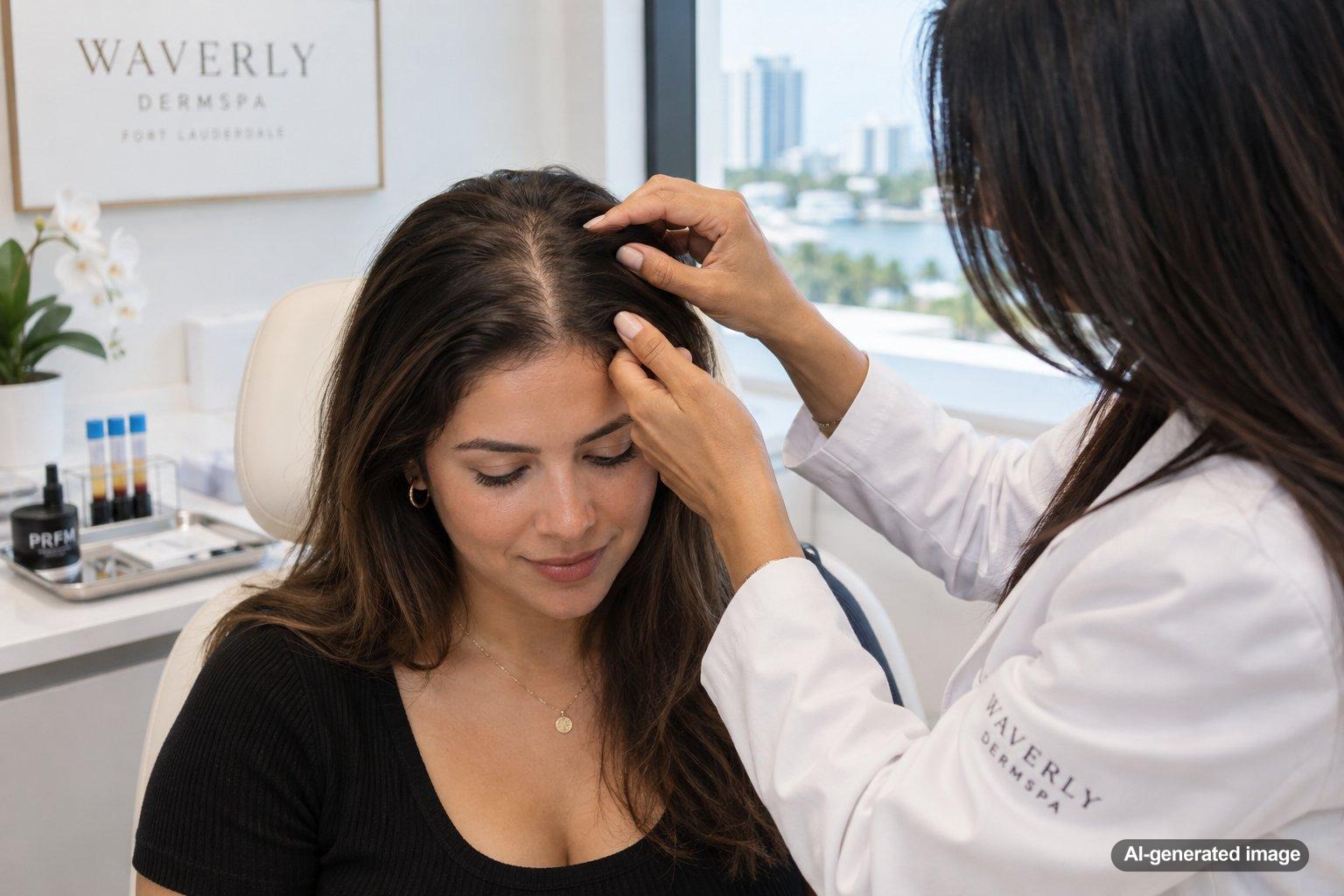
For women with androgenetic alopecia, also called female pattern hair loss, gradual thinning can become especially noticeable through the part line, crown, or overall scalp density. PRFM is an office-based treatment that uses a concentrated preparation derived from your own blood and is sometimes considered as part of a broader hair-loss treatment plan.
PRFM is not appropriate for every type of shedding or thinning. Because several different conditions can look similar, a dermatologist should first evaluate the pattern of hair loss, scalp health, medical history, and other possible contributors before deciding whether PRFM may be worth considering.
Quick answer
- PRFM stands for platelet-rich fibrin matrix and is prepared from a patient’s own blood.
- It is placed into targeted areas of the scalp during an in-office procedure.
- For women with androgenetic alopecia, it may be considered as one component of a personalized hair-loss plan.
- Results vary, and PRFM does not address every cause of thinning or excessive shedding.
- A dermatologist can help determine whether the hair-loss pattern is consistent with androgenetic alopecia and discuss appropriate options.
What is PRFM for hair loss?
PRFM is an autologous treatment, meaning the material used comes from your own blood. A small blood sample is processed to create a platelet-rich fibrin matrix that contains platelets and naturally occurring signaling components. The prepared material is then introduced into selected areas of the scalp.
In hair-restoration care, the goal is to support the environment around existing hair follicles rather than create entirely new follicles. That distinction matters because the degree of thinning, how long it has been present, and whether follicles remain active can influence what a dermatologist recommends.
How androgenetic alopecia appears in women
Female pattern hair loss often develops gradually. Women may notice a widening part, reduced ponytail volume, more visible scalp through the crown, or an overall reduction in hair density. The frontal hairline may remain relatively preserved even as density behind it decreases.
Not every woman with thinning hair has androgenetic alopecia. Temporary shedding, nutritional issues, hormonal changes, scalp disorders, medication effects, traction, and other medical factors can produce overlapping symptoms. That is why evaluation before treatment is important.
Why PRFM may be considered
PRFM may appeal to patients interested in an office-based option that uses material derived from their own blood. For appropriate candidates, a dermatologist may consider it alongside other approaches rather than viewing it as a stand-alone answer to every form of hair loss.
The treatment plan may depend on the pattern and severity of thinning, scalp examination findings, medical history, medications, previous treatments, and individual goals. Some patients may be better served by other therapies or by combining approaches under medical supervision.
What happens during a PRFM appointment?
A typical visit begins with a blood draw. The sample is processed according to the treatment protocol to prepare the platelet-rich fibrin matrix. The scalp is then cleansed, and the PRFM is placed into targeted thinning areas through a series of small injections.
Because the scalp is sensitive, patients can experience temporary tenderness, pinpoint bleeding, swelling, or soreness around treated areas. Your clinician can explain preparation instructions, comfort measures, and aftercare based on your individual treatment plan.
What can you do at home for thinning hair?
Gentle hair and scalp care can support overall hair health, although home care does not replace evaluation of persistent thinning. Practical steps include:
- Avoid hairstyles that repeatedly place strong tension on the hairline or scalp.
- Limit unnecessary heat, aggressive brushing, and chemical processing when hair feels fragile.
- Use gentle cleansing products appropriate for your scalp and hair type.
- Maintain adequate nutrition rather than relying on hair supplements without knowing whether a deficiency is present.
- Take periodic photos of your part or crown under similar lighting if you want to track changes over time.
If shedding is sudden, severe, patchy, painful, or accompanied by scalp inflammation, it is worth getting checked rather than assuming it is female pattern hair loss.
Professional options for female pattern hair loss
Hair-loss treatment is highly individualized. Depending on the diagnosis and medical history, a dermatologist may discuss topical therapies, prescription options, procedural treatments such as PRFM, or a combination approach. The purpose of evaluation is to identify the likely cause of thinning and select options that make sense for that specific situation.
PRFM can be part of that conversation, but suitability and expected response vary from person to person. It is also important to discuss previous hair-loss treatments, medications, pregnancy considerations, bleeding disorders, and other health factors before undergoing a procedure.
When to see a dermatologist
Consider scheduling a dermatology evaluation if you notice progressive widening of your part, reduced scalp density, persistent shedding, bald patches, scalp pain, redness, scaling, scarring, or a rapid change in your usual hair pattern. A medical evaluation can help distinguish androgenetic alopecia from other causes that may require a different approach.
Earlier assessment can also provide a clearer baseline. Your dermatologist may use your history, scalp examination, photographs, and other testing when appropriate to better understand what is contributing to the change.
FAQ
Is PRFM the same as PRP?
They are related autologous treatments, but the preparation methods and final blood-derived products are not identical. PRFM incorporates a fibrin matrix, while platelet-rich plasma treatments use a plasma preparation. Your clinician can explain which approach is offered and why it may be considered.
Can PRFM help every woman with thinning hair?
No. Hair thinning has many possible causes, and PRFM may not be appropriate for every diagnosis or every stage of hair loss. A dermatologist can evaluate the pattern before recommending treatment.
How many PRFM sessions are needed?
There is no single schedule that applies to everyone. Treatment frequency and maintenance planning can vary based on the clinical approach, degree of thinning, response, and individual goals. Your clinician can outline a personalized plan after evaluation.
When might I notice a change?
Hair growth occurs slowly, so changes are generally assessed over time rather than immediately after treatment. Response varies considerably, and no specific amount or timing of improvement can be promised.
Can PRFM be combined with other hair-loss treatments?
In some cases, a dermatologist may discuss PRFM as part of a broader treatment strategy. Whether combination treatment is appropriate depends on the diagnosis, health history, medications, and individual goals.
Is there downtime after PRFM?
Many people can return to routine activities relatively quickly, but temporary scalp tenderness, redness, swelling, or sensitivity may occur. Your clinician should provide individualized aftercare instructions.
At Waverly DermSpa, we offer PRFM for Hair Loss and can help you understand whether it may be appropriate.
Ready to get help?
Schedule an appointment or send a message and our team will get back to you.
Prefer to call? 954-666-3736
Disclaimer
This article is for educational purposes and is not medical advice. For diagnosis and personalized treatment, please book an appointment with a board-certified dermatologist.
