

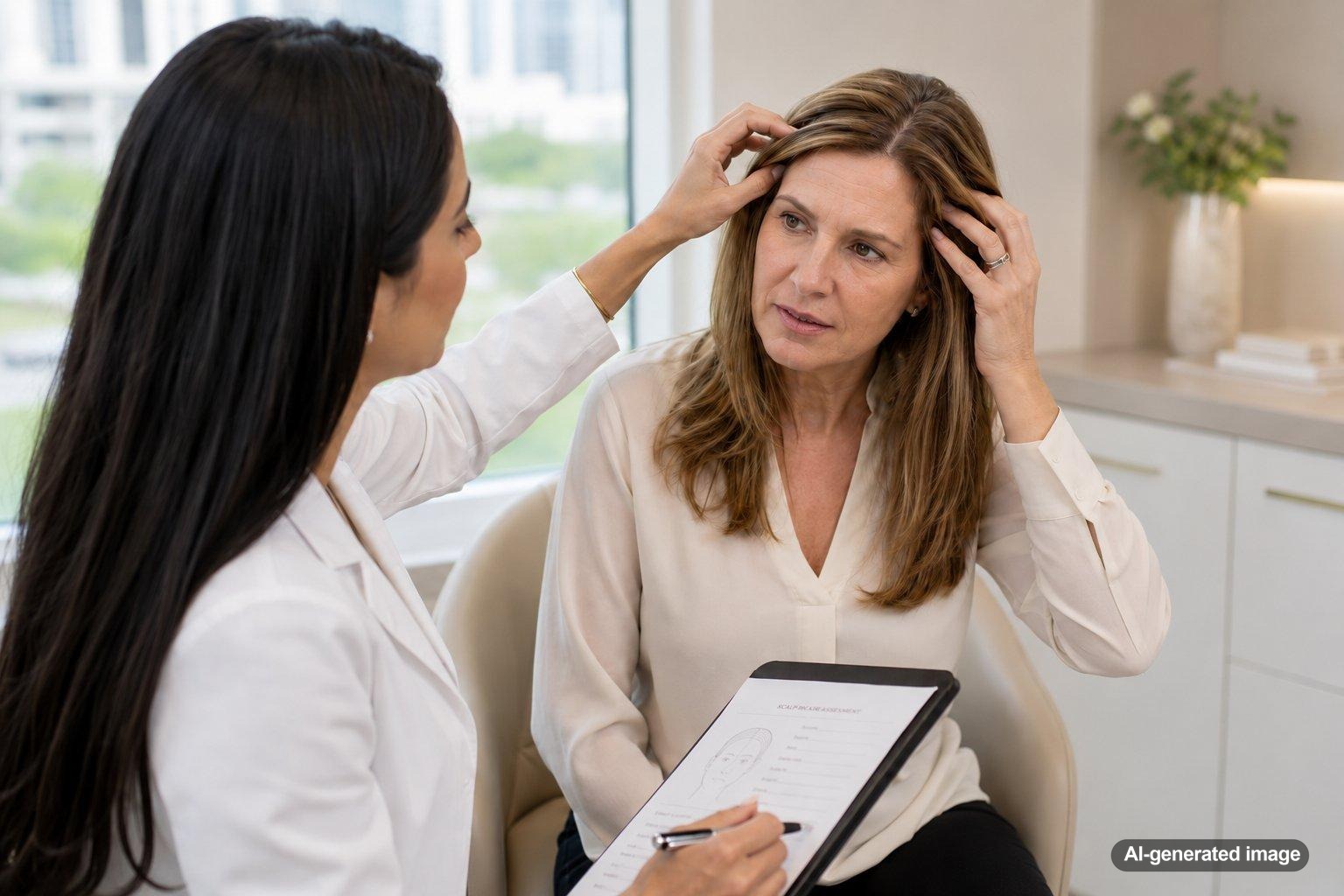
Seeing more hair than usual in the shower, on your brush, or around your hairline after having a baby can feel unsettling. Postpartum shedding is common, and in many cases it reflects telogen effluvium, a temporary shift in the normal hair growth cycle that can follow major hormonal and physical changes.
For some patients, the most appropriate approach is reassurance, gentle hair care, and time. Others may benefit from a dermatologist evaluation to confirm the pattern of shedding, look for additional contributors, and discuss whether an office-based option such as platelet-rich fibrin matrix, or PRFM, has a role in their individual treatment plan.
Quick answer
- Postpartum hair shedding is often related to telogen effluvium, which can occur after hormonal and physical changes associated with pregnancy and childbirth.
- Many cases improve gradually without a procedure, although the course varies from person to person.
- PRFM is an autologous, blood-derived platelet and fibrin preparation that may be discussed as an office-based option for certain types of hair loss.
- PRFM should not replace an evaluation when shedding is persistent, severe, patchy, painful, or otherwise unusual.
- If you’re breastfeeding, recently delivered, or have other health considerations, your dermatologist can help determine whether treatment should be considered now or later.
What postpartum telogen effluvium is
Hair follicles naturally move through phases of growth, transition, rest, and shedding. Pregnancy can alter that balance. After delivery, hormonal changes can cause a larger number of hairs to enter the resting and shedding phase around the same time. The result can be diffuse shedding that becomes noticeable in the months after childbirth.
This type of shedding is commonly called telogen effluvium. It generally affects hair density across the scalp rather than creating a single completely bare patch. Even when the shedding is temporary, the visual change can be significant because many hairs may cycle together.
Not every episode of hair loss after pregnancy is necessarily explained by postpartum telogen effluvium. A dermatologist can evaluate the pattern and determine whether other forms of hair loss or scalp conditions should be considered.
Common causes or triggers
Postpartum hormonal changes are a well-known trigger for temporary excessive shedding, but other factors can occur at the same time. Depending on the individual, a dermatologist may consider factors such as:
- Hormonal changes associated with pregnancy and delivery
- Physical stress related to childbirth or recovery
- Significant emotional or physiologic stress
- Changes in nutrition or eating patterns
- Illness, fever, surgery, or another recent physical stressor
- Certain medications or medication changes
- Another form of hair loss occurring alongside temporary shedding
The goal of an evaluation is not to assume that one factor is responsible. It is to understand the overall pattern and decide whether observation, additional evaluation, or treatment is appropriate.
What you can do at home
When postpartum shedding is consistent with telogen effluvium, conservative hair care can help reduce unnecessary breakage and make changing density easier to manage while the hair cycle stabilizes.
- Handle wet hair gently and avoid aggressive brushing or detangling.
- Limit tight hairstyles that repeatedly pull on the hairline or scalp.
- Use heat styling thoughtfully and avoid unnecessary chemical stress when hair feels fragile.
- Consider lightweight or volumizing hair products if heavier products make thinning areas appear flatter.
- Maintain balanced nutrition rather than starting high-dose supplements without guidance from a clinician.
- Take occasional photos in similar lighting if you want a more objective way to follow changes over time.
If you’re breastfeeding or taking medications or supplements, discuss new hair-loss products with an appropriate healthcare professional before starting them. A product that is commonly used for hair loss is not automatically appropriate for every postpartum patient.
Where PRFM may fit
PRFM stands for platelet-rich fibrin matrix. It is prepared from a patient’s own blood and is designed to create a platelet- and fibrin-rich preparation that can be administered into targeted areas of the scalp. Research on platelet-rich fibrin approaches for hair loss has focused primarily on conditions such as androgenetic alopecia rather than uncomplicated postpartum telogen effluvium, so the reason for hair loss matters when discussing whether this type of procedure makes sense.
Postpartum telogen effluvium often improves as the hair cycle normalizes, which means an office procedure is not automatically necessary simply because shedding is noticeable. A dermatologist may first focus on confirming the diagnosis and determining whether there is another form of hair loss that could affect the treatment plan.
If PRFM is being considered, the discussion can include the pattern and duration of shedding, scalp health, medical history, pregnancy or breastfeeding status, other possible contributors to hair loss, and the limitations of available evidence. Individual responses vary, and no procedure can promise a specific degree of regrowth or density.
Professional options for postpartum hair loss
Professional care starts with identifying what is driving the shedding. Depending on the findings, options may range from observation and supportive care to further evaluation or treatment for another hair-loss condition that is present at the same time.
A dermatologist may examine the scalp and hair pattern, review recent health changes, discuss medications and nutrition, and determine whether additional testing is appropriate. If a procedural treatment is being considered, the potential benefits, limitations, timing, and alternatives should be reviewed in the context of the specific diagnosis.
PRFM and other platelet-based approaches are not interchangeable with every hair-loss treatment, and they are not necessarily the first step for temporary postpartum shedding. Your clinician can help you decide whether monitoring alone, another approach, or a procedure is reasonable.
When to see a dermatologist
It’s worth getting checked when the pattern does not seem typical for temporary postpartum shedding or when you are concerned about the amount or duration of hair loss. Consider a dermatologist evaluation if you notice:
- Distinct bald patches rather than diffuse shedding
- Scalp pain, significant itching, scaling, redness, or sores
- Scarring or areas where follicle openings appear to be disappearing
- Rapidly worsening or unusually severe shedding
- Hair loss involving the eyebrows, eyelashes, or other body areas
- Shedding that does not appear to be improving over time
- Other symptoms or health changes that make you concerned about an underlying cause
A dermatologist can evaluate whether the pattern fits telogen effluvium or whether another diagnosis should be considered before choosing treatment.
Frequently asked questions
Is postpartum hair loss the same as telogen effluvium?
Postpartum shedding is commonly a form of telogen effluvium triggered by the hormonal and physical changes surrounding pregnancy and childbirth. However, not every case of hair loss after pregnancy has the same cause, so persistent or unusual patterns deserve evaluation.
Does everyone with postpartum hair loss need PRFM?
No. Temporary postpartum shedding often improves without a procedure. PRFM may be discussed in selected situations, but whether it is appropriate depends on the diagnosis, medical history, timing, and individual goals.
Can PRFM stop postpartum shedding immediately?
No treatment should be expected to stop a changing hair cycle immediately. Hair growth and shedding occur in phases, and individual responses vary. A dermatologist can explain realistic expectations based on the pattern of hair loss being treated.
Can PRFM be considered while breastfeeding?
Breastfeeding status is important to discuss before any elective procedure or hair-loss treatment. Rather than assuming that a treatment is appropriate during nursing, review the timing, medical history, and available options with your dermatologist and other appropriate healthcare professionals.
How can I tell whether my shedding is normal after pregnancy?
Postpartum telogen effluvium usually causes diffuse shedding rather than a sharply defined bald area. Because other conditions can overlap with postpartum changes, a dermatologist can provide a more specific assessment if the pattern is persistent, patchy, symptomatic, or concerning.
Should I wait for postpartum shedding to improve before considering treatment?
That depends on the pattern and cause of the hair loss. In some situations, monitoring may be reasonable because temporary shedding can improve as the hair cycle stabilizes. In others, an evaluation may identify an additional condition that deserves attention. Your clinician can help you decide what makes sense for your situation.
At Waverly DermSpa, we offer PRFM for Hair Loss and can help you understand whether it may be appropriate.
Ready to get help?
Schedule an appointment or send a message and our team will get back to you.
Prefer to call? 954-666-3736
This article is for educational purposes and is not medical advice. For diagnosis and personalized treatment, please book an appointment with a board-certified dermatologist.
Sources & further reading
- American Academy of Dermatology (AAD) – Hair loss in new moms: Dermatologist tips
- Cleveland Clinic – Postpartum Hair Loss: Causes, Treatment & What to Expect
