

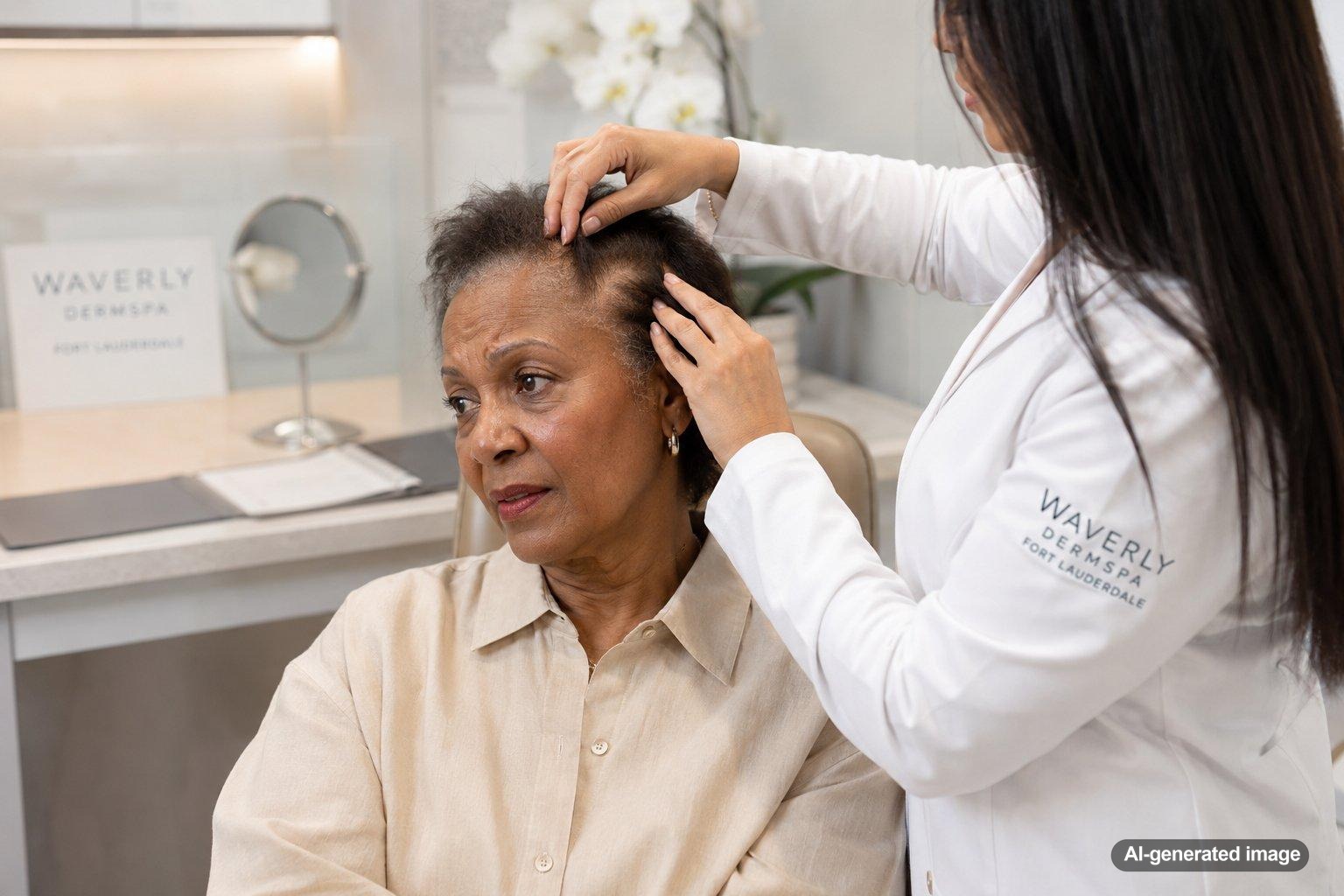
Noticing that your hair looks thinner on one side of your head can be confusing, especially when the other side seems relatively unchanged. Uneven thinning can happen for several reasons, ranging from repeated tension or friction to breakage, underlying scalp concerns, or certain forms of hair loss.
The pattern alone usually isn’t enough to identify the cause. A dermatologist can examine the scalp, look closely at the hair and follicles, review your styling habits and health history, and help determine whether the difference is primarily breakage, shedding, or true hair loss.
Quick answer
- Hair can appear thinner on one side because of repeated pulling, pressure, friction, or styling habits that affect one area more than another.
- Breakage can create the appearance of thinning even when hairs aren’t being lost from the follicle.
- Some types of hair loss, including alopecia areata, may affect localized areas rather than the entire scalp evenly.
- Scalp inflammation or other medical causes may also contribute to an uneven pattern.
- Sudden, clearly defined, worsening, or symptomatic hair loss is worth discussing with a dermatologist.
Why can hair thinning be more noticeable on one side?
Hair density is not always perfectly symmetrical, and everyday habits can amplify small differences. The side where you part your hair, sleep, tuck hair behind your ear, wear accessories, or apply more tension during styling may experience different mechanical stress than the opposite side.
It is also important to distinguish between hair breakage and hair loss from the root. Broken hairs may look shorter, uneven, or frayed, while true thinning can involve fewer visible hairs in an area. A scalp examination can help clarify what is happening.
Common causes and triggers
- Repeated tension from hairstyles: Tight ponytails, braids, buns, extensions, or styles that consistently pull more strongly on one side may place stress on the hair and follicles.
- Friction and pressure: Regularly sleeping on one side, wearing certain headwear, or repeatedly rubbing the same area may contribute to breakage in some people.
- Haircare and heat damage: Flat irons, curling tools, chemical processing, bleaching, and aggressive brushing can weaken the hair shaft. If one section receives more styling attention, the difference may become more visible.
- Uneven pattern hair loss: Hereditary hair thinning does not always look perfectly balanced from side to side, particularly in its earlier stages.
- Alopecia areata: This autoimmune form of hair loss commonly causes localized patches and can sometimes create a noticeably uneven pattern. The American Academy of Dermatology notes that it often begins with round or oval areas of hair loss.
- Scalp inflammation or other conditions: Redness, scaling, tenderness, itching, or changes in the scalp can occur alongside some forms of hair loss and deserve professional evaluation.
What you can do at home
A few simple observations may help you give your dermatologist a clearer picture. Consider taking photos of the same area in similar lighting every few weeks rather than checking it repeatedly from day to day. This can make meaningful changes easier to recognize.
In the meantime, gentle haircare is reasonable. Avoid hairstyles that feel tight or painful, rotate your part and styling patterns when practical, use heat conservatively, and avoid aggressive brushing or repeated chemical processing on fragile areas. If you suspect breakage, look for shorter hairs of different lengths rather than assuming every visible change represents follicle-level hair loss.
It can also help to think about whether the change followed a new hairstyle, extension placement, chemical service, scalp irritation, illness, medication change, or another significant event. Don’t start supplements or medications solely because your hair looks thinner on one side without first discussing the possible cause with an appropriate clinician.
Professional evaluation and treatment options
Treatment depends on why the thinning is happening. A dermatologist may examine the scalp with magnification, assess the distribution of thinning, review your medical and family history, and decide whether additional evaluation is appropriate.
Depending on the findings, professional options may include changes to styling practices, treatment of an underlying scalp condition, topical or prescription therapies, or office-based approaches. There is no single treatment that is appropriate for every form of hair loss, so identifying the likely cause is an important first step.
For appropriate patients, regenerative procedures may also be discussed as part of a broader hair-loss plan. At Waverly DermSpa, we offer PRFM for Hair Loss and can help you understand whether it may be appropriate.
When should you see a dermatologist?
Consider scheduling an evaluation if the thinning is new, clearly progressing, or difficult to explain. It is especially important to get checked when hair loss appears suddenly, forms a distinct smooth patch, or occurs along with scalp symptoms.
- A rapidly expanding or sharply defined area of hair loss
- Redness, significant itching, scaling, tenderness, swelling, crusting, or drainage
- Areas where the scalp looks unusually smooth, shiny, or otherwise different
- Hair loss involving the eyebrows, eyelashes, beard, or other body areas as well as the scalp
- Persistent thinning despite reducing tension, heat, or other obvious sources of damage
- Hair loss that concerns you or is affecting your quality of life
A dermatologist can evaluate whether the asymmetry reflects breakage, traction, a localized form of alopecia, another scalp condition, or a combination of factors.
Frequently asked questions
Can sleeping on one side cause hair thinning?
Repeated friction may contribute to breakage in some people, but one-sided thinning should not automatically be attributed to sleep position. If the difference is significant or progressing, a dermatologist can help determine whether another factor is involved.
Can wearing my hair parted on the same side cause thinning?
A simple part does not necessarily cause hair loss. However, styling habits associated with that part, such as repeated tension, heat, brushing, or tightly secured hairstyles, may place more stress on one area.
Does one-sided hair loss mean alopecia areata?
No. Alopecia areata is one possible cause of localized hair loss, but uneven thinning can have many explanations. Alopecia areata often produces patchy hair loss, and a dermatologist can evaluate the pattern rather than relying on appearance alone.
How can I tell whether my hair is breaking or falling out?
Breakage often leaves shorter hairs of varying lengths, while hair loss from the follicle may create a noticeable reduction in density. The distinction isn’t always obvious at home, particularly when both processes are occurring at the same time.
Should I switch sides when I sleep?
If you notice substantial friction or repeated pressure on the same area, changing positions occasionally may be reasonable, but it should not replace an evaluation when thinning is persistent or worsening.
Can one-sided thinning grow back?
That depends on the cause and the condition of the affected follicles. Some causes of hair loss or breakage may improve when the contributing factor is addressed, while other conditions require medical management. Your clinician can help you understand what may be realistic after identifying the likely cause.
Ready to get help?
Schedule an appointment or send a message and our team will get back to you.
Prefer to call? 954-666-3736
This article is for educational purposes and is not medical advice. For diagnosis and personalized treatment, please book an appointment with a board-certified dermatologist.
Sources & further reading
- American Academy of Dermatology (AAD) – Hair loss types: Alopecia areata overview
- National Alopecia Areata Foundation – Alopecia Areata
- Cleveland Clinic – Hair Loss: Causes, Treatments and Prevention Options
