

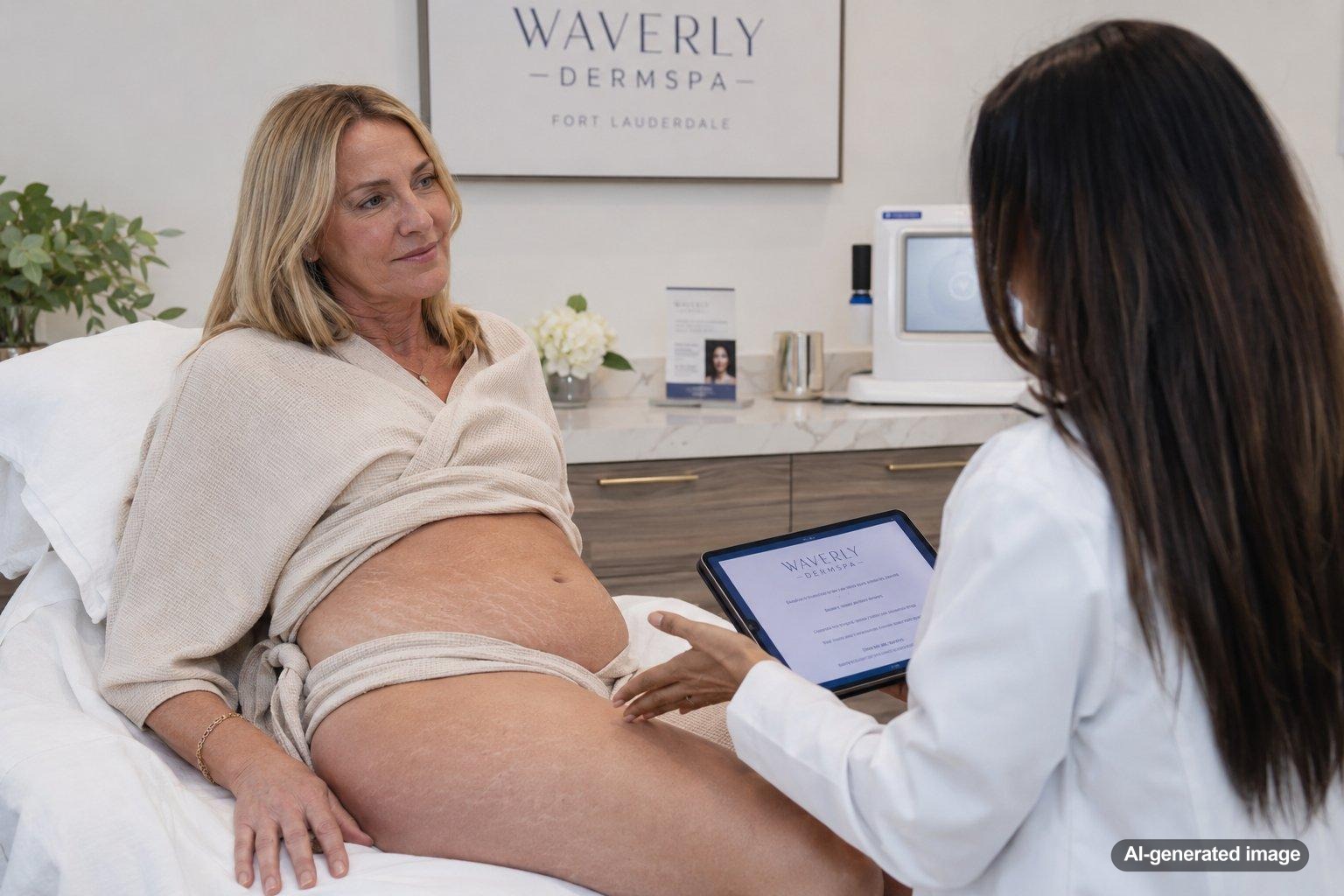
Stretch marks on the abdomen and thighs are extremely common, especially after periods when the skin has expanded or changed relatively quickly. Although they are harmless, their color, texture, or contrast with the surrounding skin can bother some people. Tetra CoolPeel CO2 is one in-office resurfacing option that may be considered when the goal is to make stretch marks less noticeable rather than remove them completely.
Because stretch marks are a form of scar, treatment is highly individual. Their age, color, depth, location, your skin tone, and your history of healing can all influence which approach is appropriate. A dermatologist can evaluate these factors before recommending laser resurfacing or another option.
Quick answer
- CO2 laser resurfacing may help improve the visible texture and contrast of some stretch marks.
- Stretch marks generally cannot be completely erased, so treatment focuses on making them less noticeable.
- The abdomen and thighs can be treated, but settings and treatment plans should be individualized.
- Skin tone, scar characteristics, recent tanning, medications, and healing history can affect whether laser treatment is appropriate.
- A consultation with a dermatologist is important before deciding on a laser procedure.
What are stretch marks?
Stretch marks, also called striae, are a type of scar that can develop when skin stretches or shrinks relatively quickly. Changes within the skin’s supporting tissue can leave linear marks that may initially look pink, red, purple, or darker than the surrounding skin. Over time, many become lighter and can develop a slightly indented or textured appearance.
The abdomen and thighs are common places for stretch marks because these areas can experience substantial changes in skin tension. While stretch marks do not usually require medical treatment, some people choose cosmetic treatment because they would prefer a smoother or more even-looking appearance.
Common causes or triggers
- Growth during puberty
- Pregnancy-related skin stretching
- Changes in body size or weight
- Rapid increases in muscle mass
- Individual differences in skin elasticity and tendency to develop stretch marks
- Certain medications or medical conditions in some cases
If stretch marks appear unexpectedly, are unusually widespread, or occur alongside other unexplained changes, a dermatologist can help determine whether further evaluation is appropriate.
How CO2 laser resurfacing may help
CO2 laser resurfacing uses controlled laser energy to create a carefully planned treatment effect within the skin. The healing response that follows may gradually improve the appearance of texture, scars, and other surface irregularities. For stretch marks, the goal is generally to soften their appearance and help treated skin look more blended with the surrounding area.
Results vary because stretch marks are scars, and no laser can reliably make every stretch mark disappear. Older pale marks, newer colored marks, deeply textured striae, and subtle surface changes may respond differently. The most appropriate treatment approach also depends on the individual’s skin tone and tendency to develop pigment changes or scars.
What about Tetra CoolPeel CO2?
Tetra CoolPeel CO2 is an in-office CO2 laser resurfacing option. When considering it for stretch marks on the abdomen or thighs, the dermatologist can assess the treatment area and decide whether a CO2-based approach makes sense for the specific type of stretch mark present.
Parameters should be selected for the individual rather than using a one-size-fits-all approach. The size of the treatment area, skin tone, recent sun exposure, sensitivity, previous procedures, and healing history can all matter. More than one session may be discussed for some patients, but the number and spacing of treatments can vary and cannot be predicted without an evaluation.
What you can do at home
Home care cannot completely remove established stretch marks, but gentle skin care can help keep the area comfortable and support the skin barrier. A simple moisturizer can reduce dryness, while regular sun protection can help limit tanning that may increase the visual contrast between stretch marks and surrounding skin.
Avoid aggressive scrubbing, harsh exfoliation, or attempting to use professional-strength resurfacing products on your own. If you are planning an in-office laser procedure, follow the specific pre-treatment and post-treatment skin care instructions provided by your clinician rather than adding new active products without guidance.
Professional options for stretch marks
Laser resurfacing is only one category of treatment that may be considered. Depending on how the stretch marks look and the individual’s skin characteristics, professional options can include different laser or light-based approaches, microneedling, radiofrequency-based procedures, or prescription topical treatment in selected situations. These approaches work differently and are not interchangeable.
A dermatologist can help compare the potential benefits, limitations, downtime, and risks of each option. For some people, combining approaches over time may be discussed, while others may be better served by a simpler treatment plan or by leaving the stretch marks untreated.
What to expect after laser treatment
Temporary redness, warmth, sensitivity, swelling, dryness, or a rough texture can occur after laser resurfacing. The exact recovery experience depends on the treatment intensity, the area treated, and individual skin response. Laser procedures can also carry risks such as infection, scarring, discomfort, and changes in skin color, which is why appropriate patient selection and professional supervision matter.
Protecting treated skin from sun exposure and following aftercare instructions are important parts of recovery. Avoid picking, peeling, or aggressively exfoliating healing skin. Contact your treating clinician if you have concerns about how the area is healing.
When to see a dermatologist
Consider a dermatology evaluation if you want to understand which type of stretch mark treatment may be appropriate for your skin, particularly if you have a history of difficult healing, keloids, persistent pigment changes, or reactions to previous procedures. It is also worth getting checked if stretch marks develop suddenly without an obvious reason or are accompanied by other unexplained symptoms.
If you are pregnant, nursing, taking prescription medications, or managing an active skin condition in the area you would like treated, tell your dermatologist during your consultation. Your clinician can help you decide whether treatment should be performed, modified, or postponed.
FAQ
Can Tetra CoolPeel CO2 completely remove stretch marks?
No procedure can reliably erase stretch marks completely. CO2 resurfacing may help make some stretch marks less noticeable by improving their visible texture and how they blend with surrounding skin, but outcomes vary.
Can the abdomen and thighs both be treated?
These areas may be considered for treatment. A dermatologist should first assess the size of the area, the characteristics of the stretch marks, skin tone, and other factors that can influence treatment planning.
Are newer stretch marks easier to treat than older ones?
The age and color of stretch marks can influence which treatment approach is considered. Newer colored stretch marks and older pale or textured stretch marks may respond differently, so an individualized evaluation is helpful.
How many treatments will I need?
There is no universal number. The treatment plan can vary according to the extent and depth of the stretch marks, the laser settings selected, healing response, and personal goals. Your dermatologist can provide a more individualized discussion after examining the area.
Can darker skin tones receive laser treatment for stretch marks?
Laser treatment may be considered for a range of skin tones, but the risk of pigment changes and the appropriate device settings can differ. Evaluation by a clinician experienced with laser procedures and diverse skin tones is especially important.
Is there anything I should avoid before treatment?
Your clinician may recommend avoiding tanning, excessive sun exposure, or certain skin care products before a laser procedure. Medication and skin care instructions should be individualized, so review your current products and medications during your consultation.
At Waverly DermSpa, we offer Tetra CoolPeel CO2 and can help you understand whether it may be appropriate.
Ready to get help?
Schedule an appointment or send a message and our team will get back to you.
Prefer to call? 954-666-3736
This article is for educational purposes and is not medical advice. For diagnosis and personalized treatment, please book an appointment with a board-certified dermatologist.
Sources & further reading
- American Academy of Dermatology (AAD) – Stretch marks: Why they appear and how to get rid of them
- U.S. Food and Drug Administration (FDA) – Medical Lasers
