

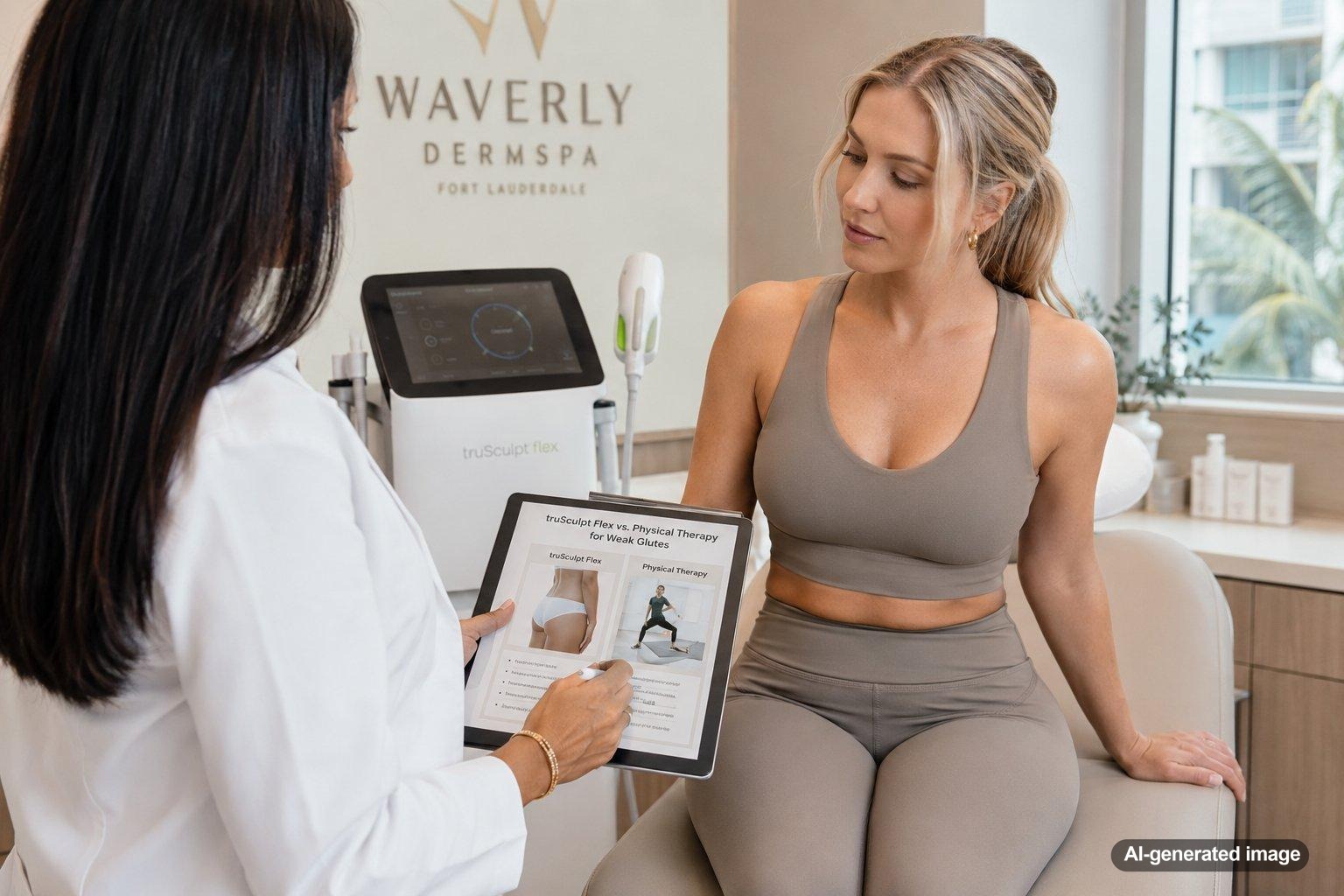
Weak or underconditioned glute muscles can affect how you feel during exercise, daily movement, or simply getting back into a regular fitness routine. If you’re comparing truSculpt Flex with physical therapy, the most important distinction is that they serve different purposes rather than functioning as interchangeable treatments.
truSculpt Flex is an in-office muscle stimulation option designed to create controlled muscle contractions, while physical therapy is a broader rehabilitation approach that can evaluate movement, strength, mobility, and functional limitations. Choosing between them depends largely on why your glutes feel weak and what you want to accomplish.
Quick answer
- truSculpt Flex focuses on stimulating muscle contractions during an aesthetic or muscle-conditioning treatment session.
- Physical therapy focuses on evaluating and improving strength, movement patterns, mobility, and function through an individualized rehabilitation plan.
- Physical therapy may be more appropriate when weakness is connected with pain, injury, balance problems, altered movement, or a medical concern.
- truSculpt Flex may appeal to someone interested in supplemental muscle conditioning when there is no unresolved injury or unexplained weakness.
- One approach does not automatically replace the other, and professional evaluation can help clarify which path makes sense.
| Comparison | truSculpt Flex | Physical Therapy |
|---|---|---|
| Primary focus | Muscle stimulation and conditioning | Movement, strength, mobility, and function |
| Approach | Device-generated muscle contractions | Assessment, exercises, movement training, and other rehabilitation strategies |
| Best suited to | People seeking supplemental muscle conditioning after appropriate evaluation | People with weakness that affects movement, function, recovery, or comfort |
| Evaluation component | Focused consultation for treatment appropriateness | Detailed functional and movement assessment |
How truSculpt Flex differs from physical therapy
The biggest difference is the goal of the appointment. During truSculpt Flex treatment, a device creates repeated muscle contractions in the targeted area. The experience is centered on muscle stimulation rather than teaching you how to move, correcting exercise form, or evaluating why a muscle may not be performing as expected.
Physical therapy takes a more comprehensive approach. A physical therapist can look at how the hips, pelvis, lower back, knees, and surrounding muscles work together. The plan may include progressive strengthening, mobility work, balance exercises, movement retraining, and strategies that you continue outside the clinic.
What physical therapy may address that muscle stimulation does not
Glute weakness is not always simply a matter of needing stronger muscles. Sometimes the issue involves discomfort, a previous injury, limited mobility, altered movement mechanics, or difficulty activating certain muscles during everyday activities.
Physical therapy is designed to investigate those functional pieces. That makes it especially important when weakness has appeared unexpectedly, is noticeably different on one side, follows an injury, or is accompanied by pain, numbness, tingling, balance changes, or difficulty walking. Those situations deserve appropriate medical or rehabilitation evaluation rather than an aesthetic treatment alone.
Where truSculpt Flex may fit
For someone without an unresolved injury or concerning symptoms, truSculpt Flex may be considered as a supplemental muscle-conditioning option. Because the treatment produces controlled contractions, it offers a different experience from voluntary exercises such as squats, bridges, lunges, or hip extensions.
That does not mean it replaces exercise or rehabilitation. Everyday strength depends on coordinated movement, progressive activity, and the ability to use your muscles effectively in real-world tasks. Your clinician can help you decide whether muscle stimulation fits your goals and whether another evaluation should come first.
Can truSculpt Flex and physical therapy complement each other?
Potentially, but only when each has a clear role. Someone completing physical therapy may still be interested in aesthetic or supplemental muscle-conditioning treatments after discussing their situation with the appropriate clinicians. Likewise, someone considering truSculpt Flex who reports pain, injury, or unexplained weakness may be better served by having those concerns evaluated before proceeding.
The key is not to treat the two options as competitors. Physical therapy is built around rehabilitation and functional movement, while truSculpt Flex is an in-office muscle stimulation service. The right choice depends on the underlying reason for the concern and the outcome you’re trying to achieve.
Practical clues for deciding what to do next
- If your main concern is pain, injury recovery, balance, walking, or difficulty performing everyday movements, consider a medical or physical therapy evaluation.
- If one side suddenly feels much weaker than the other, seek appropriate medical evaluation rather than assuming the issue is simple deconditioning.
- If you are generally healthy and interested in supplemental muscle conditioning, an aesthetic consultation can help you understand what truSculpt Flex can and cannot address.
- If you’re unsure why your glutes feel weak, getting evaluated first can provide a clearer starting point.
Limitations to keep in mind
No single treatment addresses every reason a person may perceive weak glutes. Muscle stimulation does not provide the same functional assessment, movement coaching, or rehabilitation planning as physical therapy. Physical therapy, meanwhile, is not an aesthetic body-contouring or device-based muscle stimulation service.
Results and treatment experiences can vary based on individual anatomy, baseline conditioning, activity level, health history, and goals. A consultation is the appropriate place to discuss expectations and determine whether a particular option may be suitable.
FAQ
Is truSculpt Flex the same as exercising my glutes?
No. truSculpt Flex uses device-generated muscle contractions, while exercise requires voluntary movement and develops skills such as coordination, balance, technique, and progressive load management. They are different approaches.
Can truSculpt Flex replace physical therapy?
It should not be considered a substitute for physical therapy when rehabilitation, injury recovery, pain, functional weakness, or movement problems need to be addressed. Physical therapy includes evaluation and individualized rehabilitation strategies that a muscle stimulation treatment does not provide.
Should I see a physical therapist if only one glute feels weak?
A noticeable difference from one side to the other can have many possible explanations. If the change is new, persistent, associated with pain, or affecting movement, it’s worth getting appropriately evaluated rather than trying to determine the cause on your own.
Can I use truSculpt Flex if I already work out?
People who exercise regularly may still be interested in supplemental muscle conditioning. Whether truSculpt Flex is appropriate depends on your individual health history, goals, and treatment considerations, which should be reviewed during a consultation.
What if I have glute weakness plus back or hip pain?
Pain combined with weakness deserves professional evaluation. A qualified clinician can assess whether your symptoms may involve the hip, lower back, surrounding muscles, movement patterns, or another issue and guide you toward an appropriate next step.
At Waverly DermSpa, we offer truSculpt Flex and can help you understand whether it may be appropriate.
Ready to get help?
Schedule an appointment or send a message and our team will get back to you.
Prefer to call? 954-666-3736
This article is for educational purposes and is not medical advice. For diagnosis and personalized treatment, please book an appointment with a board-certified dermatologist.
